1969 · AMC · United States
1969 AMC Rebel: The Raider Test Market and the Big Bad Colors
A base and SST Rebel with no convertible. The Big Bad colors were test-marketed through the New York–New Jersey 'Raider' hardtop. This is host-car context for the 1970 Machine.
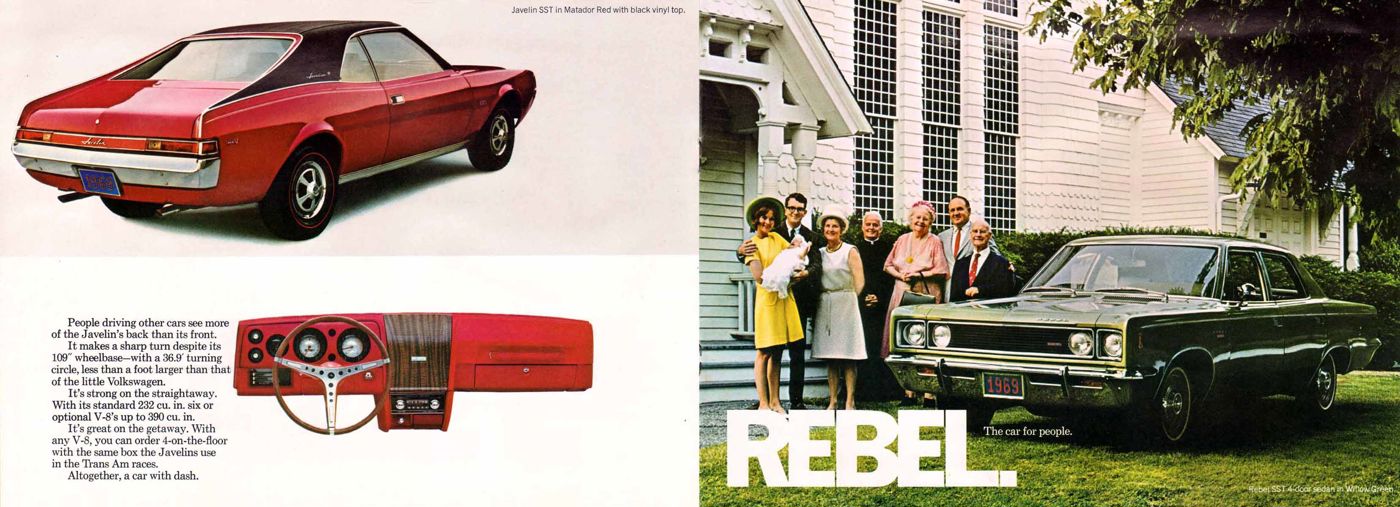
For 1969 AMC trimmed the Rebel line down to just base and SST series, dropping the convertible entirely. OldRide's tabulated factory prices show the base hardtop at $2,496 and the SST hardtop at $2,598, a modest $102 gap between the two remaining trims, with the 343 V8 at up to 280 horsepower as the strongest engine either one could be ordered with. Below it, the 232 six came with 145 horsepower on a one-barrel or 155 on a two-barrel, and the four-barrel 343 made its 280 at 4,800 rpm with 365 lb-ft at 3,000.1
Sold only through New York and New Jersey dealers, the Rebel Raider tested a genuinely different idea: a two-door hardtop advertised at $2,699 with the 290 V8, column-shift automatic, a black vinyl roof, and what period advertising called "blow-your-mind" colors, a regional trial for what became AMC's Big Bad color program before it spread to nearly every AMC line except the Ambassador starting January 31, 1969. Wikipedia gives 300 Raiders in total, citing Hemmings Motor News, while Planet Houston AMX's production notes read "300 each color," which would put the total several hundred higher depending on how many Big Bad shades the Raider came in.2,3
The two production counts for the SST hardtop differ. OldRide's tabulated page gives 5,405 units, while AMC's own 1969 factory tally sheet shows 8,225 for the same body at the Kenosha plant, broken down as 1,709 sixes, 5,206 with the 290, and 1,310 with the 343, figures that sum to the row total. Gearing followed the engine. AMC's full-line catalog pairs the 232 six with a column three-speed on a 3.15 axle, or 3.54 with overdrive, and puts the V8s on a 2.87 axle with the Shift-Command automatic, while the four-speed came with the four-barrel 343 on a 3.54 axle. Dealer kits ran from 3.73 all the way to 5.00.1,4
AMC's Kenosha plant alone built 48,397 Rebels of all body styles in 1969, with a separate 14,529 built at the Brampton, Ontario plant, split 9,542 sixes and 4,987 290 V8s there. Across the Kenosha production, the 232 six accounted for 22,293 cars, the 290 V8 for 21,495, and the 343 V8 for 4,609, and the 390 went into none of them: not one Kenosha Rebel of any body style was built with the 390 engine in 1969. The six and the 290 between them powered nine Kenosha Rebels in ten.4
The SST hardtop carried a shipping weight of 3,140 pounds, and its options sheet ran mostly to comfort and appearance items rather than performance hardware: individually adjustable reclining seats, an 8-track stereo tape player with rear speakers, Solex tinted glass, and a choice of Turbo-cast or wire wheel covers, alongside a Twin-Grip limited-slip differential and dual exhaust for the four-barrel 343 as the closest things to genuine performance options on the sheet. Simulated wood-grain side panels were reserved for SST wagons and could not be combined with the two-tone paint option, one of several small fitment restrictions spelled out in AMC's own 1969 options chart.1
Fact sheet · 1969 · United States
The numbers
1969 AMC Rebel: A base and SST Rebel with no convertible. The Big Bad colors were test-marketed through the New York–New Jersey 'Raider' hardtop. This is host-car context for the 1970 Machine.
Figures may describe different groups of cars. Add rows together only when the note says they make up a total.
Key facts
Production
| What was counted | Built |
|---|---|
| Rebel Raider (NY/NJ regional)2 Rebel Raider · 2-door hardtop · 290 V8 · automatic · New York and New Jersey dealers Planet Houston AMX reads '300 each color'. | 300 |
| What was counted | Built |
|---|---|
| Rebel SST hardtop, body 6919-7 (OldRide's count)1 Rebel SST · 2-door hardtop · US The only body count on the page, uncorroborated and without a scope note. The page has known transcription errors. | 5,405 |
| Rebel hardtop, body 6919 (AMC tally sheet)4 Rebel · 2-door hardtop · built at Kenosha 232 = 2,842, 290 = 2,328, 343 = 226; 390 column blank. | 5,396 |
| Rebel SST hardtop, body 6919-7 (AMC tally sheet)4 Rebel SST · 2-door hardtop · built at Kenosha 232 = 1,709, 290 = 5,206, 343 = 1,310; 390 column blank. | 8,225 |
| What was counted | Built |
|---|---|
| Rebel, all bodies, Kenosha (AMC tally sheet)4 Rebel (all) · all bodies · US, Canada and export market; built at Kenosha | 48,397 |
| What was counted | Built |
|---|---|
| Rebel, Brampton assembly (AMC tally sheet)4 Rebel (all) · all bodies · US, Canada and export market; built at Brampton, Ontario 232 = 9,542, 290 = 4,987. | 14,529 |
Prices when new
| Model | Price | Price type |
|---|---|---|
| Rebel hardtop (6919)1 | $2,496 | factory price, 1968-09 |
| Rebel SST hardtop (6919-7)1 | $2,598 | factory price, 1968-09 |
| Rebel Raider2 | $2,699 | advertised total price, 1969 |
Prices are the nominal dollars of the day, not adjusted for inflation.
Engines
| Engine | Factory rating | Availability | Built |
|---|---|---|---|
| 232 six (145 or 155 hp)1 232 cu in | 145 hp @ 4,300, 215 lb-ft @ 1,600 (period factory rating (gross era), as tabulated); 155 hp @ 4,400, 222 lb-ft @ 1,600 (period factory rating (gross era), as tabulated) | standard | 22,2934 |
| 290 V81 290 cu in | 200 hp (period factory rating (gross era), as tabulated) | optional | 21,4954 |
| 343 V8 (235 or 280 hp)1 343 cu in | 235 hp @ 4,400, 345 lb-ft @ 2,600 (period factory rating (gross era), as tabulated); 280 hp @ 4,800, 365 lb-ft @ 3,000 (period factory rating (gross era), as tabulated) | optional | 4,6094 |
Ratings are published figures, not dyno results. Gross and net ratings aren't directly comparable.
Options and packages
| Option |
|---|
| Two-tone paint; special application of American Motors colors |
| Simulated wood-grain side panels (SST wagons; not with two-tone) |
| All-vinyl seat upholstery (standard on wagons); exterior pin stripe (basic) |
| Twin-Grip differential; dual exhaust for 343 4-bbl |
| Power steering; power front disc brakes (V-8); power brakes; power tailgate window; Cruise-Command (V-8 automatic) |
| Individually adjustable reclining seats; reclining bucket seats with center armrest and cushion or console with floor automatic (hardtop only, SST) |
| AM radio; AM/FM radio; 8-track stereo tape with 2 rear speakers; Duo-Coustic rear speaker |
| Solex glass; custom steering wheel (standard SST); Turbo-cast or wire wheel covers; wheel discs (standard SST); bumper guards |
Paint
| Color |
|---|
| Big Bad colors (Raider test market; all lines except Ambassador after 31 January 1969)3,2 |
Color names are the factory's. We don't show color swatches, because a screen color is no guide for a restoration.
Specifications
| Measure | Value | Applies to |
|---|---|---|
| Shipping weight, SST hardtop1 | 3,140 lb | 6919-7, as tabulated |
| Axle ratios (standard; no-cost optional) | 232: 3-speed column 3.15 (3.54 overdrive), Shift-Command column 3.15; 290 and 343: Shift-Command column or console 2.87 (3.15), 4-speed floor 3.54 (3.15) with 343 4-bbl; 3.73, 3.91, 4.10, 4.44 and 5.00 dealer kits :1 | Rebel |
Where the sources disagree
Identification
Read a 1969 AMC VIN
The VIN decoder runs in your browser and never sends the VIN anywhere. How the factory numbered this year's cars:
Same model year
Also in 1969
- AMC AMX The two-seat AMX's biggest year: 8,293 cars by the enthusiast production table, with a mid-year run of Big Bad colors and 52 Hurst-built Super Stock AMXs for NHRA drag racing.
- AMC Javelin Production fell to 40,675, but the 1969 Javelin added the Big Bad colors, with 2,282 cars painted blue, green or orange, plus the Mod package.
- Buick Riviera Another record at 52,872 Rivieras; 5,272 had the GS handling option.
- Buick Skylark Gran Sport, GS and GSX Stage 1 became a factory GS 400 option, alongside distinct GS 350 and California GS choices; output, base-price and convertible-count disputes remain visible.
- Buick Wildcat 67,453 Wildcats; the last year of the 430.
- Chevrolet Chevelle and Malibu SS Super Sport became RPO Z25 option equipment, available for 1969 only on the 300 Deluxe coupes as well as Malibu sport coupe, convertible and El Camino.
- Chevrolet Chevy II and Nova SS is RPO Z26 per the source, with L48, L34 and L78 engines. Enthusiast-compiled production: 251,849 cars; Super Sport 17,564.
- Chevrolet El Camino SS SS 396 became RPO Z25 option equipment on the V8 Malibu El Camino, with 396s up to 375 hp; 86,307 Z25s across eligible models.
- Chevrolet Impala SS Only the SS427 (RPO Z24) remains; the reported count ranges from 2,425 to about 2,455.
- Dodge Charger The second-generation Charger's peak-sales year added the SE package and the aero-bodied Charger 500 and Charger Daytona homologation cars, whose production totals are still disputed.
- Dodge Coronet R/T and Super Bee The Super Bee added a hardtop body and the 440 Six Pack, while the 440-powered Coronet R/T continued as the upscale hardtop and convertible.
- Dodge Dart GTS, Swinger and Demon The low-priced Swinger 340 arrived and outsold the GTS by more than two to one (16,637 against about 6,700), while a 375 hp 440 joined the GTS options.
- Ford Fairlane The Fairlane hardtop was the intermediate line's volume leader, while the Fairlane 500 SportsRoof shared its body with the Torino GT, Cobra and Talladega.
- Ford Ranchero GT A second year of Torino GT trim on the Ranchero: 1,658 GTs, with a separate line of 727 listed with bucket seats.
- Ford Thunderbird Fifth-generation Thunderbird; only the whole-line production total was found.
- Ford Torino The Torino GT carried most of the line's volume, the 428 Cobra Jet was in its first full year, and the Talladega aero fastback was built in a short run at Atlanta to homologate a NASCAR nose.
- Mercury Comet and Cyclone The Cyclone fastback came as Cyclone and Cyclone CJ, mid-year Spoilers carried Dan Gurney and Cale Yarborough graphics, and the extended-nose Cyclone Spoiler II was built at Lorain for NASCAR homologation.
- Mercury Cougar A longer, restyled Cougar added a convertible, the Boss 302 arrived in April, and the Eliminator replaced the GT as the performance Cougar.
- Mercury Marauder and S-55 The Marauder name returned on a full-size hardtop, and the X-100 carried the 360 hp 429 four-barrel as its only engine.
- Oldsmobile Cutlass, 4-4-2 and Hurst/Olds The 4-4-2 kept its 400 while the second Hurst/Olds, in white and gold with a 380 hp 455, went into production at about 900 cars.
- Plymouth Barracuda and 'Cuda The last A-body Barracuda introduced the 'Cuda name as a stripped performance package with a standard 340, alongside Formula S and a midyear 440.
- Plymouth GTX, Belvedere and Satellite The GTX shared the Road Runner's new Air Grabber scoop and Super Track Pack but sold 15,602 cars, fewer than a fifth of the cheaper Road Runner.
- Plymouth Road Runner A convertible joined the coupe and hardtop, the 440 Six Barrel arrived at mid-year, and the Road Runner reached its production peak of 84,420.
- Pontiac Firebird and Trans Am The last first-generation Firebird, and the mid-year debut of the Trans Am package: 697 cars by the commonly published count, eight of them convertibles.
- Pontiac GTO Three four-barrel 400s under one nameplate, and the first year of the Judge package built around Ram Air power.
- Pontiac Grand Prix A new 118-inch Grand Prix with the SJ and a 390 hp 428 HO: production more than tripled to 112,486.
- Pontiac Tempest and LeMans The last year of the OHC Sprint six and the 350 HO.
- Rambler American and SC/Rambler AMC and Hurst put the 315-hp 390 V8 and a close-ratio four-speed into the compact Rambler hardtop for NHRA F/Stock. 1,512 were built, and the split between the two paint schemes is disputed.