1969 · Rambler · United States
1969 Hurst SC/Rambler: The Last Rambler American Wore Red, White and Blue and Carried a 390
AMC and Hurst put the 315-hp 390 V8 and a close-ratio four-speed into the compact Rambler hardtop for NHRA F/Stock. 1,512 were built, and the split between the two paint schemes is disputed.
United States · researched through 2026-09-22
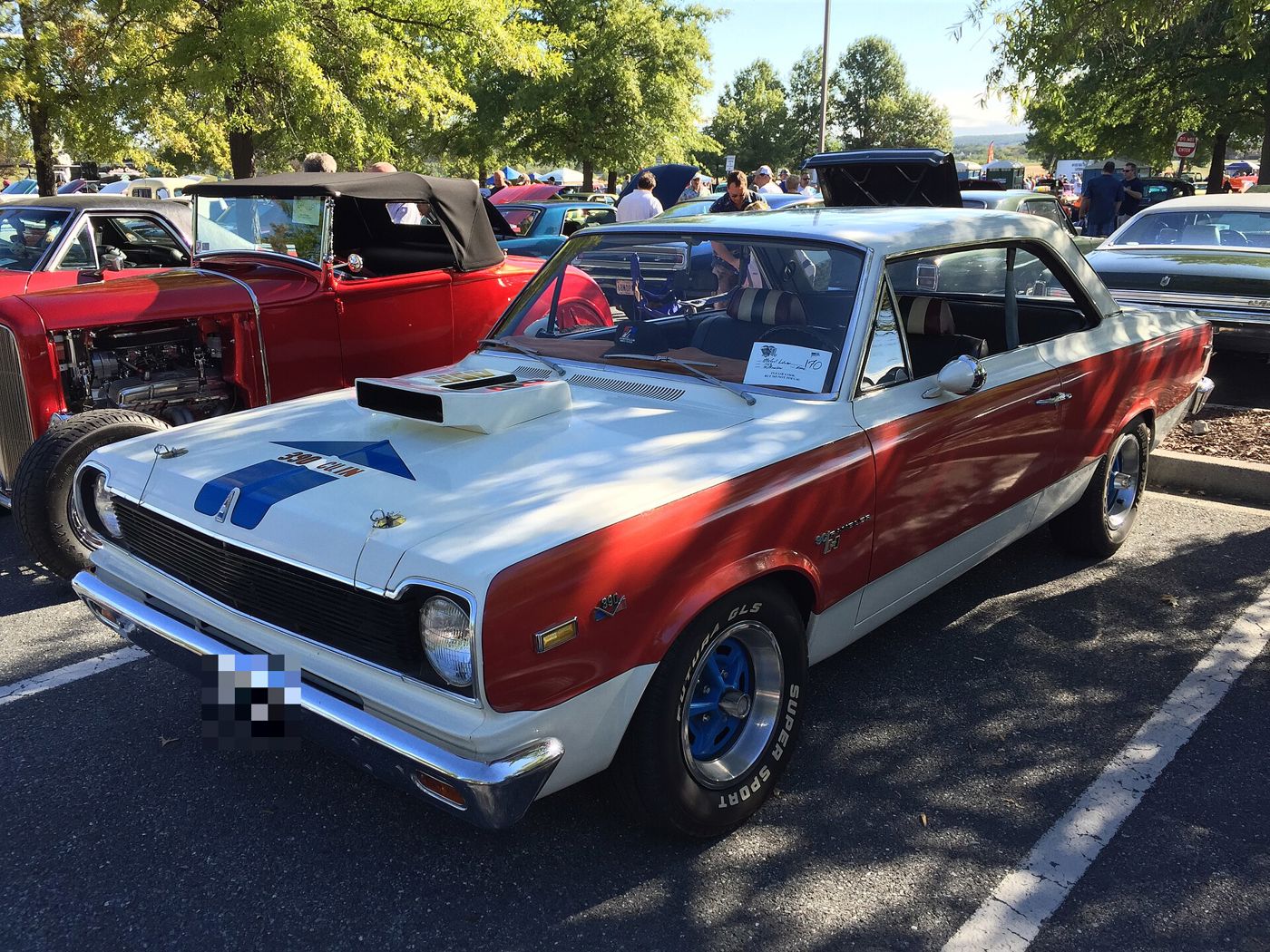
Old Cars Weekly describes the scene at the Chicago Auto Show in March 1969. Among American Motors' new products, one of the most eye-catching was “a small hardtop with a patriotic color scheme” and a huge scoop on its hood. The car was a Rambler American, the plainest compact in the showroom, painted red, white and blue and fitted with the 390 V8 from the AMX. American Motors and Hurst Performance Research called it the SC/Rambler. It was the final model year of the Rambler American, and the company used that year to build a limited-production drag car around the sensible little Rambler instead of letting it end quietly.1,2
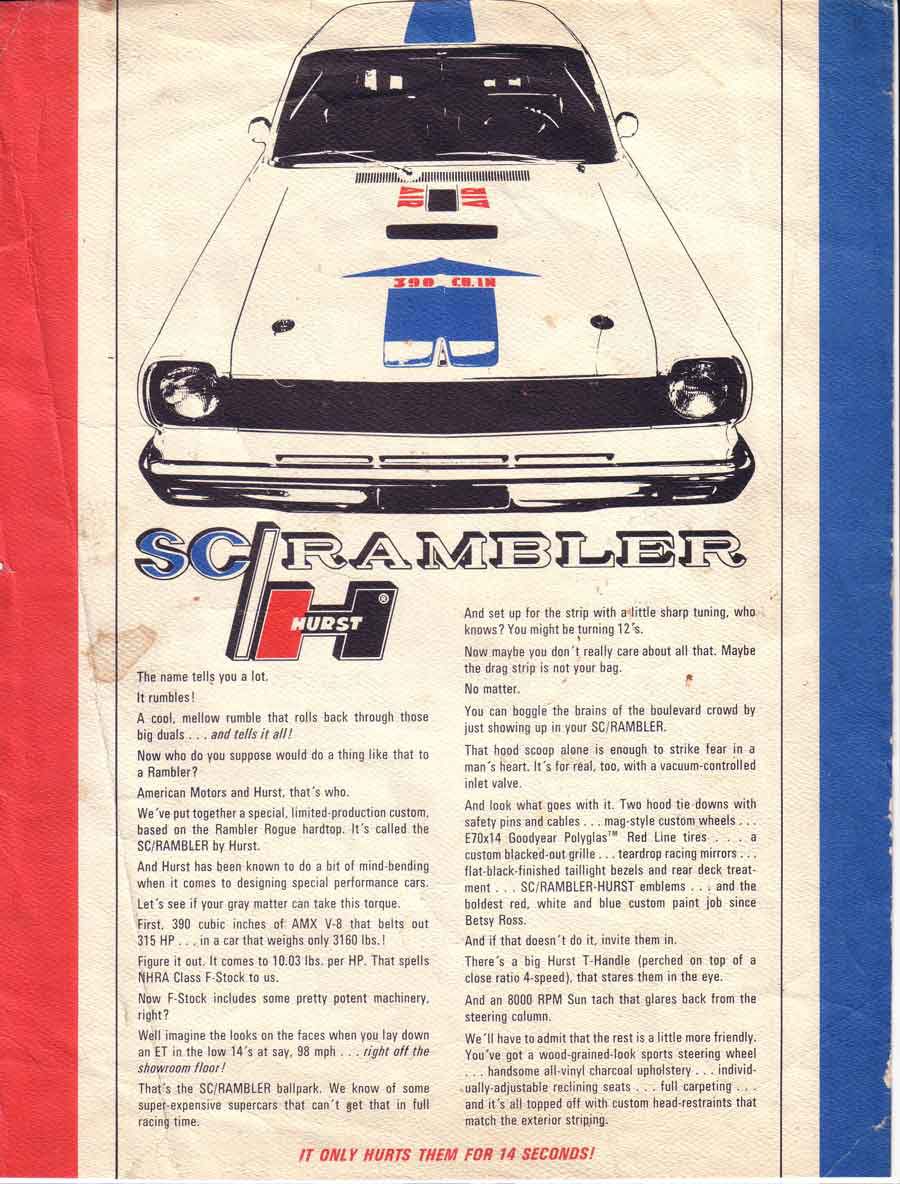
The idea did not start at AMC. Old Cars Weekly states that Hurst actually thought it up and AMC bought it. AMC's own foldout presents the car as a joint effort of American Motors engineering and Hurst Performance Research. Ate Up With Motor supplies the corporate background. George Romney, AMC's earlier chairman, had supported the 1957 Automobile Manufacturers Association ban on factory racing, and AMC kept that stance until chairman Roy Chapin Jr. announced a racing program in the spring of 1967, and engineering vice president Victor Raviolo took charge of racing and performance parts. By Ate Up With Motor's account, a Hurst-built high-performance Rambler would probably have appalled Romney.1,2
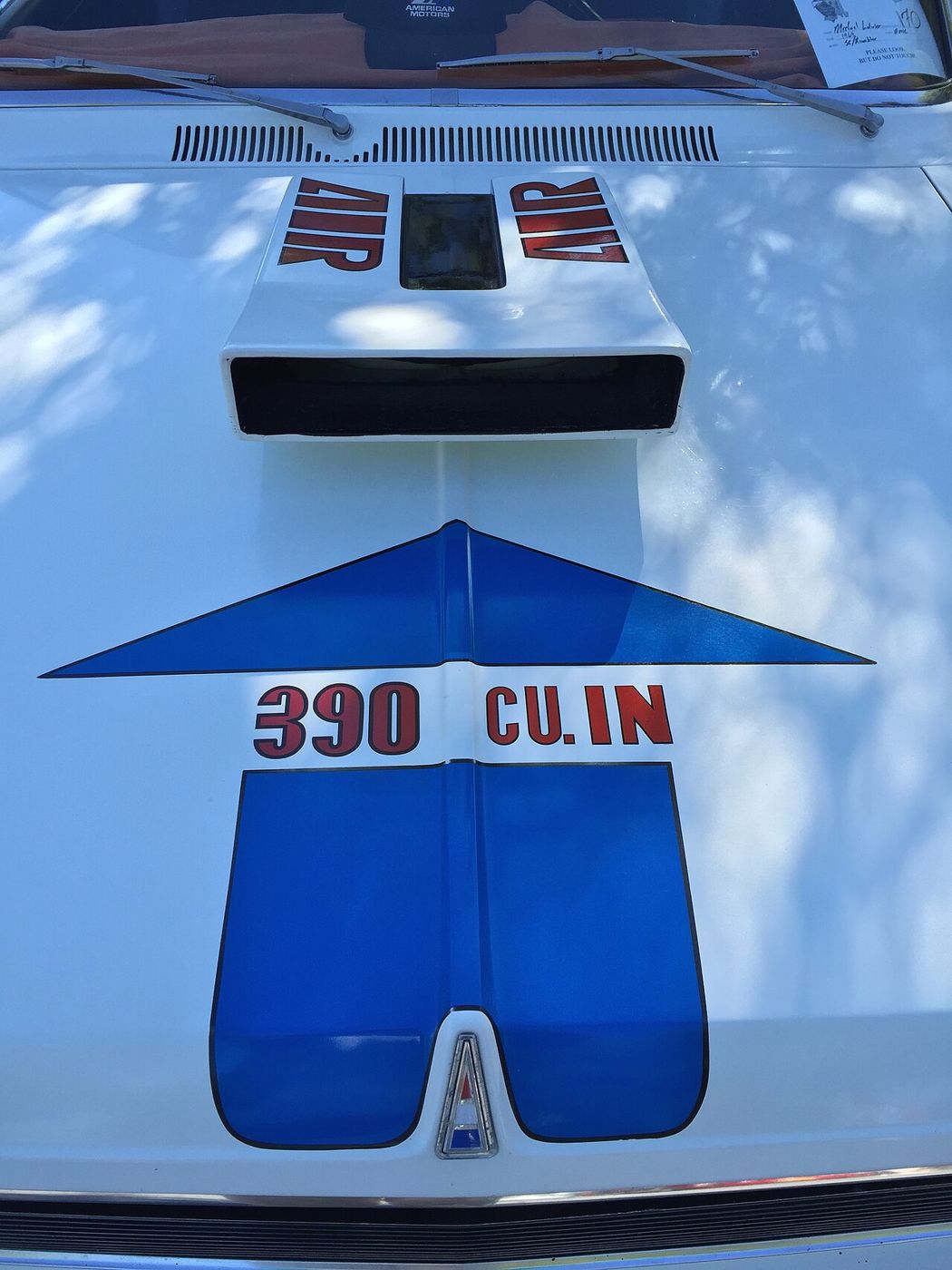
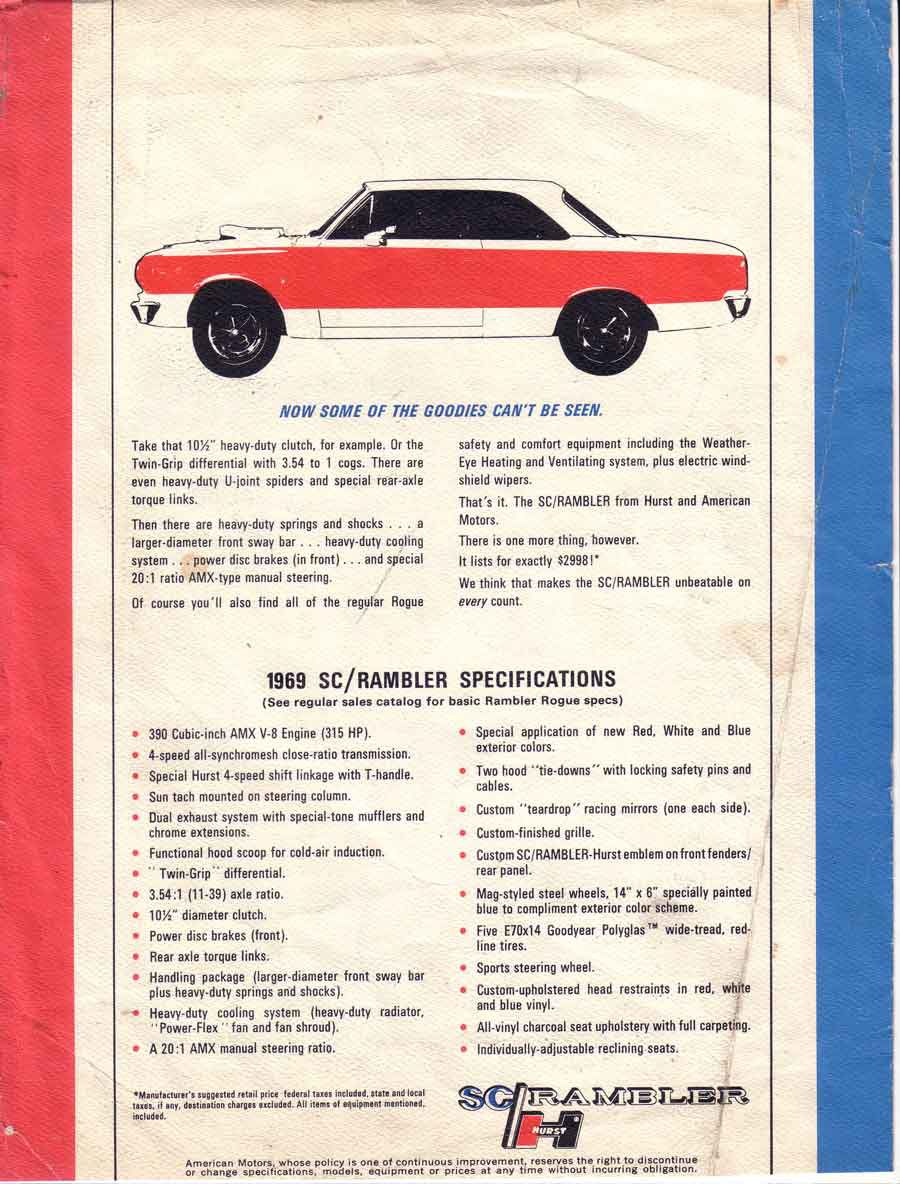
The recipe was simple. AMC's foldout rates the 390 V8 at 315 horsepower at 4,600 rpm and 425 lb-ft at 3,200, with a Carter AFB four-barrel and 10.2:1 compression. It lists a close-ratio four-speed with gears of 2.33, 1.77, 1.35 and 1.00. Old Cars Weekly adds a Borg-Warner gearbox, a Hurst shifter and a 3.54:1 Twin-Grip axle, but prints the engine at 325 horsepower. That does not match AMC's own literature, so the foldout's 315 is used here. Ate Up With Motor lists the rest: Thrush glasspacks, blue Magnum 500 wheels, hood pins, a vacuum-operated scoop marked “AIR,” a column-mounted Sun tachometer, front disc brakes and red-white-blue headrests.1,2
Everything about the car was aimed at one NHRA class. Old Cars Weekly says the car qualified for the National Hot Rod Association's F/Stock category. AMC's foldout gives the arithmetic behind that: an official shipping or license weight of 3,160 pounds and a calculated 10.03 pounds per horsepower. That ratio is AMC's own calculation from its advertised rating, not a scale reading. The foldout also promised quarter-miles of “little more than 14 seconds,” which is advertising, not a test result. Ate Up With Motor says AMC first planned only 500 cars, enough to homologate the car for F/Stock. The plan then rose to 1,000 and then to 1,500.1,2
The package was compact. Ate Up With Motor gives the Rambler American a 106-inch wheelbase and an overall length of 181 inches, and it puts the SC/Rambler's weight at about 3,150 pounds, close to the 3,160-pound shipping figure in AMC's foldout. AMC's 1969 full-line brochure gives the same 315-horsepower rating to the 390 offered in the AMX two-seater. In the SC/Rambler that engine went into a plain two-door hardtop body with a back seat and a trunk, built on the company's smallest platform. Ate Up With Motor adds a practical footnote from the period: fuel economy of about 12 mpg on premium fuel.2
The price is one of the most striking numbers in the story. The Western Pennsylvania Region of the AACA gives an original sticker of $2,998, and Wikipedia attributes the same figure to Consumer Guide. Ate Up With Motor says the only factory option was an AM radio at $61.20. The factory decided almost everything else, from the stripes to the scoop, the four-speed and the 390. The result was a 390 V8 in a compact body for under $3,000. The club page's featured car shows how simple the order sheet was: its AM radio is the only option fitted.3,4,2
Every source consulted gives 1,512 cars, but none names the AMC or Hurst shipping document behind that figure. The dispute is over how the 1,512 divide between the two paint schemes. The A scheme had red body sides and heavy blue stripes. The B scheme was mostly white with narrow red and blue stripes. One lineage, traced by Wikipedia to the painter Paul Hatton through a 2021 CarTech book by Richard Truesdell and Mark Fletcher and repeated by autoevolution, gives 1,215 A cars and 297 B cars. The Western Pennsylvania AACA page, citing AMO's American Motoring, gives 1,188 A cars and 324 B cars. Ate Up With Motor says only that about half had the less outrageous scheme.1,4,5,3,2
Each of the two numerical splits adds up to 1,512, but they must not be mixed. A reader cannot pair one lineage's A count with the other's B count. The build sequence is disputed too. Old Cars Weekly says the first 500 cars were A-scheme, a B-scheme batch followed, and a third batch went back to the A scheme without all of its elements. Wikipedia, citing the Pennsylvania club page, gives a 500 A, 500 B, 512 A sequence. That would mean 500 B cars, a number that matches neither published split. Paint codes do not settle it. The same special codes appear on both schemes, and registry B-scheme cars include very early builds.1,4,3
Road Test magazine's car, as reported by Old Cars Weekly, ran the quarter-mile in 14.4 seconds at 100.44 mph and reached 109 mph without topping out. The report does not give the tested car's axle ratio, and the figures belong to that one car. The result was close to AMC's promise of a little more than 14 seconds. Ate Up With Motor's bibliography lists period coverage from Car and Driver in May 1969 and from Road Test. The more important numbers for the car's purpose were its NHRA classification and its weight-to-power ratio, which placed a Rambler with a 390 in F/Stock. Hurst and AMC had built the car for drag racing, and the price made it affordable.1,2
Showrooms had more trouble with the car than drag strips did. Ate Up With Motor reports that dealers struggled to sell it, because its looks clashed with the typical Rambler buyer. The same account says sales of the ordinary Rambler Americans rose nearly 20 percent in their final year. Whether the SC/Rambler helped cause that rise is not documented. The 1970 Hornet replaced the Rambler American, and AMC continued the formula in larger and smaller packages: the 1970 Rebel Machine, with a 340-horsepower 390, and the 1971 Hornet SC/360, with 784 built against an anticipated 10,000. The Rambler name left the American market with its loudest car.2
Fact sheet · 1969 · United States
The numbers
1969 Hurst SC/Rambler — AMC and Hurst put the 315-hp 390 V8 and a close-ratio four-speed into the compact Rambler hardtop for NHRA F/Stock. 1,512 were built, and the split between the two paint schemes is disputed.
Coverage: Partial — researched sections are shown; missing ones are not yet sourced. Researched through 2026-09-22.
Every figure is labeled with how sure we are. Reported means a manufacturer, registry, or reference figure we cite but have not reconciled against factory records ourselves. Disputed means credible sources disagree and both are shown. Rows are separately scoped; don't add them together unless the note says they make up a total.
Key facts
- 1,512 SC/Ramblers built.1,3
- Price $2,998.3,4
- AMC quoted an official shipping or license weight of 3,160 lb and a calculated 10.03 lb per horsepower. That is a manufacturer ratio, not a scale measurement.
- Road Test magazine, as reported by Old Cars Weekly, ran 14.4 s at 100.44 mph and reached 109 mph.1
Production
| What was counted | Count | Basis | Status |
|---|---|---|---|
| SC/Rambler, all1,3,5 Hurst SC/Rambler · 2-door hardtop · 390 V8 · 4-speed manual · US No AMC or Hurst shipping document was read. The sources agree but do not name one. | 1,512 | built, model-year | Reported |
| Rogue hardtop (6909-7) with the 390 V8 (AMC tally sheet)6 SC/Rambler (390-engined 6909-7) · 2-door hardtop · 390 V8 · US, Canada and export market; built at Kenosha AMC's tally counts 1,512 390-engined 6909-7 hardtops, which is the SC/Rambler figure. Row 6909-7 total 5,055 (232 = 2,935, 290 = 608, 390 = 1,512). The sheet does not label the SC/Rambler by name. | 1,512 | built, model-year | Reported |
| What was counted | Count | Basis | Status |
|---|---|---|---|
| 'A' scheme (Hatton lineage)5,4 Hurst SC/Rambler · 2-door hardtop · US | 1,215 | painted, model-year | Disputed |
| 'B' scheme (Hatton lineage)5,4 Hurst SC/Rambler · 2-door hardtop · US | 297 | painted, model-year | Disputed |
| 'A' scheme (American Motoring lineage)3 Hurst SC/Rambler · 2-door hardtop · US | 1,188 | painted, model-year | Disputed |
| 'B' scheme (American Motoring lineage)3 Hurst SC/Rambler · 2-door hardtop · US | 324 | painted, model-year | Disputed |
The two A/B splits come from different lineages. Each pair sums to 1,512. Never mix one lineage's A count with the other's B count.
Prices when new
| Model | Price | Basis |
|---|---|---|
| SC/Rambler3,4 | $2,998 | original MSRP as reported (club page; Consumer Guide via Wikipedia), 1969 |
Prices are the nominal dollars of the day, not adjusted for inflation.
Engines
| Engine | Factory rating | Availability | Built |
|---|---|---|---|
| 390 V8, Carter AFB four-barrel1 390 cu in · Carter AFB 4-barrel | 315 hp @ 4,600, 425 lb-ft @ 3,200 (period factory advertised (gross era)) | standard (only engine) | 1,5121 Reported |
Ratings are the manufacturer's advertised figures under the standard shown (SAE gross before 1972, SAE net after). They are not dyno results, and gross and net ratings can't be compared directly.
Transmissions
| Transmission | Availability | Built |
|---|---|---|
| Close-ratio four-speed manual with Hurst shifter (2.33, 1.77, 1.35, 1.00)1 | standard (only transmission) | Not yet sourced |
Options and packages
| Code | Option | Price | Installed |
|---|---|---|---|
|
Standard package: 390 AMX V-8 with functional ram-air hood scoop, 4-speed all-synchromesh close-ratio transmission with Hurst linkage and T-handle, Sun tachometer on steering column, dual exhaust with special-tone mufflers and chrome extensions, hood tie-downs, blue-painted mag-styled wheels with trim rings, E70x14 Goodyear Polyglas red-line tires, Twin-Grip differential, front power disc brakes, rear axle torque links, handling package, heavy-duty cooling, 3.54:1 axle, 10.5-in clutch, 20:1 manual steering | — | Not yet sourced |
|
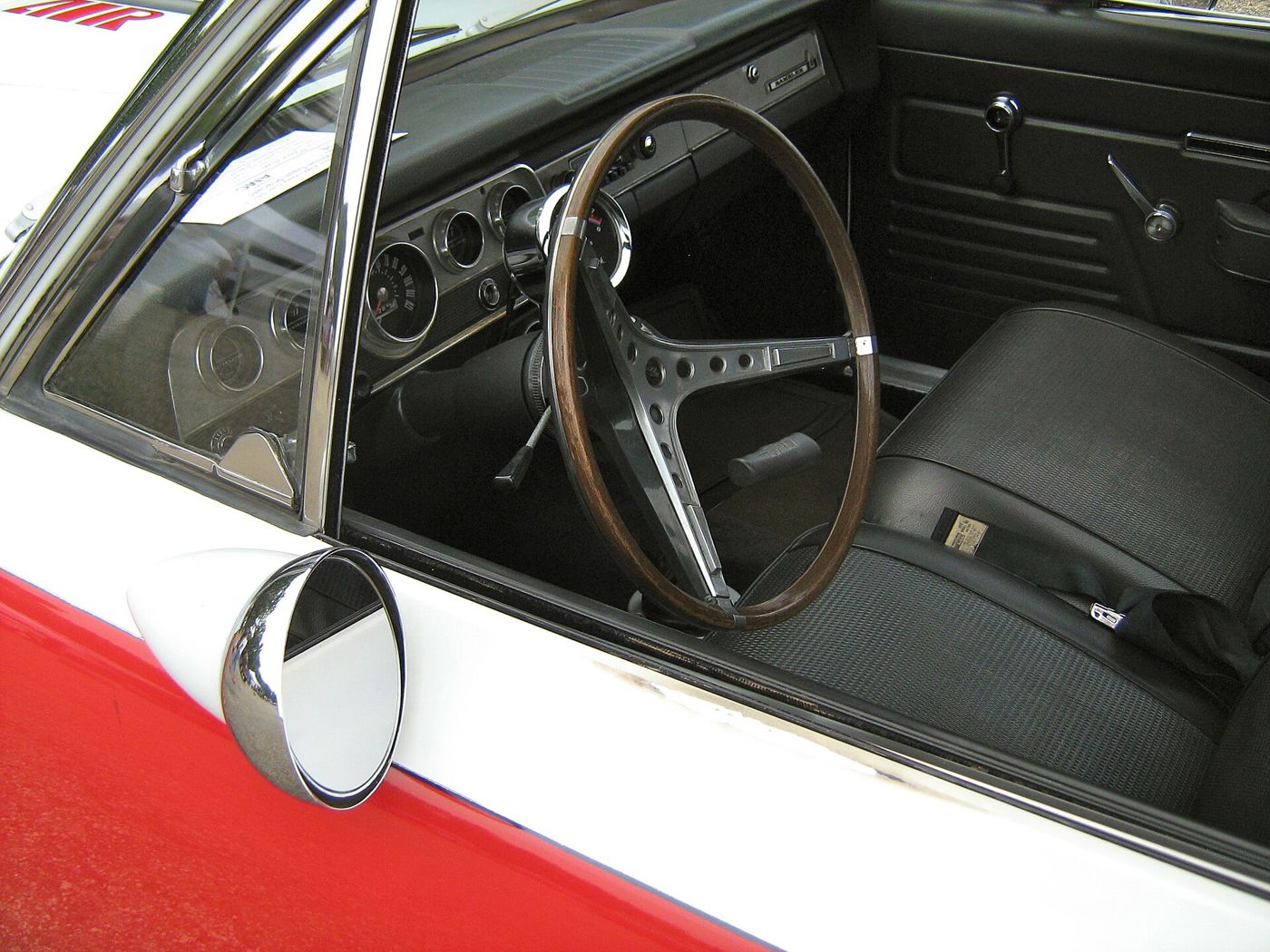
Standard appearance: red, white and blue Lustre-Gard exterior; flat-black grille, taillights and rear-deck panel; custom teardrop racing mirrors; SC/Rambler-Hurst emblems on each fender and rear panel; sports steering wheel | — | Not yet sourced |
Paint
| Code | Color | Built |
|---|---|---|
SPEC / SPECIAL / 88A / OOA |
Scheme A (red body sides, blue stripes) or Scheme B (white with narrow red and blue stripes). Any of these codes may appear with either scheme.4,1 | Not yet sourced |
Color names are the factory's. We don't show color swatches, because a screen color is no guide for a restoration.
Interiors
| Code | Trim | Built |
|---|---|---|
|
All-vinyl charcoal seat upholstery, individually adjustable reclining seats, full carpeting, custom-upholstered head restraints in red, white and blue | Not yet sourced |
Specifications
| Measure | Value | Applies to |
|---|---|---|
| Shipping/license weight | 3,160 lb | official shipping or license weight (not curb) |
| Weight-to-power ratio (AMC calculation) | 10.03 lb/hp | manufacturer-calculated |
| Rear axle1 | 3.54:1 Twin-Grip | as reported |
| Crankcase capacity (incl. filter) | 5 US qt | SC/Rambler |
| Cooling system capacity | 13 US qt | SC/Rambler |
| 4-speed transmission capacity | 2.5 pt | SC/Rambler |
| Clutch diameter | 10.5 in | SC/Rambler |
| Tires | E70 x 14 Goodyear Polyglas wide-tread red-line | SC/Rambler |
Period road tests
| Test | Car tested | Result |
|---|---|---|
| Road Test, 19691quarter-mile | SC/Rambler 390, four-speed (axle not stated in the secondary report)trap speed 100.44 mph; as reported by Old Cars Weekly; original issue not read | 14.4 s |
| Road Test, 19691top speed reached | SC/Rambler 390, four-speedas reported by Old Cars Weekly | 109 mph |
A road test result belongs to the one car that was tested, with its engine, gearing, tires, and conditions. It is not a figure for every car of the year.
Identification
- Authentication
- Paint scheme and paint code do not prove the scheme or originality. The same special codes appear on A and B cars, and registry B-scheme cars include very early builds.4
Where the sources disagree
A-scheme / B-scheme split
Present both splits with their lineages. Neither is an AMC document.
Identification
Read a 1969 Rambler VIN
The VIN decoder runs in your browser and never sends the VIN anywhere. How the factory numbered this year's cars:
Same model year
Also in 1969
- AMC AMX The two-seat AMX's biggest year: 8,293 cars by the enthusiast production table, with a mid-year run of Big Bad colors and 52 Hurst-built Super Stock AMXs for NHRA drag racing.
- AMC Javelin Production fell to 40,675, but the 1969 Javelin added the Big Bad colors, with 2,282 cars painted blue, green or orange, plus the Mod package.
- AMC Rebel and Rebel Machine A base and SST Rebel with no convertible. The Big Bad colors were test-marketed through the New York–New Jersey 'Raider' hardtop. This is host-car context for the 1970 Machine.
- Buick Riviera Another record at 52,872 Rivieras; 5,272 had the GS handling option.
- Buick Skylark Gran Sport, GS and GSX GS production fell to 12,465, and the GS 400's Stage 1 package became a factory option while Stage 2 stayed a dealer item.
- Buick Wildcat 67,453 Wildcats; the last year of the 430.
- Chevrolet Chevelle and Malibu SS Super Sport became RPO Z25 option equipment, available for 1969 only on the 300 Deluxe coupes as well as Malibu sport coupe, convertible and El Camino.
- Chevrolet Chevy II and Nova SS is RPO Z26 per the source, with L48, L34 and L78 engines. Enthusiast-compiled production: 251,849 cars; Super Sport 17,564.
- Chevrolet El Camino SS SS 396 became RPO Z25 option equipment, orderable on the V8 Malibu El Camino (13680); the El Camino share of the 86,307 Z25s is not separately published.
- Chevrolet Impala SS Only the SS427 (RPO Z24) remains; the reported count ranges from 2,425 to about 2,455.
- Dodge Charger The second-generation Charger's peak-sales year added the SE package and the aero-bodied Charger 500 and Charger Daytona homologation cars, whose production totals are still disputed.
- Dodge Coronet R/T and Super Bee The Super Bee added a hardtop body and the 440 Six Pack, while the 440-powered Coronet R/T continued as the upscale hardtop and convertible.
- Dodge Dart GTS, Swinger and Demon The low-priced Swinger 340 arrived and outsold the GTS by more than two to one (16,637 against about 6,700), while a 375 hp 440 joined the GTS options.
- Ford Fairlane The Fairlane hardtop was the intermediate line's volume leader, while the Fairlane 500 SportsRoof shared its body with the Torino GT, Cobra and Talladega.
- Ford Ranchero GT The Ranchero GT carried Torino GT trim; 1,658 GTs were built, per reference-site counts in the Standard Catalog lineage.
- Ford Thunderbird Fifth-generation Thunderbird; only the whole-line production total was found.
- Ford Torino The Torino GT carried most of the line's volume, the 428 Cobra Jet was in its first full year, and the Talladega aero fastback was built in a short run at Atlanta to homologate a NASCAR nose.
- Mercury Comet and Cyclone The Cyclone fastback came as Cyclone and Cyclone CJ, mid-year Spoilers carried Dan Gurney and Cale Yarborough graphics, and the extended-nose Cyclone Spoiler II was built at Lorain for NASCAR homologation.
- Mercury Cougar A longer, restyled Cougar added a convertible, the Boss 302 arrived in April, and the Eliminator replaced the GT as the performance Cougar.
- Mercury Marauder and S-55 The Marauder name returned on a full-size hardtop, and the X-100 carried the 360 hp 429 four-barrel as its only engine.
- Oldsmobile Cutlass, 4-4-2 and Hurst/Olds The 4-4-2 kept its 400 while the second Hurst/Olds, in white and gold with a 380 hp 455, went into production at about 900 cars.
- Plymouth Barracuda and 'Cuda The last A-body Barracuda introduced the 'Cuda name as a stripped performance package with a standard 340, alongside Formula S and a midyear 440.
- Plymouth GTX, Belvedere and Satellite The GTX shared the Road Runner's new Air Grabber scoop and Super Track Pack but sold 15,602 cars, fewer than a fifth of the cheaper Road Runner.
- Plymouth Road Runner A convertible joined the coupe and hardtop, the 440 Six Barrel arrived at mid-year, and the Road Runner reached its production peak of 84,420.
- Pontiac Firebird and Trans Am The last first-generation Firebird, and the mid-year debut of the Trans Am package: 697 cars by the commonly published count, eight of them convertibles.
- Pontiac GTO Three four-barrel 400s under one nameplate, and the first year of the Judge package built around Ram Air power.
- Pontiac Grand Prix A new 118-inch Grand Prix with the SJ and a 390 hp 428 HO: production more than tripled to 112,486.
- Pontiac Tempest and LeMans The last year of the OHC Sprint six and the 350 HO.