1971 · Pontiac · United States
1971 Pontiac Grand Prix: Boat-Tail Styling and the End of the Manual
Boat-tail styling, lower compression, and the manual transmission gone by March: 116 of 58,325 had one.
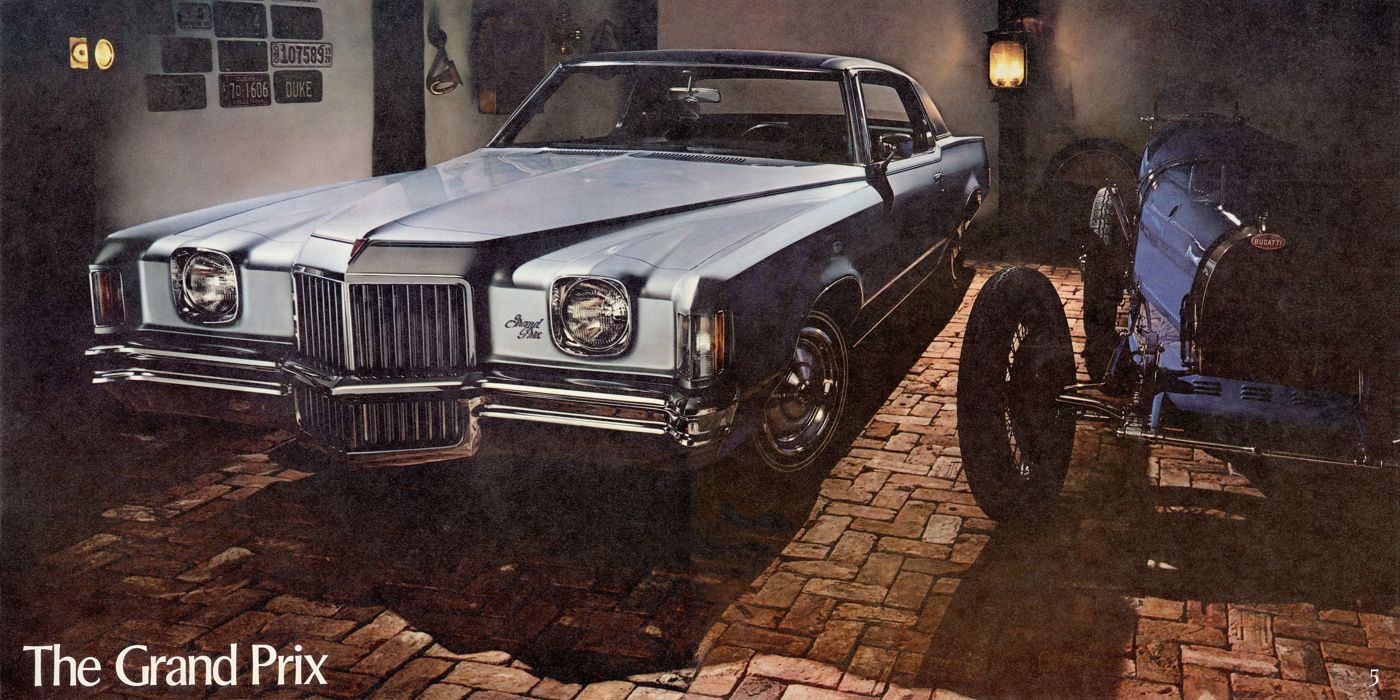
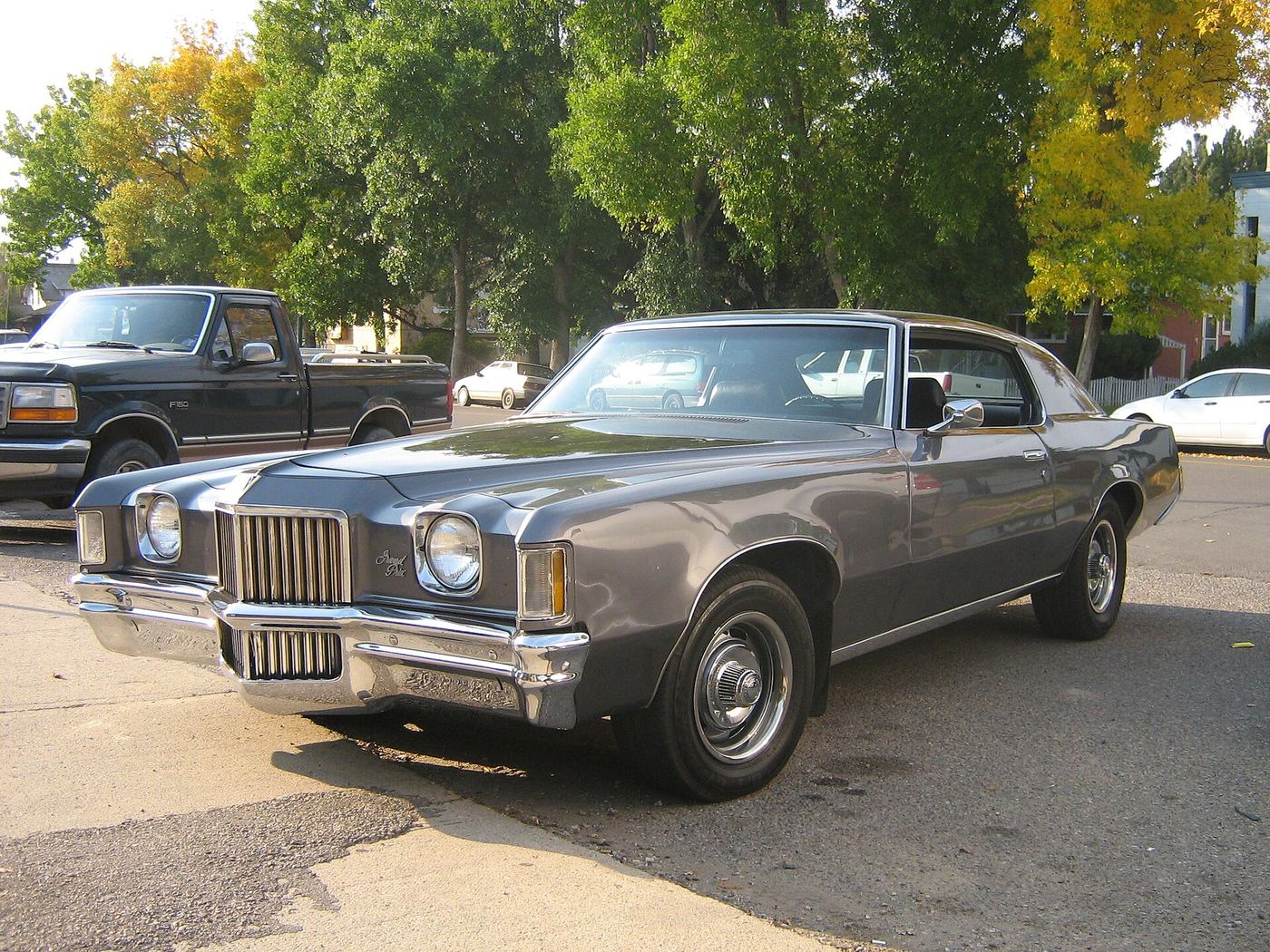
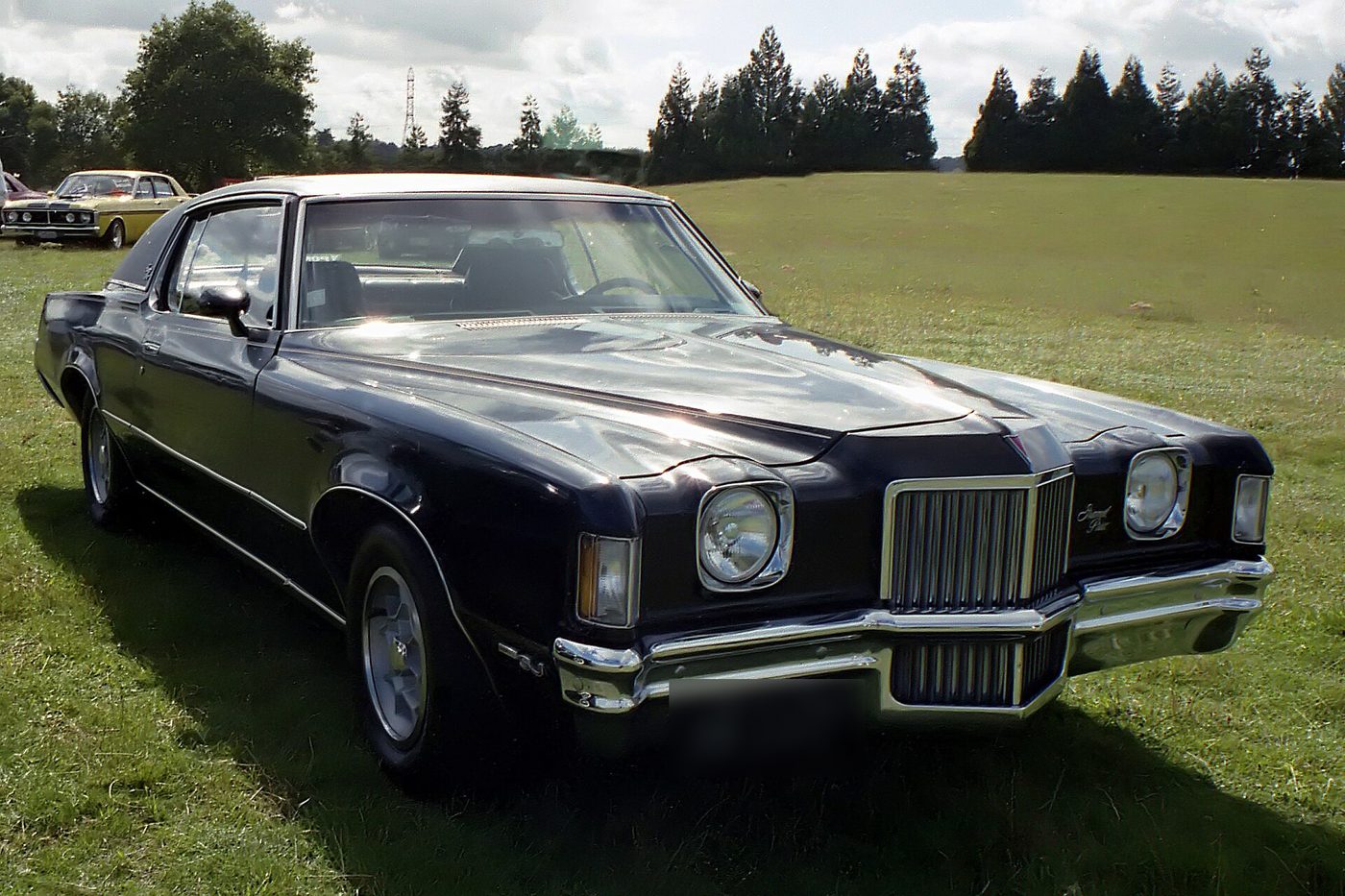
Pontiac reshaped the Grand Prix for 1971 with single headlamps and a boat-tail rear. The 400 was rated at 300 hp gross and the SJ's 455 at 325 hp gross; compression fell to 8.4:1 for regular fuel. During the model year, Turbo Hydra-Matic became standard and manual transmissions disappeared. By the published count Pontiac built 58,325 cars, with 116 Synchromesh installations. The listed price rose from $4,314 at the fall 1970 introduction to $4,557 after March.1,2
The same count gives 58,208 Turbo Hydra-Matic cars. Added to the 116 Synchromesh cars, that makes 58,324, one short of the printed 58,325 total. It also gives 4,884 Grand Prix SJ cars and 157 Hurst SSJ conversions. A secondary article gives 52 four-speed Grand Prix, all with the 400, but states no basis for that count or the SJ total. These are published counts from compilations, not a complete factory accounting of the year's production.2,1,3
The standard 400 four-barrel was rated at 300 hp and 400 lb-ft gross; the SJ's 455 four-barrel, automatic only, at 325 hp and 455 lb-ft gross. Another engine table gives the 400's torque as 461 lb-ft, against the 400 lb-ft printed in the main engine rating. A three-speed Synchromesh was standard until March; the four-speed and Turbo Hydra-Matic were each listed at $226. The automatic came standard with the 455 and became standard across the line in March. The production count does not separate three- from four-speed among the 116 manual cars.1,4,2

Buyers could order the $195 SJ package, hood tachometer, Rally gauge cluster, automatic air conditioning, Cordova top, power bucket seats, power steering, power windows, radios and a long list of convenience items. The full-size option list also priced automatic level control, bumper guards, cornering lights, cruise control, tilt and remote mirrors, Rally II wheels, rear defogger, Ride and Handling package, tinted glass and wire wheel discs. Those were the choices Pontiac offered; no record shows which mix each buyer selected.1
Inside, buyers chose a notchback bench or bucket seats at no extra charge, with the console standard on bucket-seat cars. Pontiac offered new cloth and vinyl patterns, carpeted lower door panels, safety armrests with ashtrays, loop-pile carpet, foam seat padding, a custom-cushion steering wheel and Castilian leather-appearance dash trim. The leather option was discontinued for the year. Upper-level ventilation, courtesy lamps and a glove-box lamp completed the standard equipment that Pontiac described for the cabin.1

The Grand Prix measured 212.9 inches long on a 118-inch wheelbase, with 76.4-inch width and 62/60-inch front/rear track. Shipping weight rose from 3,838 pounds at introduction to 3,863 after March, alongside the transmission change. Pontiac listed G78-14 blackwall tires standard and G70-by-14 optional. Ratios were 2.42/1.58/1.00 for the three-speed and 2.48/1.48/1.00 for Turbo Hydra-Matic. Standard equipment also included variable-ratio power steering, front disc brakes, deluxe wheel covers and concealed wipers, with dual exhausts on the 400.1,2
Pontiac identified the Grand Prix as Series 276, body 27657. Its factory ratings and dimensions describe a car built for regular fuel, with a boat-tail rear and, by March, an automatic in every car.2
Fact sheet · 1971 · United States
The numbers
1971 Pontiac Grand Prix and SJ: Boat-tail styling, lower compression, and the manual transmission gone by March: 116 of 58,325 had one.
Figures may describe different groups of cars. Add rows together only when the note says they make up a total.
Key facts
Production
| What was counted | Built |
|---|---|
| Grand Prix 2-door sport coupe2,1,4 Grand Prix · 2-door sport coupe | 58,325 |
| What was counted | Built |
|---|---|
| Grand Prix with Synchromesh manual2 Grand Prix · 2-door sport coupe · manual (Synchromesh) | 116 |
| Grand Prix with Hydramatic2 Grand Prix · 2-door sport coupe · Turbo Hydra-Matic | 58,208 |
| Grand Prix with four-speed manual3 Grand Prix (Model J; 400 only) · 2-door sport coupe · 400 4-bbl · four-speed manual (Muncie) | 52 |
| What was counted | Built |
|---|---|
| Hurst SSJ conversions1 Grand Prix SJ (Hurst SSJ) · 2-door sport coupe | 157 |
| Grand Prix SJ3 Grand Prix SJ · 2-door sport coupe · 455 4-bbl · Turbo Hydra-Matic A subset of the total. | 4,884 |
Prices when new
| Model | Price | Price type |
|---|---|---|
| Grand Prix 2-door sport coupe, at introduction2 | $4,314 | factory price, 1970-09 (fall 1970 introduction) |
| Grand Prix 2-door sport coupe, after automatic became standard2 | $4,557 | factory price, 1971-03 |
Prices are the nominal dollars of the day, not adjusted for inflation.
Engines
| Engine | Factory rating | Availability |
|---|---|---|
| 400 4-bbl1 400 cu in · Rochester 4-barrel, 8.4:1 | 300 hp @ 4,800, 400 lb-ft @ 3,600 (SAE gross) | standard |
| 455 4-bbl1 455 cu in · Rochester 4-barrel, 8.4:1 | 325 hp @ 4,400, 455 lb-ft @ 3,200 (SAE gross) | SJ; automatic only |
Ratings are published figures, not dyno results. Gross and net ratings aren't directly comparable.
Transmissions
| Transmission | Availability | Built |
|---|---|---|
| Three-speed manual (Synchromesh)1,2 | standard until March 1971 | 1162 |
| Four-speed manual1 | optional, $226, later eliminated | |
| Turbo Hydra-Matic 4001,2 | optional $226, standard with 455, standard on all from March 1971 | 58,2082 |
Options and packages
| Option | Price |
|---|---|
| SJ option1 | $195 |
| Hood-mounted tachometer1 | $63 |
| Rally gauge cluster with tachometer1 | $84 |
| Automatic air conditioning1 | $521 |
| Cordova top1 | $142 |
| 60/40 bench seat with 6-way power adjustment1 | $79 |
| Automatic level control1 | $79 |
| Bumper guards1 | $16 |
| Capacitor ignition1 | $104 |
| Cornering lights1 | $37 |
| Cruise control1 | $68 |
| Door edge guards1 | $6 |
| Electric clock1 | $18 |
| Mirror, rear view glare-proof tilt1 | $4 |
| Mirror, remote control outside rear view1 | $12 |
| Power brakes1 | $42 |
| Power bucket seats1 | $79 |
| Power steering1 | $105 |
| Power windows1 | $104 |
| Radio, AM/FM stereo1 | $239 |
| Radio, push-button AM1 | $89 |
| Radio, push-button AM/FM1 | $151 |
| Rally II wheels1 | $63 |
| Rear window defogger1 | $41 |
| Remote control deck lid release1 | $14 |
| Ride and Handling package1 | $9 |
| Safeguard speedometer1 | $16 |
| Tinted glass1 | $51 |
| Tinted windshield1 | $36 |
| Under-hood utility lamp1 | $7 |
| Visor vanity mirror1 | $4 |
| Wire wheel discs1 | $58 |
Paint
| Code | Color |
|---|---|
11 |
Cameo White1 |
13 |
Nordic Silver1 |
16 |
Bluestone Gray1 |
19 |
Starlight Black1 |
24 |
Adriatic Blue1 |
26 |
Lucerne Blue1 |
29 |
Regency Blue1 |
39 |
Aquarius Green1 |
42 |
Limekist Green1 |
43 |
Tropical Lime1 |
49 |
Laurentian Green1 |
53 |
Quezal Gold1 |
55 |
Baja Gold1 |
59 |
Aztec Gold1 |
61 |
Sandalwood1 |
62 |
Canyon Copper1 |
66 |
Bronzini Gold1 |
67 |
Castilian Bronze1 |
75 |
Cardinal Red1 |
78 |
Rosewood1 |
Color names are the factory's. We don't show color swatches, because a screen color is no guide for a restoration.
Interiors
| Trim |
|---|
| Choice of notchback bench or bucket seats at no charge (console with buckets); new cloth and vinyl trim patterns for both; leather option discontinued. Carpeted lower door panels, safety armrests with ash trays, loop-pile carpet, foam seat padding, pedal trim plates, custom cushion steering wheel, Castilian leather-appearance dash trim, upper-level ventilation, courtesy and glove-box lamps.1 |
Specifications
| Measure | Value | Applies to |
|---|---|---|
| Wheelbase1,2 | 118 in | Grand Prix |
| Overall length1 | 212.9 in | Grand Prix |
| Shipping weight2 | 3,838 lb | Grand Prix at introduction |
| Shipping weight2 | 3,863 lb | Grand Prix after March 1971 |
| Overall width1 | 76.4 in | Grand Prix |
| Front track1 | 62 in | Grand Prix |
| Rear track1 | 60 in | Grand Prix |
| Tires and wheels1 | G78-14 blackwall on 7-inch-wide safety rims standard; G70 x 14 optional | Grand Prix |
| Transmission ratios1 | 3-speed 2.42/1.58/1.00; 4-speed 2.52/1.88/1.46/1.00; M40 Turbo Hydra-Matic 2.48/1.48/1.00 :1 | Grand Prix |
| Rear axle ratios1 | 400 300 hp four-speed 3.23; 455 325 hp automatic 3.07 :1 | Grand Prix |
| Compression ratio1 | 8.4 :1 | 400 and 455 (down from 10.25:1 in 1970, for regular fuel) |
| Standard equipment1 | Power steering (variable ratio), power front disc brakes, Deluxe wheel covers, concealed wipers, dual exhausts with the 400 | Grand Prix |
Identification
- Series and body
- Series 276, body 27657.2
Where the sources disagree
Identification
Read a 1971 Pontiac VIN
The VIN decoder runs in your browser and never sends the VIN anywhere. How the factory numbered this year's cars:
Same model year
Also in 1971
- AMC AMX The AMX name moves onto the redesigned Javelin as its top model. It is a derivative badge, not a continuation of the two-seater. 2,054 were built, all with the 360 or 401.
- AMC Hornet SC/360 AMC's one-year compact muscle car pitched as an insurance-friendly alternative. AMC reportedly planned 10,000, but 784 were built.
- AMC Javelin A new, flared-fender Javelin, with the AMX name as its top model. Javelin won AMC the 1971 Trans-Am manufacturers' championship.
- AMC Matador Machine The Rebel Machine's unadvertised successor: a 'Machine Go' package for the Matador hardtop, with reported counts from 43 to 68.
- Buick Riviera The boattail Riviera: 455 rated 315 gross / 255 net, GS 330 / 265; 3,175 of 33,810 were GS.
- Buick Skylark Gran Sport, GS and GSX Buick’s revised factory form lists gross and net ratings for the GS engines; the early Stage 1 test used a pre-production car, and GSX appearance did not identify an engine.
- Chevrolet Chevelle and Malibu SS A single RPO Z15 SS package now spanned small- and big-block V8s; 9,502 of 19,293 SS cars carried the LS5 454, and Chevrolet began printing net ratings beside gross.
- Chevrolet Chevy II and Nova SS limited to the L48 350 per the source; Rally Nova (RPO YF1) offered. Enthusiast-compiled production: 194,878 cars; Super Sport 7,015.
- Chevrolet El Camino SS A single RPO Z15 SS package on the Malibu/Custom El Camino, up to the 425 hp LS6; 19,293 SS cars across Malibu models.
- Chevrolet Monte Carlo SS The last SS 454 year: RPO Z20 on 1,919 of 128,600 Monte Carlos.
- Dodge Challenger Challenger's second year lost the SE, the R/T convertible, and the T/A; a new pillared coupe joined the hardtop and convertible, and production fell to roughly a third of 1970's.
- Dodge Charger A new, shorter third-generation body absorbed the Coronet two-doors and the Super Bee; it was the last year for the R/T and for a factory Hemi Charger.
- Dodge Coronet R/T and Super Bee The end of the line for Coronet performance: the two-door Coronets were replaced by the Charger, taking the Super Bee with them.
- Dodge Dart GTS, Swinger and Demon Dodge's version of the Duster fastback arrived as the Demon, and the Demon 340 became the performance Dart: 10,098 built, plus 85 Canadian Swinger 340 Specials.
- Ford Maverick Grabber The Grabber became its own model with a dual-scoop hood, and the 210 hp 302 V8 arrived; Classic Industries counts 38,963 Grabbers.
- Ford Ranchero GT The second Torino-based Ranchero year; reference counts give 3,632 GTs, while Barn Finds rounds the GT figure to about 3,900 of 24,946 Rancheros.
- Ford Thunderbird The last fifth-generation year kept the 360-hp 429 as standard; production fell to 36,055.
- Ford Torino A carryover year for the 1970 body; the Torino Cobra now came standard with a 351 four-barrel and offered the 429 Cobra Jet-R, but only 3,054 Cobras were built.
- Mercury Comet and Cyclone The final Cyclone year: production fell to a few thousand across Cyclone, Cyclone GT and Cyclone Spoiler.
- Mercury Cougar A larger second-generation Cougar, new body codes, and the one-year 429 Cobra Jet option, fitted to 448 cars.
- Oldsmobile Cutlass, 4-4-2 and Hurst/Olds Compression fell to 8.5:1 for regular fuel, the W-31 was dropped, the sports coupe was gone, and 4-4-2 production fell to 7,589.
- Plymouth Barracuda and 'Cuda Four headlamps and a new grille marked the second E-body year; the Hemi and 440 Six Barrel stayed on the 'Cuda order form, but Barracuda-line production fell to about a third of 1970's.
- Plymouth Duster 340 and 360 The Duster 340's second year brought a new grille, a Thermo-Quad 340 rated 275 gross and 235 net hp, and a $2,703 list price, while output fell to about 12,900.
- Plymouth GTX, Belvedere and Satellite On the redesigned 1971 Satellite body the GTX fell to 2,942 cars, only 30 of them with the Hemi.
- Plymouth Road Runner Redesigned on the new Satellite body as a hardtop only, the Road Runner fell to 14,218 cars, and a 340 joined the 383, 440, and Hemi.
- Pontiac Firebird and Trans Am The 455 HO year: the Trans Am's biggest engine, 2,116 cars, and a Formula line split across three V-8s.
- Pontiac GTO Lower compression, dual gross and net ratings, the 455 HO as the top engine, and production down to 10,532.
- Pontiac Tempest and LeMans The Tempest name gives way to T-37; the GT-37 option carries on and the 455 HO is available in two-door LeMans models.