1969 · Pontiac · United States
1969 Pontiac Grand Prix SJ: The Longest Hood in Detroit Saves a Nameplate
A new 118-inch Grand Prix with the SJ and a 390 hp 428 HO: production more than tripled to 112,486.
United States · researched through 2026-09-23
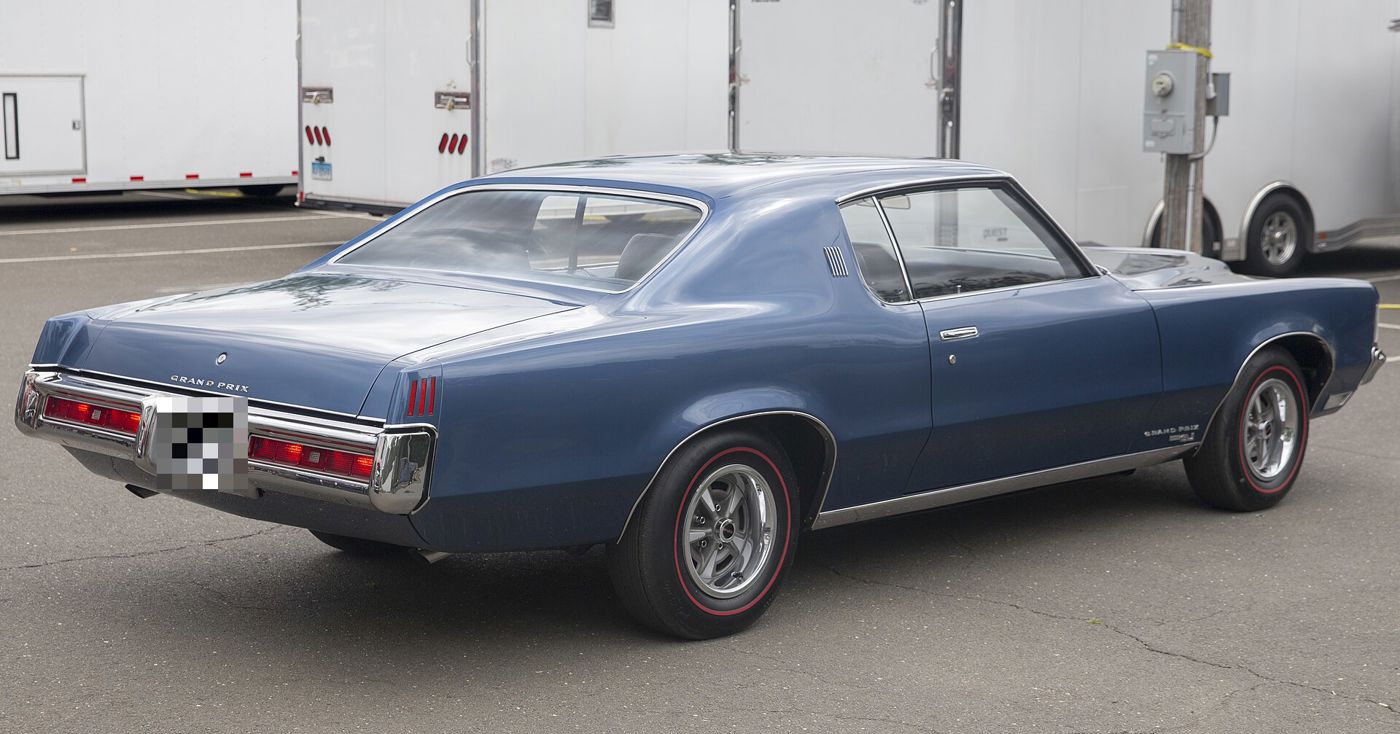
The 1969 Grand Prix began as a memo written while the old one was dying. Ate Up With Motor records that on April 17, 1967, Benjamin Harrison proposed a special long-wheelbase coupe built from Pontiac's intermediate A-body parts, with a long hood and a short deck. By then, the same history says, the division had discussed dropping the Grand Prix altogether. Its sales had fallen to around 40,000 a year in 1966 and 1967, and Bill Collins, then an assistant chief engineer, called the car a disaster. General manager John DeLorean concluded that the Grand Prix's bulk was at the heart of the problem and decided to restyle and resize it completely.1
The numbers behind that judgment got worse before the new car arrived. The compiled Pontiac production table records 31,711 Grand Prix hardtops for 1968 at a factory price of $3,697, the last year of the big Catalina-based car. Pontiac's styling studio, under chief stylist Jack Humbert, turned the memo into a shape. Designer Wayne Vieira developed the look, and the stated aim, in Ate Up With Motor's account, was to evoke the great multicylinder touring cars of the 1930s. Mac's Motor City Garage places the work under the eye of GM styling chief Bill Mitchell. What emerged was a hood that seemed to go on forever.2,1,3
Getting it built required corporate politics as well as design. Production engineering for a B-body 1969 Grand Prix had already begun, so the switch cost money. The new car used what Ate Up With Motor calls an A-Special chassis, a stretched version of the A-body frame two inches longer than the sedan frame, on a 118-inch wheelbase. DeLorean won the support of Pete Estes, and Chevrolet agreed to share the tooling cost of the new roof for its own future personal coupe, the car that became the Monte Carlo. The Engineering Policy Committee approved the program for 1969, and DeLorean and chief engineer Steve Malone had to scramble to launch it on time.1,4
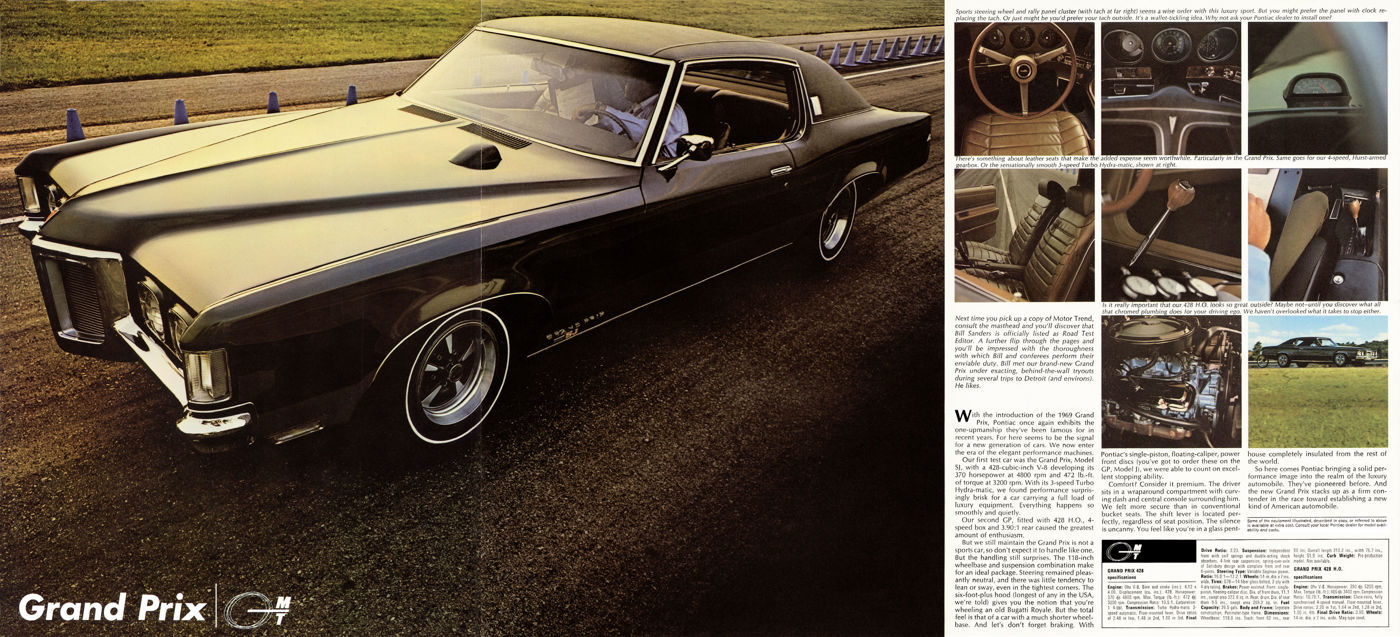
Pontiac rolled the car out on September 26, 1968. It was about 400 pounds lighter than the 1968 Grand Prix, though heavier than a GTO, and it measured 210.2 inches long on its 118-inch wheelbase. The cabin was built around the driver: Mac's Motor City Garage describes a wraparound instrument panel, sculpted bucket seats, a shift lever in a full-length padded console and a mini-console for the controls on the driver's door. Over-Drive's fact sheet adds a V-shaped grille, a radio antenna embedded in the windshield and flush door handles. Strato bucket seats were standard, in Morrokide vinyl or cloth, with leather trim a $199 option.3,1,4
The engine list rose in three steps, all gross ratings. The standard Grand Prix, the Model J, carried a 400 four-barrel rated at 350 horsepower, with a 265-horsepower two-barrel 400 for regular fuel available at no cost. The SJ package, $315.96 in Ate Up With Motor's figures, brought a 428 four-barrel rated at 370 horsepower at 4,800 rpm and 472 lb-ft, along with automatic-leveling suspension and SJ badging. A 428 HO at 390 horsepower and 5,200 rpm was optional on both. A three-speed manual was standard, with the four-speed and the Turbo Hydra-Matic each about $226, and the history notes that the vast majority of buyers took the automatic.1,4
How many took the stick is reported by one source. Mac's Motor City Garage says only 676 Grand Prix were equipped with the optional Muncie four-speed, a figure it does not source. No published count of SJs is documented: Over-Drive offers only an estimate, and dealer and auction claims of particular SJ four-speed and 428 HO four-speed counts come with no stated basis. The SJ share is therefore unknown, not small and not zero. What is certain is the price structure. The base car listed at $3,866, $169 more than the 1968 car and $710 more than a 1969 GTO, and a loaded Grand Prix ran to about $5,500.3,4,1,5
The option sheet tells the same story of a personal car sold on comfort as well as speed. Ate Up With Motor lists the automatic at $227.04, power steering at $115.85, an AM/FM stereo at $248.56, front disc brakes at $71.62, a padded vinyl top at $142.18 and air conditioning at $421.28. Air conditioning alone cost more than the SJ package. Pontiac, that history argues, did not try to sell the car on its smaller size; it sold it as an extravagantly styled personal car and a flagship for the division's rakish image. The Grand Prix of 1969 was a performance car that expected to be ordered with every convenience.1
Motor Trend's October 1968 test shows what that meant on the road. Its SJ had the 370-horsepower 428, Turbo Hydra-Matic, a 3.23 axle and G78-14 tires, and the magazine timed it with and without the air conditioning running: 8.5 seconds to 60 mph with the compressor off and 9.5 seconds with it on. The quarter-mile figures in the same data panel run the other way, 16.5 seconds at 86 mph with air conditioning and 17.0 seconds at 83 mph without, an inconsistency in the magazine's own panel. Ate Up With Motor's general claim, that even base automatic cars could reach 60 in 8 seconds or less, is not tied to a named test.6,1
Buyers answered emphatically. The compiled table counts 112,486 Grand Prix for 1969, three and a half times the 1968 figure, and Ate Up With Motor says the car outsold the Ford Thunderbird by more than two to one. It was the same price-and-proportion argument that the Riviera had made in 1963, delivered in a Pontiac that wore its performance openly. The nameplate that had been a candidate for cancellation in early 1967 had, two years later, more than tripled its sales.5,2,1,7
The success carried the seed of its own second-year slump. Chevrolet, which had helped pay for the roof, launched the Monte Carlo for 1970 on the same long-hood idea at a lower price, and ChevelleStuff's tables count 145,976 Monte Carlos built that year. The Pontiac table counts 65,750 Grand Prix for 1970, a fall of about 42 percent. Ate Up With Motor attributes the drop partly to the inevitable second-year decline of a fashion-driven model and partly to new competition from the Monte Carlo and Oldsmobile's Cutlass Supreme. The 1969 car had shown General Motors how to sell a personal coupe, and a sister division had already paid for a share of the formula.1,8,9
Fact sheet · 1969 · United States
The numbers
1969 Pontiac Grand Prix and SJ — A new 118-inch Grand Prix with the SJ and a 390 hp 428 HO: production more than tripled to 112,486.
Coverage: Partial — researched sections are shown; missing ones are not yet sourced. Researched through 2026-09-23.
Every figure is labeled with how sure we are. Reported means a manufacturer, registry, or reference figure we cite but have not reconciled against factory records ourselves. Disputed means credible sources disagree and both are shown. Rows are separately scoped; don't add them together unless the note says they make up a total.
Key facts
Production
| What was counted | Count | Basis | Status |
|---|---|---|---|
| Grand Prix 2-door sport coupe (Model J and SJ)5,4,7 Grand Prix · 2-door sport coupe · not stated by source Standard Catalog lineage. | 112,486 | built, model-year | Reported |
| What was counted | Count | Basis | Status |
|---|---|---|---|
| Grand Prix SJ4 Grand Prix SJ · 2-door sport coupe · not stated by source The fact sheet gives only an unsourced estimate, which is not used. | Unknown | built, model-year | Unknown |
| What was counted | Count | Basis | Status |
|---|---|---|---|
| Grand Prix with optional Muncie four-speed3 Grand Prix (J and SJ) · 2-door sport coupe · four-speed manual · not stated by source Single published lineage; the article states no basis for the figure. A subset of the total; engine split not stated. | 676 | built, model-year | Reported |
The table's wheelbase column shows 121 in for the Grand Prix row, a transcription slip; the fact sheet gives 118 in.
The four-speed row is a subset of the total and comes from one secondary source without a stated basis. Dealer and auction claims for particular SJ/428 HO four-speed counts remain unpublished leads.
Prices when new
| Model | Price | Basis |
|---|---|---|
| Grand Prix 2-door sport coupe5 | $3,866 | factory price as compiled, 1969 model year |
| Grand Prix with SJ option package4 | $4,182 | base price with the optional SJ trim package, as compiled, 1969 model year |
| Grand Prix base price (Car and Driver)10 | $3,777 | base price as stated in magazine text, 1969-02 |
| Car and Driver SJ test car, as tested10 | $5,673.79 | manufacturer's suggested retail including options, federal excise tax and dealer preparation; excludes state and local taxes, license and freight, 1969-02 |
| Car and Driver Royal Bobcat test car (dealer-modified), as tested10 | $5,852.40 | as tested, including $200 Royal Bobcat engine work and paint, 1969-02 |
Prices are the nominal dollars of the day, not adjusted for inflation.
Engines
| Engine | Factory rating | Availability | Built |
|---|---|---|---|
| 400 2-bbl economy4 400 cu in · 2-barrel, 8.6:1 | 265 hp @ 4,600, 397 lb-ft @ 2,400 (SAE gross (period advertised rating)) | automatic only | Not yet sourced |
| 400 4-bbl4 400 cu in · 4-barrel, 10.5:1 | 350 hp @ 5,000, 440 lb-ft @ 3,000 (SAE gross (period advertised rating)) | Grand Prix standard (non-SJ) | Not yet sourced |
| 428 4-bbl4 428 cu in · 4-barrel, 10.5:1 | 370 hp @ 4,800, 472 lb-ft @ 3,200 (SAE gross (period advertised rating)) | SJ standard; unique to Grand Prix | Not yet sourced |
| 428 HO 4-bbl4 428 cu in · 4-barrel, 10.75:1 | 390 hp @ 5,200, 465 lb-ft @ 3,400 (SAE gross (period advertised rating)) | optional | Not yet sourced |
Ratings are the manufacturer's advertised figures under the standard shown (SAE gross before 1972, SAE net after). They are not dyno results, and gross and net ratings can't be compared directly.
Transmissions
| Transmission | Availability | Built |
|---|---|---|
| Three-speed manual4 | standard (except economy engine) | Not yet sourced |
| Four-speed manual4 | optional, $226 | Not yet sourced |
| Turbo-400 Hydra-Matic4 | optional, $226 | Not yet sourced |
Options and packages
| Code | Option | Price | Installed |
|---|---|---|---|
|
Leather trim4 | $199 | Not yet sourced |
|
Front disc brakes4 | $105 | Not yet sourced |
|
Rear window defogger4 | $41 | Not yet sourced |
|
Rally II wheels4 | $63 | Not yet sourced |
|
SJ option package1,4 | $315.96 | Not yet sourced |
|
Capacitor ignition4 | $104 | Not yet sourced |
|
Cordova top4 | $105 | Not yet sourced |
|
Cornering lamps4 | $34 | Not yet sourced |
|
Cruise control4 | $63 | Not yet sourced |
|
Custom air conditioner4 | $421 | Not yet sourced |
|
Door edge guards4 | $6 | Not yet sourced |
|
Electric clock4 | $16 | Not yet sourced |
|
Hood-mounted tachometer4 | $63 | Not yet sourced |
|
Mirror, rear view glare-proof tilt4 | $4 | Not yet sourced |
|
Mirror, remote control outside rear view4 | $12 | Not yet sourced |
|
Power brakes4 | $42 | Not yet sourced |
|
Power bucket seat, left-hand4 | $69 | Not yet sourced |
|
Power steering4 | $105 | Not yet sourced |
|
Power windows4 | $104 | Not yet sourced |
|
Radio, AM/FM stereo4 | $239 | Not yet sourced |
|
Radio, push-button AM4 | $89 | Not yet sourced |
|
Radio, push-button AM/FM4 | $151 | Not yet sourced |
|
Remote control deck lid release4 | $14 | Not yet sourced |
|
Ride and Handling package4 | $9 | Not yet sourced |
|
Tinted glass4 | $43 | Not yet sourced |
|
Tinted windshield4 | $29 | Not yet sourced |
|
Under-hood utility lamp4 | $7 | Not yet sourced |
|
Visor vanity mirror4 | $4 | Not yet sourced |
|
SJ package10 | $315.96 | Not yet sourced |
|
Automatic transmission (Turbo Hydra-Matic)10 | $227.04 | Not yet sourced |
|
Four-speed manual transmission10 | $227.04 | Not yet sourced |
|
428 H.O. engine10 | $177.94 | Not yet sourced |
|
Vinyl top10 | $142.18 | Not yet sourced |
|
Lamp group10 | $41.07 | Not yet sourced |
|
Limited-slip differential10 | $42.13 | Not yet sourced |
|
AM/FM stereo radio10 | $248.56 | Not yet sourced |
|
Remote mirror10 | $10.53 | Not yet sourced |
|
Automatic speed control10 | $63.19 | Not yet sourced |
|
Wheel covers10 | $51.61 | Not yet sourced |
|
Power steering10 | $115.85 | Not yet sourced |
|
Power disc brakes10 | $71.62 | Not yet sourced |
|
Tinted glass10 | $44.23 | Not yet sourced |
|
Power door locks10 | $45.29 | Not yet sourced |
|
Power windows10 | $110.59 | Not yet sourced |
|
Power seats10 | $73.72 | Not yet sourced |
|
Deluxe steering wheel10 | $50.55 | Not yet sourced |
|
Air conditioning10 | $421.28 | Not yet sourced |
|
Leather trim10 | $199.05 | Not yet sourced |
|
Rear window defogger10 | $47.39 | Not yet sourced |
|
Tachometer10 | $84.26 | Not yet sourced |
|
Styled wheels10 | $84.26 | Not yet sourced |
|
Heavy-duty suspension10 | $9.48 | Not yet sourced |
|
Under-hood lamp10 | $7.37 | Not yet sourced |
|
G70 x 14 belted tires10 | $97.95 | Not yet sourced |
Paint
| Code | Color | Built |
|---|---|---|
10 |
Starlight Black4 | Not yet sourced |
40 |
Mayfair Maize4 | Not yet sourced |
50 |
Cameo Ivory4 | Not yet sourced |
51 |
Liberty Blue4 | Not yet sourced |
52 |
Matador Red4 | Not yet sourced |
53 |
Warwick Blue4 | Not yet sourced |
55 |
Crystal Turquoise4 | Not yet sourced |
57 |
Midnight Green4 | Not yet sourced |
59 |
Limelight Green4 | Not yet sourced |
61 |
Expresso Brown4 | Not yet sourced |
63 |
Champagne4 | Not yet sourced |
65 |
Antique Gold4 | Not yet sourced |
67 |
Burgundy4 | Not yet sourced |
69 |
Palladium Silver4 | Not yet sourced |
72 |
Carousel Red4 | Not yet sourced |
73 |
Verdoro Green4 | Not yet sourced |
76 |
Goldenrod Yellow4 | Not yet sourced |
87 |
Windward Blue4 | Not yet sourced |
|
Turquoise (dark blue, gray fleck)4 | Not yet sourced |
Color names are the factory's. We don't show color swatches, because a screen color is no guide for a restoration.
Interiors
| Code | Trim | Built |
|---|---|---|
|
Strato bucket seats standard; Morrokide vinyl or cloth; leather trim option with cut-pile carpet4 | Not yet sourced |
Specifications
| Measure | Value | Applies to |
|---|---|---|
| Wheelbase4 | 118 in | Grand Prix |
| Overall length4 | 210.2 in | Grand Prix |
| Overall width4 | 75.7 in | Grand Prix |
| Overall height4 | 52.1 in | Grand Prix |
| Shipping weight5 | 3,715 lb | Grand Prix |
| Front track4 | 62 in | Grand Prix |
| Rear track4 | 60 in | Grand Prix |
| Tires4 | G78 x 14 standard (SJ G78-14 white-line); G70 x 14 optional | Grand Prix |
| Transmission ratios4 | 3-speed 2.42/1.61/1.00; 4-speed 2.52/1.88/1.46/1.00 (special order 2.20/1.64/1.28/1.00); Turbo Hydra-Matic 400 2.48/1.48/1.00 :1 | Grand Prix |
| Rear axle ratios4 | 400 economy AMT 2.93; 400 350 hp AMT 3.23 (2.93, 3.55 optional), manual 3.55; 428 370 hp AMT 3.23 (2.93, 3.55 optional), manual 3.55; 428 HO 390 hp AMT 3.36 (2.93, 3.55 optional), manual 3.55 :1 | Grand Prix |
| SJ package content4 | SJ emblems; 428 370 hp V-8 (390 hp 428 HO available); automatic-leveling heavy-duty suspension; Rally gauges; G78-14 white-line tires; heavy-duty 3.55 axle with manual, 3.23 with automatic | Grand Prix SJ option |
| Curb weight (Car and Driver SJ test car)10 | 4,206 lb | SJ test car as equipped |
Period road tests
| Test | Car tested | Result |
|---|---|---|
| Motor Trend, 1968-1060-30 mph | Grand Prix SJ, 428 (370 hp), Turbo Hydra-Matic, 3.23:1, G78-14; air conditioning onas reported by the magazine | 3.6 s |
| Motor Trend, 1968-1060-45 mph | Grand Prix SJ, 428 (370 hp), Turbo Hydra-Matic, 3.23:1, G78-14; air conditioning onas reported by the magazine | 6 s |
| Motor Trend, 1968-1060-60 mph | Grand Prix SJ, 428 (370 hp), Turbo Hydra-Matic, 3.23:1, G78-14; air conditioning onas reported by the magazine | 9.5 s |
| Motor Trend, 1968-1060-75 mph | Grand Prix SJ, 428 (370 hp), Turbo Hydra-Matic, 3.23:1, G78-14; air conditioning onas reported by the magazine | 14 s |
| Motor Trend, 1968-106standing quarter mile, elapsed time | Grand Prix SJ, 428 (370 hp), Turbo Hydra-Matic, 3.23:1, G78-14; air conditioning onas reported by the magazine | 16.5 s |
| Motor Trend, 1968-106standing quarter mile, speed | Grand Prix SJ, 428 (370 hp), Turbo Hydra-Matic, 3.23:1, G78-14; air conditioning onas reported by the magazine | 86 mph |
| Motor Trend, 1968-1060-30 mph | Grand Prix SJ, 428 (370 hp), Turbo Hydra-Matic, 3.23:1, G78-14; air conditioning offas reported by the magazine | 3.4 s |
| Motor Trend, 1968-1060-45 mph | Grand Prix SJ, 428 (370 hp), Turbo Hydra-Matic, 3.23:1, G78-14; air conditioning offas reported by the magazine | 5.5 s |
| Motor Trend, 1968-1060-60 mph | Grand Prix SJ, 428 (370 hp), Turbo Hydra-Matic, 3.23:1, G78-14; air conditioning offas reported by the magazine | 8.5 s |
| Motor Trend, 1968-1060-75 mph | Grand Prix SJ, 428 (370 hp), Turbo Hydra-Matic, 3.23:1, G78-14; air conditioning offas reported by the magazine | 12.4 s |
| Motor Trend, 1968-106standing quarter mile, elapsed time | Grand Prix SJ, 428 (370 hp), Turbo Hydra-Matic, 3.23:1, G78-14; air conditioning offas reported by the magazine | 17 s |
| Motor Trend, 1968-106standing quarter mile, speed | Grand Prix SJ, 428 (370 hp), Turbo Hydra-Matic, 3.23:1, G78-14; air conditioning offas reported by the magazine | 83 mph |
| Car and Driver, 1969-02100-60 mph | Grand Prix SJ, 428 (370 hp), Turbo Hydra-Matic, 3.23:1, G78 x 14 Polyglas, power disc/drum brakes, air conditioning; curb weight 4,206 lb41 F | 6.9 s |
| Car and Driver, 1969-0210standing quarter mile, elapsed time | Grand Prix SJ, 428 (370 hp), Turbo Hydra-Matic, 3.23:191.0 mph | 15.3 s |
| Car and Driver, 1969-0210braking 80-0 mph | Grand Prix SJ, 428 (370 hp), Turbo Hydra-Matic, 3.23:10.67 g; rear-wheel lock-up noted | 318 ft |
| Car and Driver, 1969-02100-60 mph | DEALER-MODIFIED (Royal Pontiac Bobcat), not a factory configuration: Grand Prix Model J, 428 H.O. with Royal Bobcat tuning (about 11.25:1), 4-speed manual, 3.91 limited-slip, heavy-duty suspension, G70 x 14; curb weight 4,040 lb | 5.4 s |
| Car and Driver, 1969-0210standing quarter mile, elapsed time | DEALER-MODIFIED (Royal Pontiac Bobcat) Grand Prix J, 428 H.O., 4-speed, 3.91102.1 mph; fastest run recorded 13.98 s per text | 14 s |
A road test result belongs to the one car that was tested, with its engine, gearing, tires, and conditions. It is not a figure for every car of the year.
Identification
- Series and body
- Series 266, body 26657.5
- Series (fact sheet)
- The Over-Drive fact sheet identifies the 1969 Grand Prix as Series 276; the compiled production table shows series 266, body 26657 (see conflicts).4
Where the sources disagree
1969 Grand Prix series number
Both are Over-Drive compilations. The production table also repeats the 1968 121-inch wheelbase for this row, which is known to be a slip (see production note), so its series and body entries may also be carried over from 1968. Shown unresolved until a factory body-number source is read.
1969 Grand Prix option prices: Over-Drive vs Ate Up With Motor
- Front disc brakes $105; Rally II wheels $63; power steering $105; AM/FM stereo $239; Turbo Hydra-Matic $226; Cordova top $105; air conditioning $4214
- Front disc brakes $71.62; Rally II wheels $84.26; power steering $115.85; AM/FM stereo $248.56; automatic $227.04; padded vinyl top $142.18; air conditioning $421.281
Show both. Car and Driver's February 1969 test-car option list prints the same cent-level prices as Ate Up With Motor, so that lineage leads; Over-Drive's rounded list appears partly carried over from its full-size 1968 sheet. Neither is a factory price list; the options table carries both sets with their sources.
Identification
Read a 1969 Pontiac VIN
The VIN decoder runs in your browser and never sends the VIN anywhere. How the factory numbered this year's cars:
Same model year
Also in 1969
- AMC AMX The two-seat AMX's biggest year: 8,293 cars by the enthusiast production table, with a mid-year run of Big Bad colors and 52 Hurst-built Super Stock AMXs for NHRA drag racing.
- AMC Javelin Production fell to 40,675, but the 1969 Javelin added the Big Bad colors, with 2,282 cars painted blue, green or orange, plus the Mod package.
- AMC Rebel and Rebel Machine A base and SST Rebel with no convertible. The Big Bad colors were test-marketed through the New York–New Jersey 'Raider' hardtop. This is host-car context for the 1970 Machine.
- Buick Riviera Another record at 52,872 Rivieras; 5,272 had the GS handling option.
- Buick Skylark Gran Sport, GS and GSX GS production fell to 12,465, and the GS 400's Stage 1 package became a factory option while Stage 2 stayed a dealer item.
- Buick Wildcat 67,453 Wildcats; the last year of the 430.
- Chevrolet Chevelle and Malibu SS Super Sport became RPO Z25 option equipment, available for 1969 only on the 300 Deluxe coupes as well as Malibu sport coupe, convertible and El Camino.
- Chevrolet Chevy II and Nova SS is RPO Z26 per the source, with L48, L34 and L78 engines. Enthusiast-compiled production: 251,849 cars; Super Sport 17,564.
- Chevrolet El Camino SS SS 396 became RPO Z25 option equipment, orderable on the V8 Malibu El Camino (13680); the El Camino share of the 86,307 Z25s is not separately published.
- Chevrolet Impala SS Only the SS427 (RPO Z24) remains; the reported count ranges from 2,425 to about 2,455.
- Dodge Charger The second-generation Charger's peak-sales year added the SE package and the aero-bodied Charger 500 and Charger Daytona homologation cars, whose production totals are still disputed.
- Dodge Coronet R/T and Super Bee The Super Bee added a hardtop body and the 440 Six Pack, while the 440-powered Coronet R/T continued as the upscale hardtop and convertible.
- Dodge Dart GTS, Swinger and Demon The low-priced Swinger 340 arrived and outsold the GTS by more than two to one (16,637 against about 6,700), while a 375 hp 440 joined the GTS options.
- Ford Fairlane The Fairlane hardtop was the intermediate line's volume leader, while the Fairlane 500 SportsRoof shared its body with the Torino GT, Cobra and Talladega.
- Ford Ranchero GT The Ranchero GT carried Torino GT trim; 1,658 GTs were built, per reference-site counts in the Standard Catalog lineage.
- Ford Thunderbird Fifth-generation Thunderbird; only the whole-line production total was found.
- Ford Torino The Torino GT carried most of the line's volume, the 428 Cobra Jet was in its first full year, and the Talladega aero fastback was built in a short run at Atlanta to homologate a NASCAR nose.
- Mercury Comet and Cyclone The Cyclone fastback came as Cyclone and Cyclone CJ, mid-year Spoilers carried Dan Gurney and Cale Yarborough graphics, and the extended-nose Cyclone Spoiler II was built at Lorain for NASCAR homologation.
- Mercury Cougar A longer, restyled Cougar added a convertible, the Boss 302 arrived in April, and the Eliminator replaced the GT as the performance Cougar.
- Mercury Marauder and S-55 The Marauder name returned on a full-size hardtop, and the X-100 carried the 360 hp 429 four-barrel as its only engine.
- Oldsmobile Cutlass, 4-4-2 and Hurst/Olds The 4-4-2 kept its 400 while the second Hurst/Olds, in white and gold with a 380 hp 455, went into production at about 900 cars.
- Plymouth Barracuda and 'Cuda The last A-body Barracuda introduced the 'Cuda name as a stripped performance package with a standard 340, alongside Formula S and a midyear 440.
- Plymouth GTX, Belvedere and Satellite The GTX shared the Road Runner's new Air Grabber scoop and Super Track Pack but sold 15,602 cars, fewer than a fifth of the cheaper Road Runner.
- Plymouth Road Runner A convertible joined the coupe and hardtop, the 440 Six Barrel arrived at mid-year, and the Road Runner reached its production peak of 84,420.
- Pontiac Firebird and Trans Am The last first-generation Firebird, and the mid-year debut of the Trans Am package: 697 cars by the commonly published count, eight of them convertibles.
- Pontiac GTO Three four-barrel 400s under one nameplate, and the first year of the Judge package built around Ram Air power.
- Pontiac Tempest and LeMans The last year of the OHC Sprint six and the 350 HO.
- Rambler American and SC/Rambler AMC and Hurst put the 315-hp 390 V8 and a close-ratio four-speed into the compact Rambler hardtop for NHRA F/Stock. 1,512 were built, and the split between the two paint schemes is disputed.