1971 · AMC · United States
1971 AMC Hornet SC/360: The Insurance-Friendly Muscle Car That Buyers Passed By
AMC's one-year compact muscle car pitched as an insurance-friendly alternative. AMC reportedly planned 10,000, but 784 were built.
United States · researched through 2026-09-22
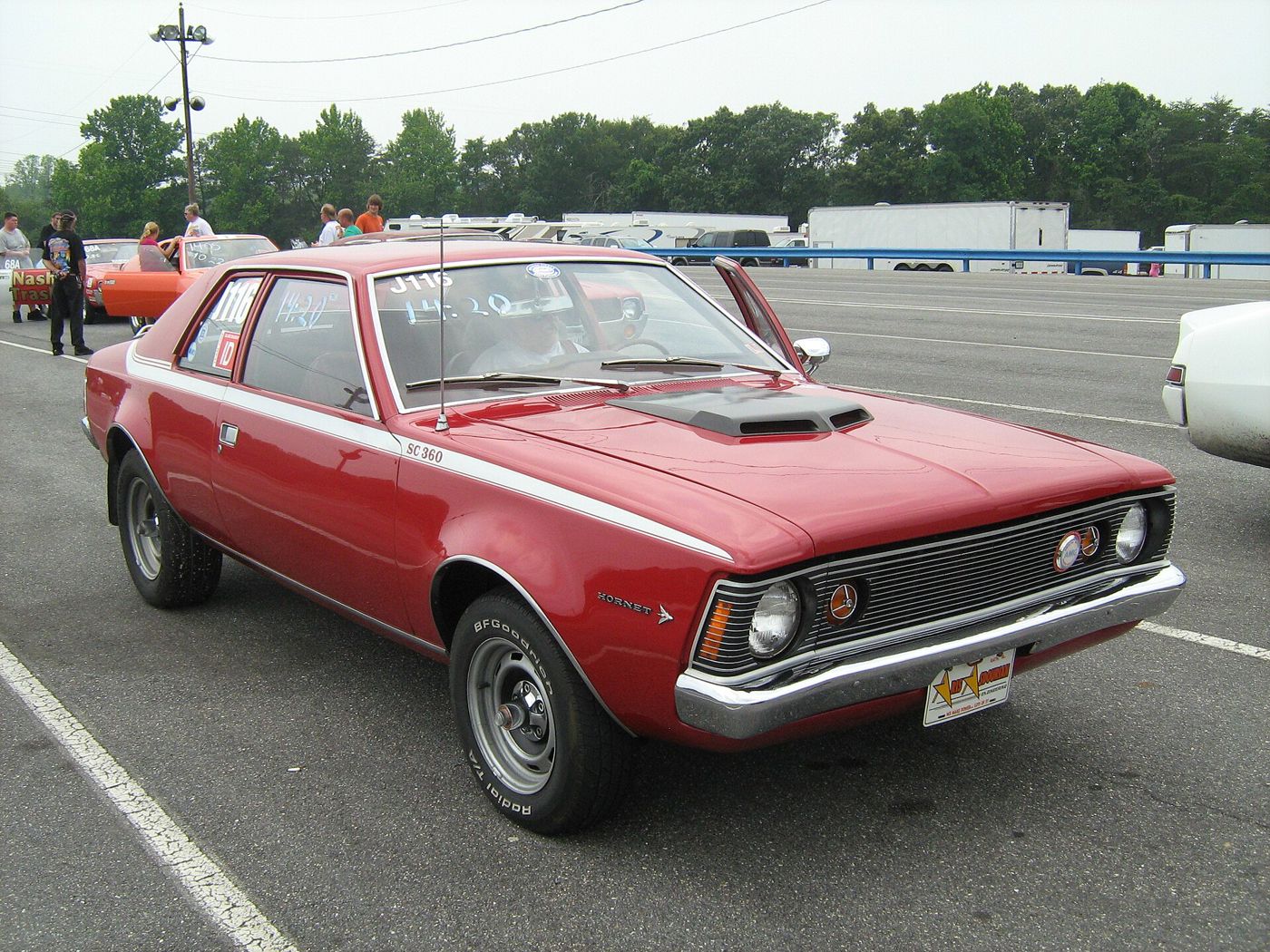
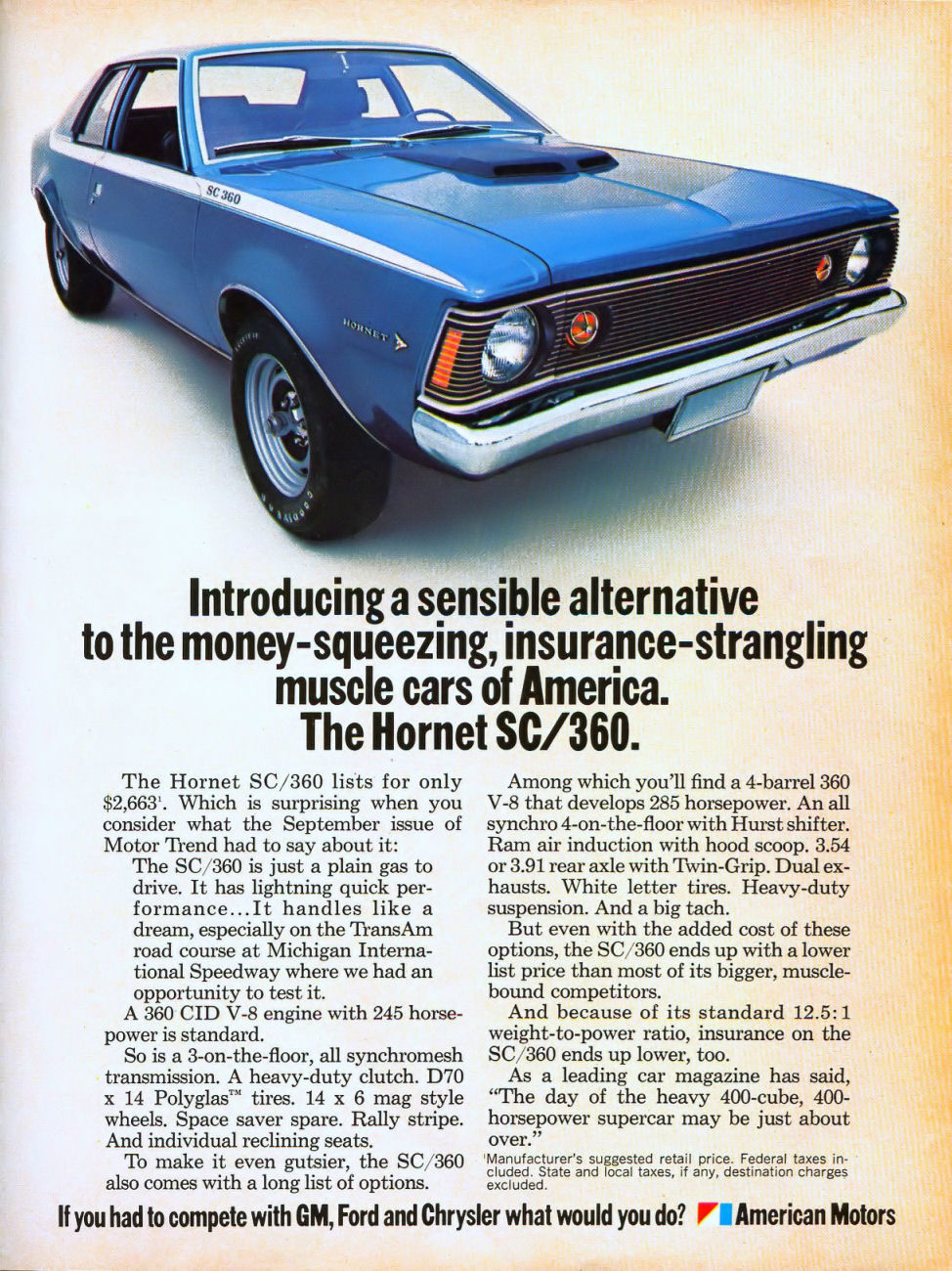
American Motors introduced the Hornet SC/360 as “a sensible alternative to the money-squeezing, insurance-strangling muscle cars of America.” That line, quoted by Old Cars Weekly, sums up the car's pitch. By 1971 the big-engine intermediates had become expensive to insure, and AMC offered a compact with a 360 V8 as the way around the problem. The sales effort was small. Old Cars Weekly quotes the observation that AMC ran a single advertisement for the car, in Motor Trend: “That's all the advertising they did for them.” AMC had a clear argument for the car and gave it very little exposure.1
The insurance argument had real substance. Old Cars Weekly reports that the SC/360 avoided the 25 percent surcharge insurers were adding to other muscle cars, although it still drew some surcharges once insurers noticed its performance. That was the business case: a small car with a moderate-displacement V8 and a modest price, pitched to buyers who could not insure a big-engine supercar. AMC's own hopes were large. Old Cars Weekly says the company expected to build 4,000 and suggested that 10,000 sales might be possible. The SC/360 registry kept by Planet Houston AMX records the plan as 10,000. Both figures are stated plans, not production.1,2
The SC/360 was the third car in a short series. In 1969 AMC and Hurst had put a 315-horsepower 390 into the Rambler American to make the SC/Rambler. In 1970 the Rebel Machine carried a 340-horsepower 390 in the midsize Rebel. For 1971 AMC moved to a smaller engine in its newer compact. AMC's 1971 literature identifies the SC/360 as a Hornet two-door sedan with the 360 V8, an available four-barrel and a Hurst-shifted four-speed. The registry gives it body number 7106-1, a factory price of $2,663 and a shipping weight of 3,300 pounds. The Hornet rode a 108-inch wheelbase.2,1
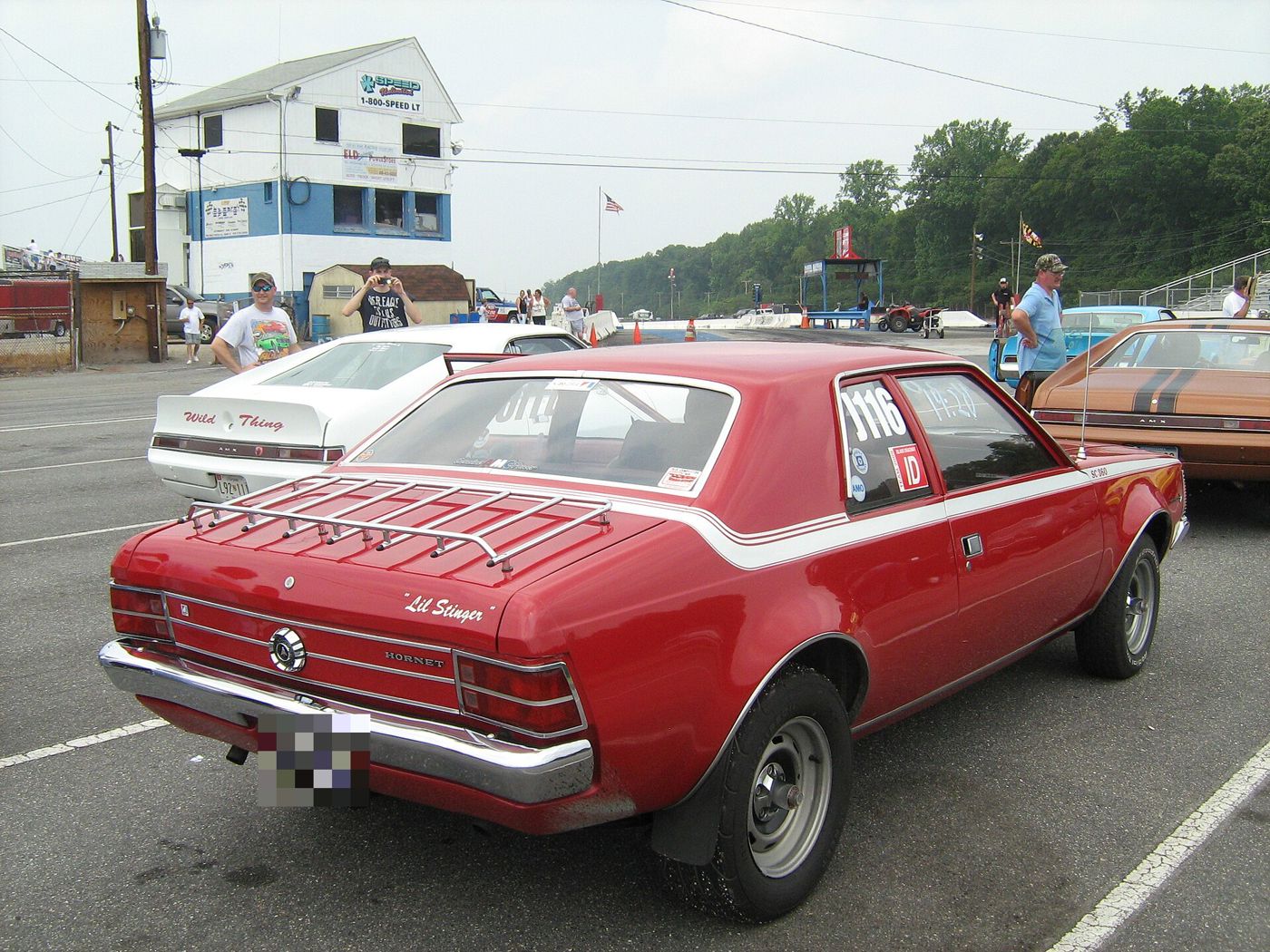
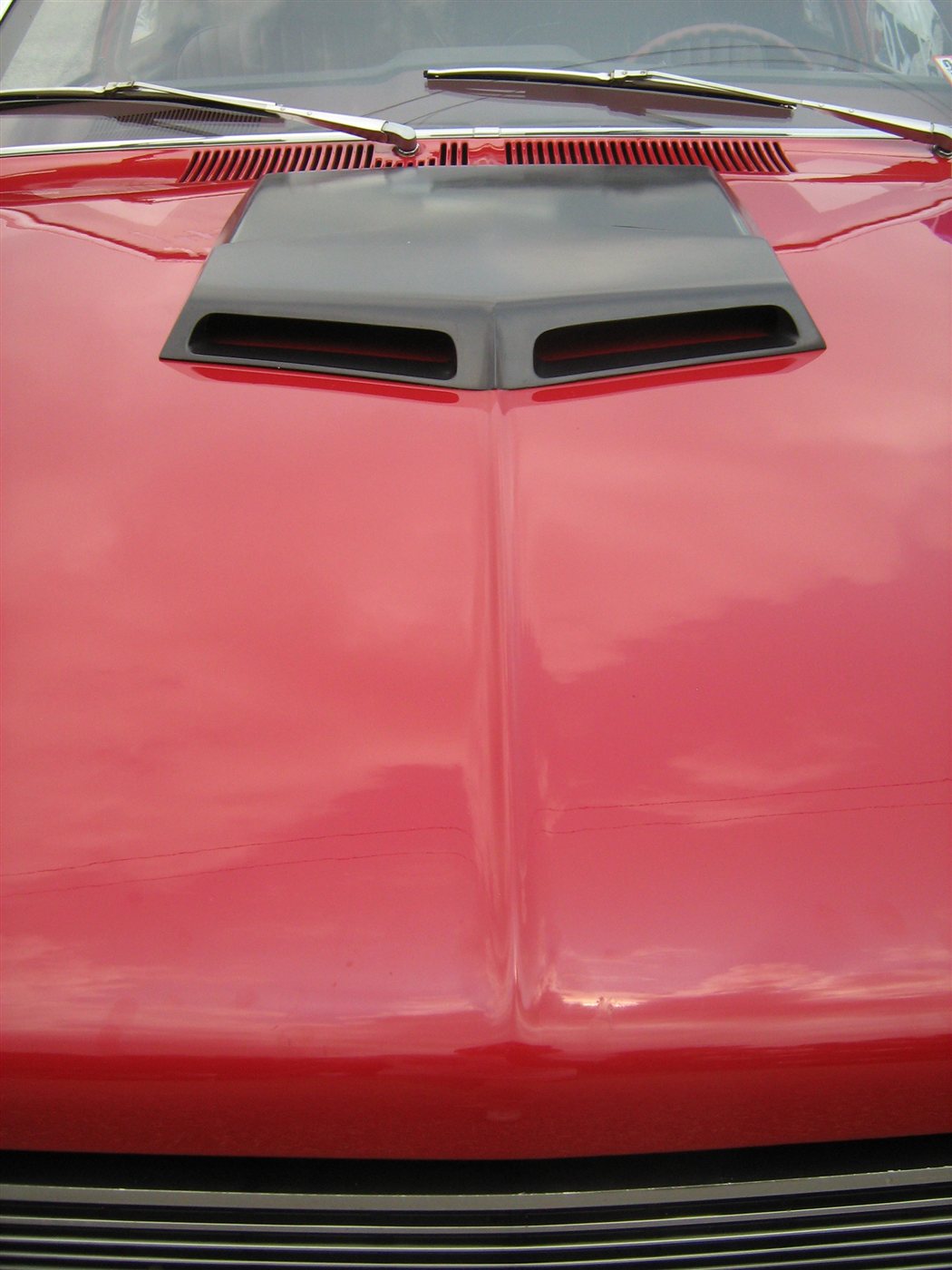
The base SC/360 was relatively mild. Old Cars Weekly lists the standard two-barrel 360 at 245 horsepower, a gross-era advertised figure, with a three-speed all-synchromesh manual, D70x14 Polyglas tires, styled wheels, rally stripes and reclining seats, for $2,663. The $199 Go Package made it a muscle car. It added a four-barrel carburetor and a 285-horsepower rating, Ram Air induction through a flat-black hood scoop, dual exhaust, a handling package, a large tachometer and raised-white-letter tires. Old Cars Weekly prices a four-speed with Hurst shifter, or an automatic, at $237.85. The registry separately prices the automatic at $200 with a floor shift or $238 on the column.1,2
The rest of the registry's price list reads like any compact of the time: Twin-Grip at $43, power front disc brakes at $84, power steering at $111, air conditioning at $399 and a Rim-Blow steering wheel at $37. The paint list runs to 21 colors, from Snow White and Canary Yellow to Wild Plum and Baja Bronze. The registry says black was a $56 extra-cost color on the SC/360. Interiors came in black, blue, green or red, in vinyl, fabric or a Serape pattern. The registry lists no production counts by color or trim. So a buyer could order an SC/360 as a flashy option-laden car or as a plain one.2
Buyers ordered 784 cars, the figure given by both the registry and Old Cars Weekly. That is less than a fifth of the 4,000 AMC expected and under 8 percent of the 10,000 it hoped for. The registry's breakdown shows who bought them. Of the 784, 578 had the four-barrel Go Package engine, about 74 percent, and 206 had the two-barrel. By transmission, 436 were automatics (187 two-barrel and 249 four-barrel), 306 were four-barrel four-speeds and only 42 were three-speeds. Wikipedia gives 304 rather than 306 four-speeds, but the registry's 306 is the figure that makes its own rows add up to 784, so it leads.2,1,3
The transmission choices show how the SC/360 differed from AMC's 1969 compact. The SC/Rambler had come only with a close-ratio four-speed, according to AMC's foldout. The SC/360 buyer had a choice, and most chose an automatic: 436 of 784 cars, about 56 percent, by the registry's rows. The Hurst four-speed went into 306 cars, about 39 percent, and in the registry's rows it appears only with the four-barrel engine. The standard three-speed went into just 42. Even the two-barrel cars were mostly automatics, 187 of 206. The SC/360 was sold largely to buyers who wanted a quick car without a clutch pedal.2
Even those counts cannot identify an individual car. The registry says the only mark that separates an SC/360 from any other Hornet is a 1 in the sixth VIN digit. Neither Ram Air nor the Go Package appears in the VIN or on the door tag. The registry ties the four-barrel to the Go Package but gives no separate count of Go Package cars. It also says that not every SC/360 had Ram Air, so a four-barrel car cannot be assumed to have the working scoop. The registry's cars show Kenosha builds, from a model year that ran from 1 August 1970 to 30 July 1971. The SC/360 reached showrooms in October 1970.2
The car performed as promised. Hot Rod's December 1970 issue tested a virtually stock SC/360 with an automatic. As reported by Old Cars Weekly, it ran the quarter-mile in 14.80 seconds at 94.63 mph. The secondary report does not say which engine the car had or what axle ratio, and the figures belong to that one car. Can-Am driver Steve Diulo then drove it on a road-racing course. He found the steering slow but summed the car up as “really a lotta car for the money!” For a compact with a $2,663 base price, a quarter-mile under 15 seconds with an automatic was a strong result, even if the insurers were starting to notice.1
It still lasted one year. Old Cars Weekly attributes the car's weak prospects to the insurance industry's crackdown, the same problem the car had been designed around. Ate Up With Motor notes the 784 built against an anticipated 10,000. With the SC/360, AMC's run of limited-production performance cars ended: the SC/Rambler in 1969, the Rebel Machine in 1970 and the SC/360 in 1971. The registry estimates that about 100 survive worldwide, as reported by Old Cars Weekly. The SC/360 was the most practical of the three by its own pitch, a muscle car sold on its insurance bill, and it ended the series with the smallest production run.1,4,2
Fact sheet · 1971 · United States
The numbers
1971 AMC Hornet SC/360 — AMC's one-year compact muscle car pitched as an insurance-friendly alternative. AMC reportedly planned 10,000, but 784 were built.
Coverage: Partial — researched sections are shown; missing ones are not yet sourced. Researched through 2026-09-22.
Every figure is labeled with how sure we are. Reported means a manufacturer, registry, or reference figure we cite but have not reconciled against factory records ourselves. Disputed means credible sources disagree and both are shown. Rows are separately scoped; don't add them together unless the note says they make up a total.
Key facts
- 784 built: 206 two-barrel, 578 four-barrel. By transmission the registry's rows give 187 + 249 automatics, 19 + 23 three-speeds and 306 four-speeds.2
- Base price $2,663. The Go Package cost $199 and added the four-barrel, Ram Air induction, dual exhaust, handling package, tachometer and Polyglas white-letter tires.2,1
- The only mark that separates an SC/360 from other Hornets is '1' in the sixth VIN digit. Neither Ram Air nor the Go Package shows in the VIN or door tag.2
Production
| What was counted | Count | Basis | Status |
|---|---|---|---|
| Hornet SC/360, body 7106-12,1 SC/360 · 2-door sedan · 360 V8 · US production | 784 | built, model-year | Reported |
| Hornet SC/360, row 7106-1 (AMC tally sheet)5 Hornet SC/360 · 2-door sedan · 360 V8 · US, Canada and export market; built at Kenosha Agrees with the registry total. The sheet does not split 2-bbl from 4-bbl or transmissions. A single further 360 appears on row 7108-7 (Hornet SST four-door), not an SC/360. | 784 | built, model-year | Reported |
| What was counted | Count | Basis | Status |
|---|---|---|---|
| 360 two-barrel2 SC/360 · 2-door sedan · 360 V8 2-bbl · US | 206 | built, model-year | Reported |
| 360 four-barrel (Go Package)2 SC/360 · 2-door sedan · 360 V8 4-bbl · US | 578 | built, model-year | Reported |
| What was counted | Count | Basis | Status |
|---|---|---|---|
| 360 two-barrel, automatic2 SC/360 · 2-door sedan · 360 V8 2-bbl · automatic · US | 187 | built, model-year | Reported |
| 360 two-barrel, three-speed2 SC/360 · 2-door sedan · 360 V8 2-bbl · 3-speed manual · US | 19 | built, model-year | Reported |
| 360 four-barrel, automatic2 SC/360 · 2-door sedan · 360 V8 4-bbl · automatic · US | 249 | built, model-year | Reported |
| 360 four-barrel, three-speed2 SC/360 · 2-door sedan · 360 V8 4-bbl · 3-speed manual · US | 23 | built, model-year | Reported |
| 360 four-barrel, four-speed2 SC/360 · 2-door sedan · 360 V8 4-bbl · 4-speed manual · US Wikipedia gives 304; see conflicts. | 306 | built, model-year | Disputed |
The five engine-transmission rows partition 784 in the registry's own figures (187 + 19 + 249 + 23 + 306).
The registry says AMC planned 10,000 SC/360s. That is a stated plan, not a production figure.
Prices when new
| Model | Price | Basis |
|---|---|---|
| Hornet SC/3602,1 | $2,663 | 'factory price' as tabulated; Old Cars Weekly 'base price', 1970-10 |
| Go Package2,1 | $199 | option price as reported, 1971 |
| Four-speed with Hurst shifter or automatic1 | $237.85 | option price as reported by Old Cars Weekly, 1971 |
Prices are the nominal dollars of the day, not adjusted for inflation.
Engines
| Engine | Factory rating | Availability | Built |
|---|---|---|---|
| 360 V8 2-bbl1 360 cu in · 2-barrel | 245 hp (period factory advertised (gross)) | standard | 2062 Reported |
| 360 V8 4-bbl (Go Package)1 360 cu in · 4-barrel, Ram Air | 285 hp (period factory advertised (gross)) | Go Package | 5782 Reported |
Ratings are the manufacturer's advertised figures under the standard shown (SAE gross before 1972, SAE net after). They are not dyno results, and gross and net ratings can't be compared directly.
Transmissions
| Transmission | Availability | Built |
|---|---|---|
| Three-speed manual2 | standard | 422 Estimate |
| Four-speed manual, Hurst shifter1 | optional (four-barrel cars) | 3062 Disputed |
| Shift-Command automatic (floor $200 or column $238)2 | optional | 4362 Estimate |
Options and packages
| Code | Option | Price | Installed |
|---|---|---|---|
|
Go Package: four-barrel carburetor, Ram Air induction (Rockwell-made scoop), dual exhaust, handling package, tachometer, Polyglas white-letter tires2 | $199 | Not yet sourced |
|
Twin-Grip rear axle2 | $43 | Not yet sourced |
|
Power front disc brakes2 | $84 | Not yet sourced |
|
Power steering2 | $111 | Not yet sourced |
|
Air conditioning2 | $399 | Not yet sourced |
|
Tachometer (non-Go Package cars)2 | $50 | Not yet sourced |
|
Styled steel wheels2 | $46 | Not yet sourced |
|
Rim-Blow steering wheel2 | $37 | Not yet sourced |
|
Rear deck luggage rack2 | $32 | Not yet sourced |
Paint
| Code | Color | Built |
|---|---|---|
A1 |
Snow White2 | Not yet sourced |
A2 |
Canary Yellow2 | Not yet sourced |
A4 |
Skyline Blue2 | Not yet sourced |
A5 |
Midway Blue Metallic2 | Not yet sourced |
A6 |
Midnight Blue Metallic2 | Not yet sourced |
A7 |
Limelight Green Metallic2 | Not yet sourced |
A8 |
Meadow Green Metallic2 | Not yet sourced |
A9 |
Raven Green Metallic2 | Not yet sourced |
B2 |
Burnish Brown Metallic2 | Not yet sourced |
B3 |
Quicksilver Metallic2 | Not yet sourced |
B4 |
Charcoal Grey Metallic2 | Not yet sourced |
B5 |
Deep Maroon Metallic2 | Not yet sourced |
B6 |
Electric Blue Metallic2 | Not yet sourced |
B7 |
Brilliant Green Metallic2 | Not yet sourced |
B8 |
Mustard Yellow2 | Not yet sourced |
B9 |
Matador Red2 | Not yet sourced |
C1 |
Golden Lime Metallic2 | Not yet sourced |
C6 |
Surfside Turquoise2 | Not yet sourced |
D3 |
Baja Bronze2 | Not yet sourced |
D9 |
Wild Plum2 | Not yet sourced |
P1 |
Black (a $56 extra-cost color on the SC/360 per the registry)2 | Not yet sourced |
Color names are the factory's. We don't show color swatches, because a screen color is no guide for a restoration.
Interiors
| Code | Trim | Built |
|---|---|---|
T141-D / T141-C / T141-V |
Black: vinyl, fabric, or Serape2 | Not yet sourced |
T143-D / T143-C / T143-V |
Blue: vinyl, fabric, or Serape2 | Not yet sourced |
T144-D / T144-C / T144-V |
Green: vinyl, fabric, or Serape2 | Not yet sourced |
T145-D / T145-C / T145-V |
Red: vinyl, fabric, or Serape2 | Not yet sourced |
Specifications
| Measure | Value | Applies to |
|---|---|---|
| Wheelbase1 | 108 in | Hornet |
| Overall length1 | 179.6 in | SC/360 |
| Width1 | 70.6 in | SC/360 |
| Shipping weight2 | 3,300 lb | body 7106-1 |
Period road tests
| Test | Car tested | Result |
|---|---|---|
| Hot Rod, 1970-121quarter-mile | SC/360, automatic (engine version and axle not stated in the secondary report)trap speed 94.63 mph; as reported by Old Cars Weekly; original issue not read | 14.8 s |
A road test result belongs to the one car that was tested, with its engine, gearing, tires, and conditions. It is not a figure for every car of the year.
Identification
- VIN
- Sixth VIN digit '1' identifies the SC/360 (body 7106-1). Ram Air and the Go Package are not encoded in the VIN or door tag. Registry cars show East-line Kenosha builds.2
- Production dates
- 1971 AMC production ran 1 August 1970 to 30 July 1971. The SC/360 reached showrooms in October 1970.2
Where the sources disagree
Same model year
Also in 1971
- AMC AMX The AMX name moves onto the redesigned Javelin as its top model. It is a derivative badge, not a continuation of the two-seater. 2,054 were built, all with the 360 or 401.
- AMC Javelin A new, flared-fender Javelin, with the AMX name as its top model. Javelin won AMC the 1971 Trans-Am manufacturers' championship.
- AMC Matador Machine The Rebel Machine's unadvertised successor, a 'Machine Go' option package for the Matador hardtop. Production is unknown; published guesses run from 43 to 68.
- Buick Riviera The boattail Riviera: 455 rated 315 gross / 255 net, GS 330 / 265; 3,175 of 33,810 were GS.
- Buick Skylark Gran Sport, GS and GSX Compression fell to 8.5:1, the GS 350 and GS 455 were merged into one GS series of 9,170 cars, and the GSX became an appearance package on any GS.
- Chevrolet Chevelle and Malibu SS A single RPO Z15 SS package now spanned small- and big-block V8s; 9,502 of 19,293 SS cars carried the LS5 454, and Chevrolet began printing net ratings beside gross.
- Chevrolet Chevy II and Nova SS limited to the L48 350 per the source; Rally Nova (RPO YF1) offered. Enthusiast-compiled production: 194,878 cars; Super Sport 7,015.
- Chevrolet El Camino SS A single RPO Z15 SS package on the Malibu/Custom El Camino; the El Camino share of 19,293 SS cars is not separately published.
- Chevrolet Monte Carlo SS The last SS 454 year: RPO Z20 on 1,919 of 128,600 Monte Carlos.
- Dodge Challenger Challenger's second year lost the SE, the R/T convertible, and the T/A; a new pillared coupe joined the hardtop and convertible, and production fell to roughly a third of 1970's.
- Dodge Charger A new, shorter third-generation body absorbed the Coronet two-doors and the Super Bee; it was the last year for the R/T and for a factory Hemi Charger.
- Dodge Coronet R/T and Super Bee The end of the line for Coronet performance: the two-door Coronets were replaced by the Charger, taking the Super Bee with them.
- Dodge Dart GTS, Swinger and Demon Dodge's version of the Duster fastback arrived as the Demon, and the Demon 340 became the performance Dart: 10,098 built, plus 85 Canadian Swinger 340 Specials.
- Ford Maverick Grabber The Grabber became its own model with a dual-scoop hood, and the 210 hp 302 V8 arrived; Classic Industries counts 38,963 Grabbers.
- Ford Ranchero GT The second Torino-based Ranchero year; reference counts give 3,632 GTs, while Barn Finds rounds the GT figure to about 3,900 of 24,946 Rancheros.
- Ford Thunderbird The last fifth-generation year kept the 360-hp 429 as standard; production fell to 36,055.
- Ford Torino A carryover year for the 1970 body; the Torino Cobra now came standard with a 351 four-barrel and offered the 429 Cobra Jet-R, but only 3,054 Cobras were built.
- Mercury Comet and Cyclone The final Cyclone year: production fell to a few thousand across Cyclone, Cyclone GT and Cyclone Spoiler.
- Mercury Cougar A larger second-generation Cougar, new body codes, and the one-year 429 Cobra Jet option, fitted to 448 cars.
- Oldsmobile Cutlass, 4-4-2 and Hurst/Olds Compression fell to 8.5:1 for regular fuel, the W-31 was dropped, the sports coupe was gone, and 4-4-2 production fell to 7,589.
- Plymouth Barracuda and 'Cuda Four headlamps and a new grille marked the second E-body year; the Hemi and 440 Six Barrel stayed on the 'Cuda order form, but Barracuda-line production fell to about a third of 1970's.
- Plymouth Duster 340 and 360 The Duster 340's second year brought a new grille, a Thermo-Quad 340 rated 275 gross and 235 net hp, and a $2,703 list price, while output fell to about 12,900.
- Plymouth GTX, Belvedere and Satellite On the redesigned 1971 Satellite body the GTX fell to 2,942 cars, only 30 of them with the Hemi.
- Plymouth Road Runner Redesigned on the new Satellite body as a hardtop only, the Road Runner fell to 14,218 cars, and a 340 joined the 383, 440, and Hemi.
- Pontiac Firebird and Trans Am The 455 HO year: the Trans Am's biggest engine, 2,116 cars, and a Formula line split across three V-8s.
- Pontiac GTO Lower compression, dual gross and net ratings, the 455 HO as the top engine, and production down to 10,532.
- Pontiac Grand Prix Boat-tail styling, lower compression, and the manual transmission gone by March: 116 of 58,325 had one.
- Pontiac Tempest and LeMans The Tempest name gives way to T-37; the GT-37 option carries on and the 455 HO is available in two-door LeMans models.