1971 · AMC · United States
1971 AMC Matador Machine: The Machine Becomes an Option Package
The Rebel Machine's unadvertised successor: a 'Machine Go' package for the Matador hardtop, with reported counts from 43 to 68.
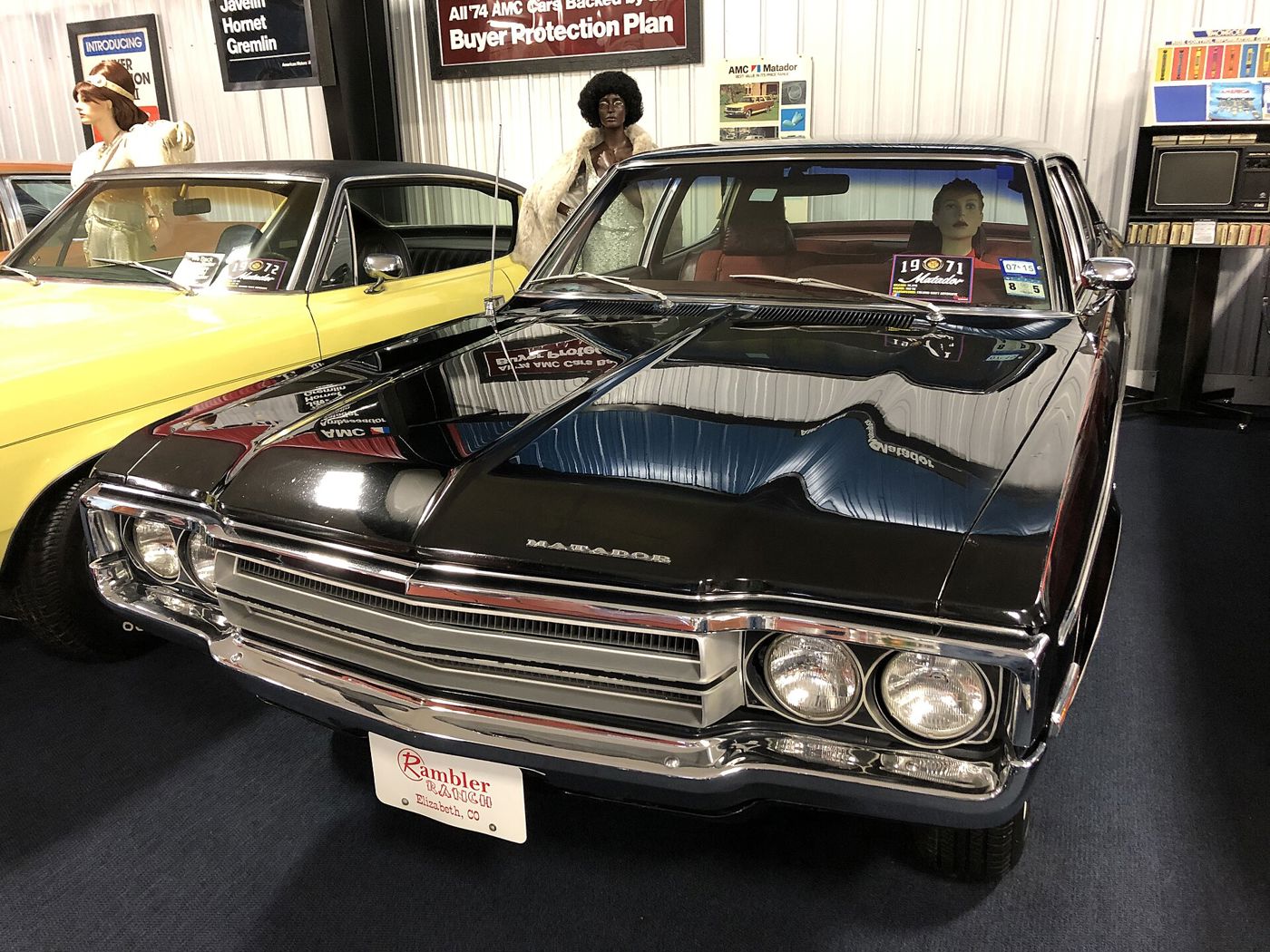

When AMC renamed the Rebel line to Matador for 1971, the Machine did not carry over as its own model; it survived only as the "Machine Go" (also called "Go-Machine") option package on the Matador hardtop, priced at $373 with the 360 V-8 or $461 with the 401. The package bundled a four-barrel carburetor, dual exhaust, a handling package of heavy-duty springs and shocks with a rear anti-sway bar, power disc brakes, E60x15 Polyglas raised-white-letter tires on 15x7 styled-steel "Machine" wheels, and a space-saver spare, but skipped the graphics that had defined the 1970 Rebel Machine: no hood scoop and no stripe kit. Planet Houston AMX states there were no printed advertisements for the package at all.1,2
Production figures for the Machine Go package vary from source to source. Planet Houston AMX cites "some literature" for a figure of 68 and mentions 50 and 43 elsewhere in the same source; JavelinAMX.com instead says fewer than 50 were built, with fewer than half of those specified as four-speed cars. Writing for StreetMuscle in 2011, Robert Kibbe put the total at 50 to 70, the majority with the larger 401; Rob Finkelman's 2023 StreetMuscle article gives best estimates of 40 to 68. Hooniverse in 2010 relayed former AMC Kenosha worker Bill Deringer's recollection of 55 or 57. AMC's own tally sheet for the 7119-7 Matador hardtop series shows exactly 43 cars built with the 401 V-8, the same as one of Planet Houston AMX's figures; that row counts every 401 Matador two-door with or without the package, and Machines built with the 360 fall outside it. Planet Houston AMX and JavelinAMX.com both describe a single well-known surviving car.1,2,3,4,5,6
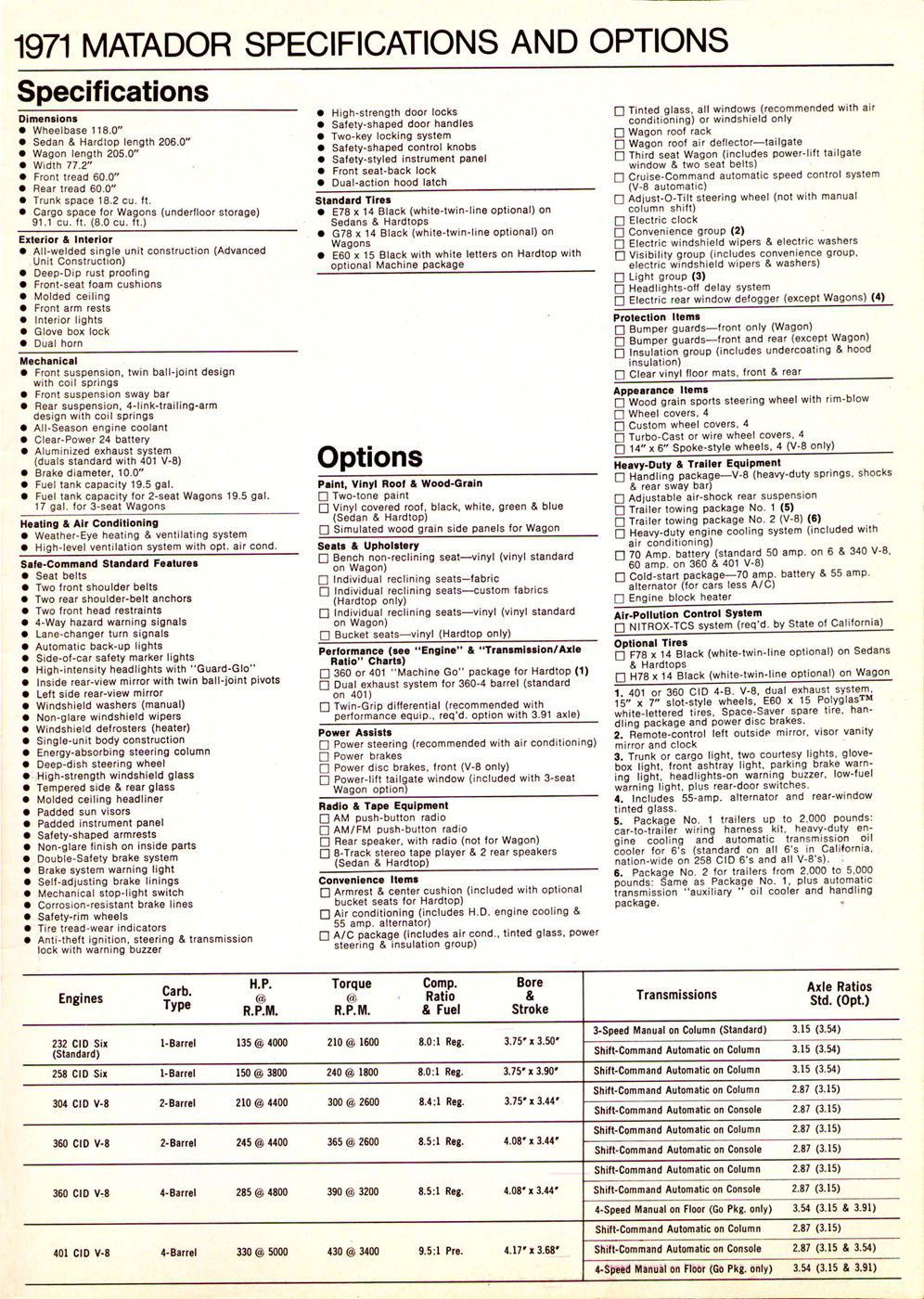
The package's two engines carry period-advertised gross ratings of 285 hp at 4,800 rpm and 390 lb-ft at 3,200 rpm for the 360, and 330 hp at 5,000 rpm and 430 lb-ft at 3,400 rpm for the 401, both of them fed by a four-barrel carburetor, with compression and displacement as given in AMC's 1971 full-line specifications. A four-speed manual with a 3.54 axle standard (3.15 or 3.91 optional) was available on the Machine Go package specifically, alongside a column- or console-shift Shift-Command automatic that used a 2.87 axle as standard behind either engine, with 3.15 optional on both and 3.54 additionally optional on the 401 console-shift automatic.2
Beyond the Machine Go hardware itself, the 1971 Matador options list offered air conditioning, tinted glass, Cruise-Command with a V-8 automatic, an Adjust-O-Tilt steering column, convenience/visibility/light equipment groups, and a rear window defogger, along with a wood-grain rim-blow sports steering wheel and a choice of wheel-cover styles or 14x6 spoke wheels for V-8 cars. AMC counted the car within its general 7119-7 Matador hardtop production series. That series came to 7,661 hardtops built in total that year across every engine offered: 482 with the 232 six, 1,158 with the 258 six, 4,414 with the 304 V-8, 1,564 with the 360, and the 43 401s already noted, a measure of how small a slice the Machine Go package, in either V-8, represented of the full hardtop run.1,3
Fact sheet · 1971 · United States
The numbers
1971 AMC Matador Machine: The Rebel Machine's unadvertised successor: a 'Machine Go' package for the Matador hardtop, with reported counts from 43 to 68.
Figures may describe different groups of cars. Add rows together only when the note says they make up a total.
Key facts
Production
| What was counted | Built |
|---|---|
| Matador Machine (figure from unnamed literature)1 Matador 'Machine Go' · 2-door hardtop · 360 or 401 V8 · US | 68 |
| Matador Machine (upper bound)2 Matador 'Machine Go' · 2-door hardtop · 360 or 401 V8 · US The value is an upper bound, not a count. | 50 |
| What was counted | Built |
|---|---|
| 1971 Matador two-doors with the 401 (not Machine-specific)1 Matador · 2-door hardtop · 401 V8 · US Scope is every 401 Matador two-door. It is not a Machine count, and 360 Machines are excluded. | 43 |
| Matador hardtop (7119-7) with the 401 V8 (AMC tally sheet; not Machine-specific)3 Matador · 2-door hardtop · 401 V8 · US, Canada and export market; built at Kenosha Machine Go cars could also have the 360. | 43 |
| Matador sedan (7118-7) with the 401 V8 (context)3 Matador · 4-door sedan · 401 V8 · US, Canada and export market; built at Kenosha Sedans; not Machine cars. | 32 |
Prices when new
| Model | Price | Price type |
|---|---|---|
| Machine Go package with 360 V81 | $373 | option package price, 1971 |
| Machine Go package with 401 V81 | $461 | option package price, 1971 |
Prices are the nominal dollars of the day, not adjusted for inflation.
Engines
| Engine | Factory rating | Availability |
|---|---|---|
| 360 V8 4-bbl2 360 cu in · 4-barrel | 285 hp @ 4,800, 390 lb-ft @ 3,200 (period factory advertised (gross), as reported) | with package |
| 401 V8 4-bbl2 401 cu in · 4-barrel | 330 hp @ 5,000, 430 lb-ft @ 3,400 (period factory advertised (gross), as reported) | with package |
Ratings are published figures, not dyno results. Gross and net ratings aren't directly comparable.
Transmissions
| Transmission | Availability |
|---|---|
| Four-speed manual (fewer than half of Machines)2 | optional |
| Automatic2 | optional |
| Four-speed manual on floor (Go package only; axle 3.54, optional 3.15 and 3.91) | Machine Go package only |
| Shift-Command automatic, column or console (360 4-bbl: 2.87 (3.15); 401: column 2.87 (3.15), console 2.87 (3.15 and 3.54)) | optional |
Options and packages
| Option | Price |
|---|---|
| Machine Go: four-barrel carburetor, dual exhaust, handling package (heavy-duty springs and shocks, rear anti-sway bar), power disc brakes, E60x15 Polyglas raised-white-letter tires, 15x7 styled steel 'Machine' wheels, space-saver spare1,2 | $373 |
| 'Machine' Go package for Hardtop (footnote 1): 401 or 360 CID 4-bbl V-8, dual exhaust system, 15 x 7 slot-style wheels, E60 x 15 Polyglas white-lettered tires, space-saver spare, handling package and power disc brakes | |
| Handling package, V-8 (heavy-duty springs, shocks and rear sway bar); adjustable air-shock rear suspension | |
| Air conditioning; A/C package; tinted glass; Cruise-Command (V-8 automatic); Adjust-O-Tilt; convenience, visibility and light groups; rear window defogger | |
| Wood-grain sports steering wheel with rim-blow; wheel covers; custom, Turbo-Cast or wire wheel covers; 14 x 6 spoke-style wheels (V-8) |
Identification
- Series
- Planet Houston AMX refers to AMC's 1971 production totals for the 7119-7 series (Matador two-door hardtop). No Machine-specific VIN or door-tag code is described.1
Where the sources disagree
Same model year
Also in 1971
- AMC AMX The AMX name moves onto the redesigned Javelin as its top model. It is a derivative badge, not a continuation of the two-seater. 2,054 were built, all with the 360 or 401.
- AMC Hornet SC/360 AMC's one-year compact muscle car pitched as an insurance-friendly alternative. AMC reportedly planned 10,000, but 784 were built.
- AMC Javelin A new, flared-fender Javelin, with the AMX name as its top model. Javelin won AMC the 1971 Trans-Am manufacturers' championship.
- Buick Riviera The boattail Riviera: 455 rated 315 gross / 255 net, GS 330 / 265; 3,175 of 33,810 were GS.
- Buick Skylark Gran Sport, GS and GSX Buick’s revised factory form lists gross and net ratings for the GS engines; the early Stage 1 test used a pre-production car, and GSX appearance did not identify an engine.
- Chevrolet Chevelle and Malibu SS A single RPO Z15 SS package now spanned small- and big-block V8s; 9,502 of 19,293 SS cars carried the LS5 454, and Chevrolet began printing net ratings beside gross.
- Chevrolet Chevy II and Nova SS limited to the L48 350 per the source; Rally Nova (RPO YF1) offered. Enthusiast-compiled production: 194,878 cars; Super Sport 7,015.
- Chevrolet El Camino SS A single RPO Z15 SS package on the Malibu/Custom El Camino, up to the 425 hp LS6; 19,293 SS cars across Malibu models.
- Chevrolet Monte Carlo SS The last SS 454 year: RPO Z20 on 1,919 of 128,600 Monte Carlos.
- Dodge Challenger Challenger's second year lost the SE, the R/T convertible, and the T/A; a new pillared coupe joined the hardtop and convertible, and production fell to roughly a third of 1970's.
- Dodge Charger A new, shorter third-generation body absorbed the Coronet two-doors and the Super Bee; it was the last year for the R/T and for a factory Hemi Charger.
- Dodge Coronet R/T and Super Bee The end of the line for Coronet performance: the two-door Coronets were replaced by the Charger, taking the Super Bee with them.
- Dodge Dart GTS, Swinger and Demon Dodge's version of the Duster fastback arrived as the Demon, and the Demon 340 became the performance Dart: 10,098 built, plus 85 Canadian Swinger 340 Specials.
- Ford Maverick Grabber The Grabber became its own model with a dual-scoop hood, and the 210 hp 302 V8 arrived; Classic Industries counts 38,963 Grabbers.
- Ford Ranchero GT The second Torino-based Ranchero year; reference counts give 3,632 GTs, while Barn Finds rounds the GT figure to about 3,900 of 24,946 Rancheros.
- Ford Thunderbird The last fifth-generation year kept the 360-hp 429 as standard; production fell to 36,055.
- Ford Torino A carryover year for the 1970 body; the Torino Cobra now came standard with a 351 four-barrel and offered the 429 Cobra Jet-R, but only 3,054 Cobras were built.
- Mercury Comet and Cyclone The final Cyclone year: production fell to a few thousand across Cyclone, Cyclone GT and Cyclone Spoiler.
- Mercury Cougar A larger second-generation Cougar, new body codes, and the one-year 429 Cobra Jet option, fitted to 448 cars.
- Oldsmobile Cutlass, 4-4-2 and Hurst/Olds Compression fell to 8.5:1 for regular fuel, the W-31 was dropped, the sports coupe was gone, and 4-4-2 production fell to 7,589.
- Plymouth Barracuda and 'Cuda Four headlamps and a new grille marked the second E-body year; the Hemi and 440 Six Barrel stayed on the 'Cuda order form, but Barracuda-line production fell to about a third of 1970's.
- Plymouth Duster 340 and 360 The Duster 340's second year brought a new grille, a Thermo-Quad 340 rated 275 gross and 235 net hp, and a $2,703 list price, while output fell to about 12,900.
- Plymouth GTX, Belvedere and Satellite On the redesigned 1971 Satellite body the GTX fell to 2,942 cars, only 30 of them with the Hemi.
- Plymouth Road Runner Redesigned on the new Satellite body as a hardtop only, the Road Runner fell to 14,218 cars, and a 340 joined the 383, 440, and Hemi.
- Pontiac Firebird and Trans Am The 455 HO year: the Trans Am's biggest engine, 2,116 cars, and a Formula line split across three V-8s.
- Pontiac GTO Lower compression, dual gross and net ratings, the 455 HO as the top engine, and production down to 10,532.
- Pontiac Grand Prix Boat-tail styling, lower compression, and the manual transmission gone by March: 116 of 58,325 had one.
- Pontiac Tempest and LeMans The Tempest name gives way to T-37; the GT-37 option carries on and the 455 HO is available in two-door LeMans models.