1969 · Mercury · United States
1969 Mercury Cyclone: Electric Orange, Two Drivers and a Nose for Daytona
The Cyclone fastback came as Cyclone and Cyclone CJ, mid-year Spoilers carried Dan Gurney and Cale Yarborough graphics, and the extended-nose Cyclone Spoiler II was built at Lorain for NASCAR homologation.
United States · researched through 2026-09-22
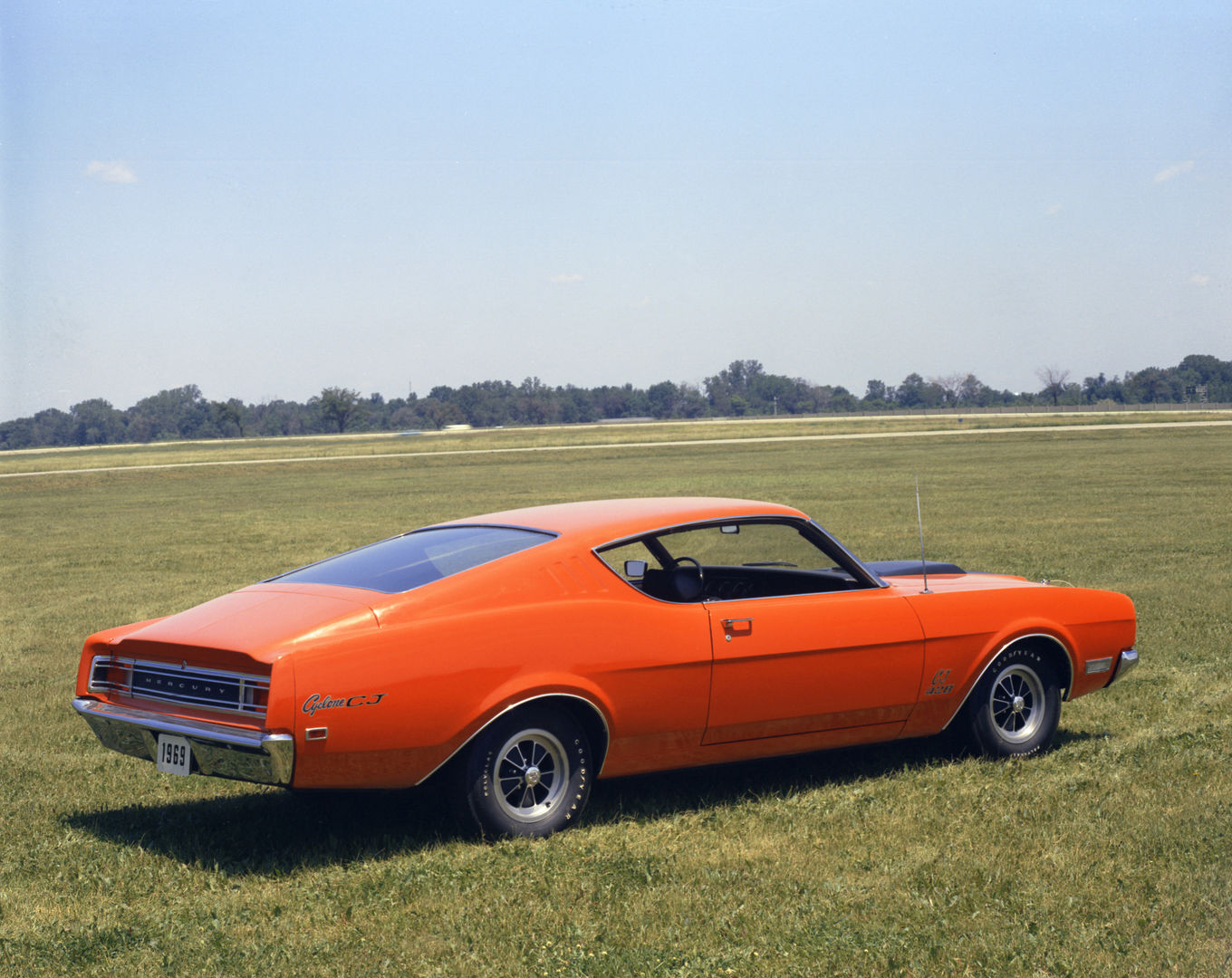
When Cars magazine asked Lincoln-Mercury for a jazzy Cyclone CJ road-test car in 1969, it got one painted Calypso Coral, a colour the staff promptly renamed Electric Orange. The June 1969 report called the car one of the most 'in' machines on the supercar scene and one of the least desirable to own for a driver who wanted to stay out of trouble, because it looked as if it was breaking the speed limit while idling. 'Driving around suburban New York in this job was like setting up street eliminations at each traffic light,' the magazine wrote, and after a while the testers accepted the ritual.1
Under the paint it was a big car. Cars listed a 116-inch wheelbase and a ready-to-go weight of 3,900 pounds, yet reported quarter-mile times of 13.90 to 14.20 seconds at 100 to 102 mph with 3.91 gears, closed stock exhausts and stock tires, through a Select Shift automatic. The magazine credited the 428 Cobra Jet with Super Stock record potential while idling as tamely as an ordinary engine, and judged the Cyclone more a cruising GT than a street racer. A caption priced the functional hood-scoop option at $140 over the basic 428 package. Those times belong to that one tested car.1
The Cars staff described the Cobra Jet's manners as carefully as its times. At normal throttle, they explained, the 735-cfm Holley drew warmed air, and when the driver floored the pedal a flap in the air cleaner opened to pull cool outside air through the functional hood scoop, finished in matte black with CJ lettering. They also found real faults: a basic understeer that demanded commitment in the esses, and power steering that tended to stay in the turn unless the driver guided it back. On the open road the verdict turned kinder, with a comfortable bucket-seat driving position, luggage room to spare and, with the 3.91 gears and Select Shift, a ride-and-handling compromise they judged solid.1
The Cyclone line itself was simple. Over-Drive Magazine's compiled table lists the Cyclone fastback, body 63A with a bench seat or 63C with buckets, at a $2,754 factory price, and the Cyclone CJ, body 63H, at $3,207, with the 428 Cobra Jet standard and Ram Air optional. It counts 5,882 Cyclones and 3,261 CJs, the same figures Wikipedia's Cyclone table gives citing Holder and Kunz. In that table the CJ is about 36 percent of the 9,143 Cyclone fastbacks and about 2.8 percent of Mercury's 115,944 mid-size cars, and Over-Drive's factoids add that only 1.8 percent of 1969 mid-size Mercurys had a four-speed.2,3,4
Mercury's performance fastback was a close relative of Ford's Cobra, and the magazines said so. Motor Trend's January 1969 supercar comparison noted that the Cobra carried the same powerplant and body as the Mercury Cyclone. Car Life, testing a Cobra that same month, compared it with a Cyclone it had tested the previous year: the Mercury, about 100 pounds lighter and fitted with the optional handling package, had leaned less, and Holman and Moody had made sure it was running right. The Cyclone was a Mercury in trim, badges and price, and a Ford in almost everything that made it go.5,6
The more consequential twin raced on the superspeedways. The NASCAR Hall of Fame's history of the aero wars records Dodge announcing the flush-grilled Charger 500 in the fall of 1968 and Ford answering with long-nose versions of its race cars, the Torino Talladega and the Mercury Cyclone Spoiler. Wikipedia's Spoiler II article says the Mercury's new nose added about six inches, that the race cars first used the 427 side-oiler and later the Boss 429 once that engine was homologated, and that NASCAR required at least 500 cars to be built and offered for sale in 1969 before a body could race.7,8
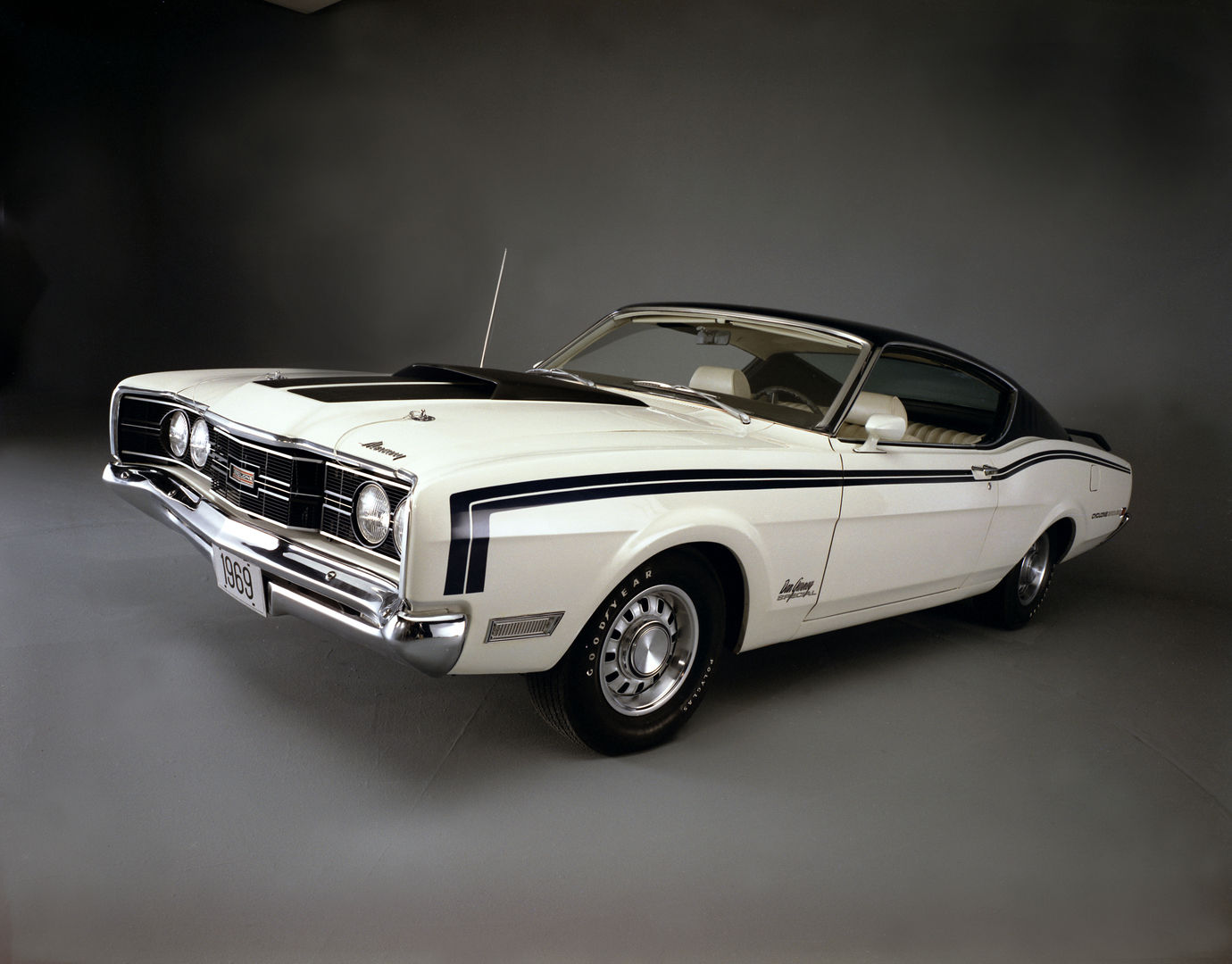
Mercury sold its racing identity through two drivers. The Talladega and Spoiler Registry records 969 Cyclone Spoilers, 352 Dan Gurney Specials and 617 Cale Yarborough Specials, all built at Lorain on body code 63A or 63C, with the 390 four-barrel or the 428 Cobra Jet with or without Ram Air, and painted in two combinations: code MX, white with Presidential Blue, for Gurney cars and code MT, white with red, for Yarborough cars. Over-Drive describes the Spoiler's S-code 390 as a 325-horsepower engine with a 735-cfm Holley, against the 320 horsepower in its own engine table, and does not reconcile the two.9,10,3
The Spoiler II was the homologation car, and it came in one specification. The registry records 503 built at Lorain, 218 Gurney and 285 Yarborough cars, all on body code 63A with the 351 Windsor four-barrel, an FMX automatic and a 3.25 axle, and notes one heater-delete car of each edition; Gurney cars used blue vinyl bench trim and Yarborough cars red. Over-Drive also says approximately 503. Wikipedia agrees on 503 and 285 but gives 215 Gurney cars, which does not add up to its own total, and a 519 figure repeated on secondary sites has no stated record behind it. The racing nose went to the public on a 351 automatic, not the Cobra Jet.10,3,8
Yarborough gave the name its results. The NASCAR Hall of Fame's account of his Wood Brothers years puts him in the No. 21 Mercury, with 1969 victories at Atlanta and at Michigan International Speedway, and the Hall's 1969 season history notes that the Michigan win, on June 15, was the track's inaugural race. Over-Drive counts four Mercury Grand National wins in 1969, and Wikipedia credits the Spoiler II with eight across 1969 and 1970, matching the Plymouth Superbird's total. The Hall's aero-wars history counts 26 wins for Ford in 1969 against Dodge's 22 without separating Mercury, and David Pearson took the title in a Holman-Moody Ford.11,12,3,8,7
The Mercury aero program ended with Ford's. The Talladega and Spoiler Registry reports that two 1970 Spoiler II prototypes with a sloping, grille-less nose were built and that one survives, and it attributes the project's end to Ford's withdrawal from racing and to NASCAR raising the homologation minimum from 500 cars to 3,000. For 1971, the Hall of Fame says, NASCAR rewrote its rulebook to legislate the aero cars out of existence. That leaves 1969 as the only year the long-nose Cyclone was a showroom Mercury, sold in two drivers' colours to 1,472 buyers by the registry's combined Spoiler and Spoiler II counts.13,7,9,10
Fact sheet · 1969 · United States
The numbers
1969 Mercury Cyclone — The Cyclone fastback came as Cyclone and Cyclone CJ, mid-year Spoilers carried Dan Gurney and Cale Yarborough graphics, and the extended-nose Cyclone Spoiler II was built at Lorain for NASCAR homologation.
Coverage: Partial — researched sections are shown; missing ones are not yet sourced. Researched through 2026-09-22.
Every figure is labeled with how sure we are. Reported means a manufacturer, registry, or reference figure we cite but have not reconciled against factory records ourselves. Disputed means credible sources disagree and both are shown. Rows are separately scoped; don't add them together unless the note says they make up a total.
Key facts
- Cyclone Spoiler II: 503 built (218 Dan Gurney, 285 Cale Yarborough) per the registry; Wikipedia relays 503 but gives 215 Gurney cars.10,8
- Cyclone Spoiler: 969 built (352 Dan Gurney, 617 Cale Yarborough) per the registry.9
- Only 1.8 percent of 1969 mid-size Mercurys had a four-speed manual, and 26.9 percent had vinyl roofs, as compiled.3
Production
| What was counted | Count | Basis | Status |
|---|---|---|---|
| All 1969 Cyclones (conceptcarz total)14 all Cyclone · as published A Cyclone-line total stated by the page (equals 5,882 + 3,261); same lineage as the rows below, not an independent count. The Spoiler and Spoiler II counts are a separate registry lineage and are not part of this total. | 9,143 | built, model-year | Reported |
| What was counted | Count | Basis | Status |
|---|---|---|---|
| Cyclone fastback, all engines3,4 Cyclone · 2-door fastback · as published Two citations, possibly one lineage. Whether Spoilers are inside this figure is not stated. | 5,882 | built, model-year | Reported |
| Cyclone CJ (428 Cobra Jet) fastback3,4 Cyclone CJ · 2-door fastback · 428 Cobra Jet · as published | 3,261 | built, model-year | Reported |
| What was counted | Count | Basis | Status |
|---|---|---|---|
| Cyclone Spoiler (Dan Gurney and Cale Yarborough Specials)9 Cyclone Spoiler · 2-door fastback (63A or 63C) · 390 4V, 428 CJ or 428 CJ Ram Air · Lorain assembly | 969 | built, model-year | Reported |
| Cyclone Spoiler, Dan Gurney Special9 Cyclone Spoiler Dan Gurney · 2-door fastback · Lorain With the Yarborough row, partitions the 969 total per the same source. | 352 | built, model-year | Reported |
| Cyclone Spoiler, Cale Yarborough Special9 Cyclone Spoiler Cale Yarborough · 2-door fastback · Lorain | 617 | built, model-year | Reported |
| Cyclone Spoiler II10,3 Cyclone Spoiler II · 2-door (body 63A) · 351 4V Windsor · FMX automatic · Lorain assembly A 519 figure circulates on secondary sites; see unpublished leads. | 503 | built, model-year | Reported |
| Cyclone Spoiler II, Dan Gurney10 Spoiler II Dan Gurney · 63A · 351 4V · FMX · Lorain Wikipedia gives 215; see conflicts. | 218 | built, model-year | Disputed |
| Cyclone Spoiler II, Cale Yarborough10 Spoiler II Cale Yarborough · 63A · 351 4V · FMX · Lorain | 285 | built, model-year | Reported |
Rows are separately scoped; do not add them. The conceptcarz total row states the Cyclone-line total, which equals the sum of the series rows (same lineage).
The Gurney and Yarborough rows partition their totals according to the registry (352 + 617 = 969; 218 + 285 = 503).
No Spoiler count by engine (390, 428 CJ, 428 CJ Ram Air) was found.
Searched 2026-09-29: conceptcarz spec pages (re-read), Over-Drive Magazine tables and Wikipedia already cited; OpenLibrary search-inside of Heasley's Production Figure Book returned nothing for Mercury mid-size totals.
Prices when new
| Model | Price | Basis |
|---|---|---|
| Cyclone 2-door fastback (63A bench / 63C bucket)2 | $2,754 | factory price as tabulated by Over-Drive Magazine (Standard Catalog-style table; basis not stated), 1969 model year |
| Cyclone CJ 2-door fastback (63H)2 | $3,207 | factory price as tabulated by Over-Drive Magazine (Standard Catalog-style table; basis not stated), 1969 model year |
Prices are the nominal dollars of the day, not adjusted for inflation.
Engines
| Engine | Factory rating | Availability | Built |
|---|---|---|---|
| 302 V8 2-bbl3 302 cu in · 2-barrel | 220 hp @ 4,600, 300 lb-ft @ 2,600 (SAE gross) | optional | Not yet sourced |
| 351 V8 4-bbl3,10 351 cu in · 4-barrel | 290 hp @ 4,800, 385 lb-ft @ 3,200 (SAE gross) | optional; the only engine in production Spoiler IIs | Not yet sourced |
| S · 390 V8 4-bbl3,9 390 cu in · 4-barrel | 320 hp @ 4,600, 427 lb-ft @ 3,200 (SAE gross) | optional; permitted in the Spoiler | Not yet sourced |
| Q · 428 Cobra Jet 4-bbl3,9 428 cu in · 4-barrel | 335 hp @ 5,400, 440 lb-ft @ 3,400 (SAE gross) | Cyclone CJ; permitted in the Spoiler | Not yet sourced |
Ratings are the manufacturer's advertised figures under the standard shown (SAE gross before 1972, SAE net after). They are not dyno results, and gross and net ratings can't be compared directly.
Transmissions
| Transmission | Availability | Built |
|---|---|---|
| 4-speed manual3 | optional; 390/428 ratios 2.32, 1.69, 1.29, 1.00 or 2.78, 1.93, 1.36, 1.00 | Not yet sourced |
| FMX Cruise-O-Matic 3-speed automatic10 | optional; the only transmission in Spoiler IIs | Not yet sourced |
Options and packages
| Code | Option | Price | Installed |
|---|---|---|---|
|
Sports appearance group (CJ)3 | $149 | Not yet sourced |
|
Styled steel wheels (CJ)3 | $95.90 | Not yet sourced |
|
Tachometer3 | $48 | Not yet sourced |
|
Hood lock pins3 | $7.80 | Not yet sourced |
|
Racing mirror (Cyclone/CJ)3 | $13 | Not yet sourced |
|
Rim-blow steering wheel3 | $35 | Not yet sourced |
|
Sports console3 | $155.70 | Not yet sourced |
|
Power disc brakes3 | $64.80 | Not yet sourced |
|
AM/FM stereo radio3 | $185.30 | Not yet sourced |
|
Vinyl roof3 | $99.80 | Not yet sourced |
|
Bucket seats without console for Montego MX, Cyclone hardtops and MX convertible3 | $110.10 | Not yet sourced |
|
Comfort weave vinyl interior for Montego MX except station wagons and Cyclone3 | $24.70 | Not yet sourced |
|
Cross-country ride package3 | $13 | Not yet sourced |
|
Competition handling package3 | $31.10 | Not yet sourced |
|
Curb moldings3 | $15.60 | Not yet sourced |
|
Decor group, includes: bright wheel lip moldings; trunk lid applique and bright upper door frames in sedans; Deluxe wheel covers on hardtops and Montego sedan ($54.50); on Montego models with special appearance group ($42.80); on Montego without special appearance group ($60.90)3 | $54.50 | Not yet sourced |
|
Deluxe front shoulder seat belts, except for convertibles; includes a seat belt reminder light3 | $15.60 | Not yet sourced |
|
Deluxe seat belts for convertibles, includes a seat belt reminder light3 | $13 | Not yet sourced |
|
Deluxe wheel covers with spinners, over hubs ($41.50); On CJ ($20.80)3 | $41.50 | Not yet sourced |
|
Dual paint tape stripes for Cyclone and Cyclone CJ3 | $31.10 | Not yet sourced |
|
Electric clock3 | $15.60 | Not yet sourced |
|
Four-Way power bench seat3 | $73.90 | Not yet sourced |
|
Front head restraints3 | $17 | Not yet sourced |
|
Heavy-duty battery3 | $7.80 | Not yet sourced |
|
Interval windshield wipers3 | $16.90 | Not yet sourced |
|
Mirror, left-hand remote-control3 | $10.40 | Not yet sourced |
|
Mirror, left-hand remote-control racing mirror on Cyclone and Cyclone CJ3 | $13 | Not yet sourced |
|
Mirror, right-hand manual racing3 | $6.50 | Not yet sourced |
|
Power steering3 | $94.60 | Not yet sourced |
|
Power windows, except on Comet and Montego,3 | $104.90 | Not yet sourced |
|
Radio, AM3 | $60.90 | Not yet sourced |
|
Radio, AM/FM stereo with twin speakers3 | $185.30 | Not yet sourced |
|
Special appearance group; includes Deluxe wheel covers; whitewall tires; courtesy light group and Comfort Stream ventilation, except Cyclone CJ3 | $64.80 | Not yet sourced |
|
Special handling package3 | — | Not yet sourced |
|
Tinted glass3 | $35 | Not yet sourced |
|
Traction-lok rear axle3 | — | Not yet sourced |
|
Two-tone paint3 | $31.10 | Not yet sourced |
Paint
| Code | Color | Built |
|---|---|---|
A |
Black (M1247)3 | Not yet sourced |
B |
Maroon (M3059)3 | Not yet sourced |
C |
Dark Ivy Green (M3197)3 | Not yet sourced |
E |
Light Aqua (M3191)3 | Not yet sourced |
F |
Dark Aqua (M3065)3 | Not yet sourced |
I |
Medium Lime (M2041)3 | Not yet sourced |
M |
White (M1619)3,10 | Not yet sourced |
Q |
Medium Blue (M1624)3 | Not yet sourced |
S |
Medium Gold (M3199)3 | Not yet sourced |
T |
Red (M2008)3,10 | Not yet sourced |
W |
Yellow (M3120)3 | Not yet sourced |
X |
Presidential Blue10 | Not yet sourced |
Y |
Burnt Orange (M3202)3 | Not yet sourced |
2 |
Light Ivy (M3071)3 | Not yet sourced |
3 |
Competition Orange (M1730)3 | Not yet sourced |
8 |
Light Blue (M3190)3 | Not yet sourced |
9 |
Yellow (M3217)3 | Not yet sourced |
Color names are the factory's. We don't show color swatches, because a screen color is no guide for a restoration.
Interiors
| Code | Trim | Built |
|---|---|---|
4B |
Blue vinyl, bench seat (Spoiler II Dan Gurney)10 | Not yet sourced |
4D |
Red vinyl, bench seat (Spoiler II Cale Yarborough)10 | Not yet sourced |
Specifications
| Measure | Value | Applies to |
|---|---|---|
| Wheelbase3 | 116 in | all except wagons (113.0) |
| Overall length, Cyclone fastback3 | 203.2 in | Cyclone fastback |
| Overall height, fastback3 | 52.6 in | fastback |
| Tires, GT and CJ3 | F70-14 size | GT and CJ; FR70-14 optional |
| Rear axle ratio, 428 CJ3 | 3.25 ratio | non-Ram Air; Ram Air 3.50 |
| Shipping weight, Cyclone / Cyclone CJ2 | 3,273 / 3,615 lb | Over-Drive table |
Identification
- Spoiler II data plate
- Body code 63A on all cars; VIN example 9H15M565427. First and last serials are not known to the registry. On the companion Spoiler page the registry decodes 9 as 1969, H as Lorain and 15 as the Cyclone 2-door fastback series.10
- Spoiler data plate
- Body code 63A or 63C; engine codes S, Q or R; paint MX (Gurney) or MT (Yarborough); trim codes 4A, 4B, 4D, 4W, 8A, 8B, 8D or 8W.9
Where the sources disagree
Identification
Read a 1969 Mercury VIN
The VIN decoder runs in your browser and never sends the VIN anywhere. How the factory numbered this year's cars:
Same model year
Also in 1969
- AMC AMX The two-seat AMX's biggest year: 8,293 cars by the enthusiast production table, with a mid-year run of Big Bad colors and 52 Hurst-built Super Stock AMXs for NHRA drag racing.
- AMC Javelin Production fell to 40,675, but the 1969 Javelin added the Big Bad colors, with 2,282 cars painted blue, green or orange, plus the Mod package.
- AMC Rebel and Rebel Machine A base and SST Rebel with no convertible. The Big Bad colors were test-marketed through the New York–New Jersey 'Raider' hardtop. This is host-car context for the 1970 Machine.
- Buick Riviera Another record at 52,872 Rivieras; 5,272 had the GS handling option.
- Buick Skylark Gran Sport, GS and GSX GS production fell to 12,465, and the GS 400's Stage 1 package became a factory option while Stage 2 stayed a dealer item.
- Buick Wildcat 67,453 Wildcats; the last year of the 430.
- Chevrolet Chevelle and Malibu SS Super Sport became RPO Z25 option equipment, available for 1969 only on the 300 Deluxe coupes as well as Malibu sport coupe, convertible and El Camino.
- Chevrolet Chevy II and Nova SS is RPO Z26 per the source, with L48, L34 and L78 engines. Enthusiast-compiled production: 251,849 cars; Super Sport 17,564.
- Chevrolet El Camino SS SS 396 became RPO Z25 option equipment, orderable on the V8 Malibu El Camino (13680); the El Camino share of the 86,307 Z25s is not separately published.
- Chevrolet Impala SS Only the SS427 (RPO Z24) remains; the reported count ranges from 2,425 to about 2,455.
- Dodge Charger The second-generation Charger's peak-sales year added the SE package and the aero-bodied Charger 500 and Charger Daytona homologation cars, whose production totals are still disputed.
- Dodge Coronet R/T and Super Bee The Super Bee added a hardtop body and the 440 Six Pack, while the 440-powered Coronet R/T continued as the upscale hardtop and convertible.
- Dodge Dart GTS, Swinger and Demon The low-priced Swinger 340 arrived and outsold the GTS by more than two to one (16,637 against about 6,700), while a 375 hp 440 joined the GTS options.
- Ford Fairlane The Fairlane hardtop was the intermediate line's volume leader, while the Fairlane 500 SportsRoof shared its body with the Torino GT, Cobra and Talladega.
- Ford Ranchero GT The Ranchero GT carried Torino GT trim; 1,658 GTs were built, per reference-site counts in the Standard Catalog lineage.
- Ford Thunderbird Fifth-generation Thunderbird; only the whole-line production total was found.
- Ford Torino The Torino GT carried most of the line's volume, the 428 Cobra Jet was in its first full year, and the Talladega aero fastback was built in a short run at Atlanta to homologate a NASCAR nose.
- Mercury Cougar A longer, restyled Cougar added a convertible, the Boss 302 arrived in April, and the Eliminator replaced the GT as the performance Cougar.
- Mercury Marauder and S-55 The Marauder name returned on a full-size hardtop, and the X-100 carried the 360 hp 429 four-barrel as its only engine.
- Oldsmobile Cutlass, 4-4-2 and Hurst/Olds The 4-4-2 kept its 400 while the second Hurst/Olds, in white and gold with a 380 hp 455, went into production at about 900 cars.
- Plymouth Barracuda and 'Cuda The last A-body Barracuda introduced the 'Cuda name as a stripped performance package with a standard 340, alongside Formula S and a midyear 440.
- Plymouth GTX, Belvedere and Satellite The GTX shared the Road Runner's new Air Grabber scoop and Super Track Pack but sold 15,602 cars, fewer than a fifth of the cheaper Road Runner.
- Plymouth Road Runner A convertible joined the coupe and hardtop, the 440 Six Barrel arrived at mid-year, and the Road Runner reached its production peak of 84,420.
- Pontiac Firebird and Trans Am The last first-generation Firebird, and the mid-year debut of the Trans Am package: 697 cars by the commonly published count, eight of them convertibles.
- Pontiac GTO Three four-barrel 400s under one nameplate, and the first year of the Judge package built around Ram Air power.
- Pontiac Grand Prix A new 118-inch Grand Prix with the SJ and a 390 hp 428 HO: production more than tripled to 112,486.
- Pontiac Tempest and LeMans The last year of the OHC Sprint six and the 350 HO.
- Rambler American and SC/Rambler AMC and Hurst put the 315-hp 390 V8 and a close-ratio four-speed into the compact Rambler hardtop for NHRA F/Stock. 1,512 were built, and the split between the two paint schemes is disputed.