1969 · Dodge · United States
1969 Dodge Dart Swinger 340: The Budget Bomb That Outsold the GTS
The low-priced Swinger 340 arrived and outsold the GTS by more than two to one (16,637 against about 6,700), while a 375 hp 440 joined the GTS options.
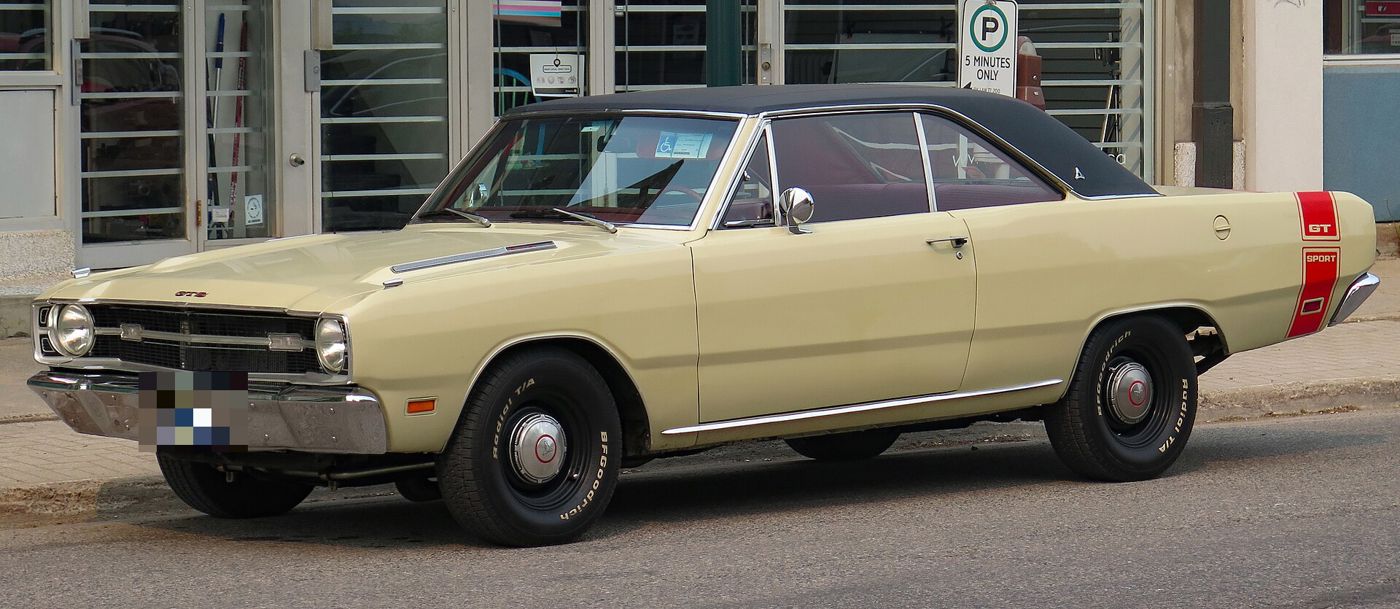

Car Life opened its January 1969 road test with a line about relatives: "Family feuds are the fiercest kind." The feud was inside Chrysler. Dodge and Plymouth sat in different places on the corporate chart, the magazine explained, but in the showroom they fought each other. The Road Runner's feathers were barely dry when the Super Bee arrived; the Formula S Barracuda competed with the Dart GTS; and for 1969 Plymouth had the 'Cuda 340, a pocket Road Runner. Dodge, Car Life said, had countered with the Swinger. When divisions of one corporation compete, the writers added, the buyer is the winner. The Swinger 340 was built to prove it.1
Car Life called the Swinger a "budget-semi-Supercar": a compact with a factory-tweaked mid-range engine and a stiffened suspension, without the accessories that usually ran the price up. It did not come in a plain wrapper. Appearance-only hood vents, stripes around the rear deck and low-restriction dual exhausts let it be identified from blocks away. It was the high-performance version of the base Swinger two-door hardtop, itself the replacement for the base Dart two-door, with a rally suspension, power-bulge hood, bumblebee stripe and wide-oval tires. The interior stayed spartan: a bench seat and a rubber floor mat instead of carpet.1,2
The engine was the whole argument. The 340 four-barrel, with a 4.04-inch bore, 3.31-inch stroke and 10.5:1 compression, was rated at 275 horsepower at 5,000 rpm and 340 lb-ft at 3,200, a rating whose basis Dodge did not state. The magazine was more interested in how it felt. "The 340 is more than responsive, it's eager," Car Life wrote, adding that it had been designed as a performance engine from the start rather than an economy engine with a hot cam bolted on. The 383 was not offered in the Swinger, and the magazine thought that was just as well.1,2

The price was the other half. The list price was $2,857 FOB factory, and Car Life's test car came to $3,470 with front disc brakes at $50.15, power brakes at $42.95, an automatic transmission at $29.35, a radio group that included power steering at $196.85, a vinyl roof at $77.25 and Polyglas tires at $31.60. The sources disagree about the gearbox. Car Life describes a four-speed as standard Swinger equipment, while Over-Drive's option list prices a four-speed at $188 with the 340. Neither source addresses the other, and without a Dodge order guide there is no way to say which is right.1,2
Car Life's test Swinger ran with the TorqueFlite, a 3.23 axle and Goodyear Polyglas D70-14 tires, which the Dodge representative had ordered but which the car first arrived without. On the standard polyester tires it spun and smoked off the line and ran the quarter-mile in the low 15s. On the belted tires it averaged 14.8 seconds at 96 mph and reached 60 mph in 6.9 seconds, at a test weight of 3,605 pounds. The magazine declined, "to avoid embarrassment," to name the more expensive performance cars it had tested that year which were slower. Fuel economy ran from 11 mpg on test to 15 on the highway.1
The chassis matched the engine better than the brakes did. Car Life found the stiffer springs and bigger shocks well chosen, handling without harshness, and described the tester coming into a corner too fast, braking, and catching the Swinger in a controlled drift, "as nice a dirt-track attitude as you'll find this side of Nazareth, Pa." The brakes, though, rated only fair; the rear wheels locked easily. The verdict came as a staff argument. One writer, a believer in cubic inches, liked the Swinger but said it was no supercar. A small-car fan answered that the Swinger isn't a supercar: "It's just faster than a Supercar."1
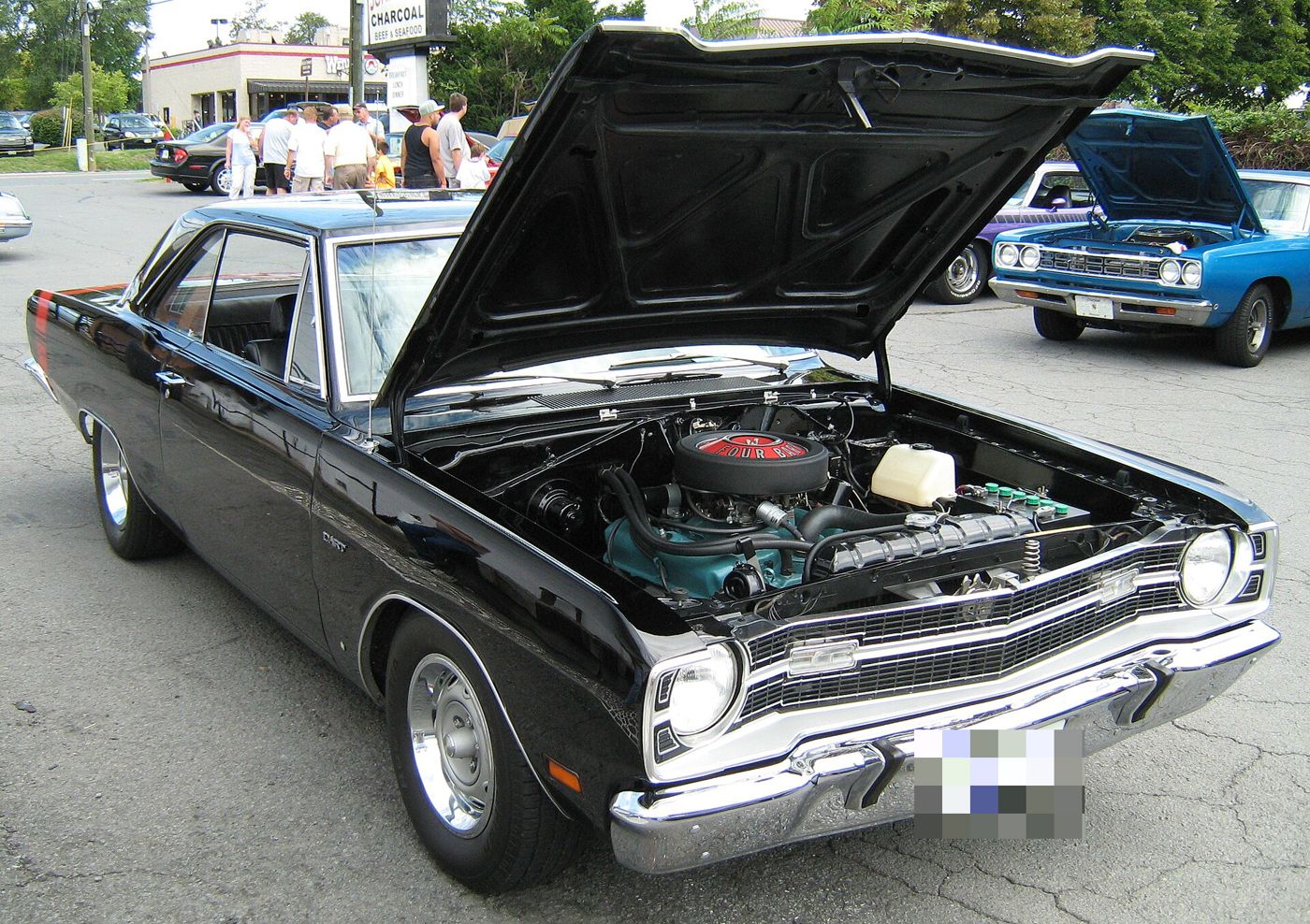
Above the Swinger sat the Dart GTS, a hardtop or convertible with all the GT features, E70-14 red-line tires, the 340 standard and the 383 optional. Over-Drive's engine table rates that 383 at 330 horsepower, though its own summary box gives the Super Bee's 335, and the fact sheet never reconciles the two. New for 1969 was the E86 440, rated at 375 horsepower at 4,600 rpm and 480 lb-ft at 3,200, the unaltered mid-size Dodge engine; power steering was unavailable with it for lack of space. Chrysler staff engineer Larry Shepard put the number plainly: "In 1969, we built over 600 440-powered Darts."2
The production figures show which Dart buyers chose. Dodge delivered 16,637 Swinger 340s, the figure Over-Drive says "most accept" and the one a 340 production compilation citing Galen Govier and Consumer Guide also gives; elsewhere Over-Drive's own text says 20,000 were sold. The GTS came to about 6,700 cars with no breakdown by body or engine, and the 340 compilation counts 3,645 GTS 340s. On those figures the cheaper Swinger 340 outsold the entire GTS line by roughly two and a half to one. The same compilation's 1968 GTS 340 total was 5,828.2,3
The Dart's drag-strip fame came from a different kind of car. Dodge built 80 Super Stock Hemi Darts, coded LO23, in 1968, starting at Hamtramck and completed by Hurst for competition. Hemi-powered factory Darts and Barracudas were a highlight of Super Stock at the U.S. Nationals at Indianapolis from 1968 on, and in 1970 Ron Mancini's Dart rolled over the competition there. Those were purpose-built race cars. The Swinger 340's claim was the one Car Life made for it: a car an ordinary buyer could order, drive home on a bench seat, and still embarrass pricier supercars.4,5,1
The formula outlived the year. The same compilation counts 13,785 Swinger 340s for 1970 and credits Plymouth's new Duster 340 with 24,875 that year, though other references print slightly different Duster totals. The feud Car Life described had simply moved down the price ladder, where Plymouth's small-block compact now outsold Dodge's. What 1969 established, and what the production numbers confirm, is that the 340 in a plain two-door body was not a niche. It drew more buyers than Dodge's bigger-engined, better-trimmed GTS, and it did so for a list price under $2,900.3,1,2
Fact sheet · 1969 · United States
The numbers
1969 Dodge Dart Swinger 340 and GTS: The low-priced Swinger 340 arrived and outsold the GTS by more than two to one (16,637 against about 6,700), while a 375 hp 440 joined the GTS options.
Figures may describe different groups of cars. Add rows together only when the note says they make up a total.
Key facts
Production
| What was counted | Count | Counted as |
|---|---|---|
| Dart Swinger 3402,3 Swinger 340 · 2-door hardtop · 340 4-bbl | 16,637 | delivered |
| Dart GTS, all bodies and engines2 GTS · 2-door hardtop and convertible | 6,700 | built |
| Dart Swinger 340 (Over-Drive production table)6 Swinger 340 · 2-door hardtop · 340 4-bbl | 20,000 | built |
| Dart GT, hardtop and convertible (Over-Drive, rounded)6 GT · hardtop and convertible | 20,900 | built |
| Dart/Swinger (base series), rounded6 Dart/Swinger · 2-door hardtop, 4-door sedan | 86,400 | built |
| Dart Custom, rounded6 Dart Custom · 2-door hardtop, 4-door sedan | 63,700 | built |
| What was counted | Built |
|---|---|
| Dart GTS with 3403 GTS · 2-door hardtop and convertible · 340 4-bbl | 3,645 |
| What was counted | Built |
|---|---|
| Total Dodge Dart Production, all series6 all Dart | 197,700 |
Prices when new
| Model | Price | Price type |
|---|---|---|
| Base price, Swinger 340 (LL23)6 | $2,836 | base price, 1969 model year |
| Base price, Dart GTS 2-door hardtop (LS23)6 | $3,226 | base price, 1969 model year |
| Base price, Dart GTS convertible (LS27)6 | $3,419 | base price, 1969 model year |
Prices are the nominal dollars of the day, not adjusted for inflation.
Engines
| Engine | Factory rating | Availability |
|---|---|---|
| 340 V8, 4-bbl2 340 cu in · Carter AVS 4-barrel | 275 hp @ 5,000, 340 lb-ft @ 3,200 (manufacturer published) | standard in Swinger 340 and GTS |
| 383 V8, 4-bbl2 383 cu in · Carter 4-barrel | 330 hp @ 5,200, 410 lb-ft @ 3,600 (manufacturer published) | optional in GTS |
| E86 · 440 V8, 4-bbl2 440 cu in · 4-barrel | 375 hp @ 4,600, 480 lb-ft @ 3,200 (manufacturer published) | optional in GTS |
Ratings are published figures, not dyno results. Gross and net ratings aren't directly comparable.
Transmissions
| Transmission | Availability |
|---|---|
| Four-speed manual2 | optional ($188 with 340) |
| TorqueFlite automatic2 | available with 340, 383, 440 |
Options and packages
| Option | Price |
|---|---|
| Four-speed manual (340)2 | $188 |
| Power steering2 | $85 |
| Console, GT/GTS only2 | $53 |
| Power brakes2 | $43 |
| AM radio2 | $62 |
| AM/FM stereo with 8-track2 | $196 |
| Vinyl top2 | $68 |
| Automatic transmission with 273, 318 or 3402 | $191 |
| Sure-Grip positive traction rear axle2 | $39 |
Paint
| Code | Color |
|---|---|
A4 |
Silver2 |
B3 |
Light Blue2 |
B5 |
Bright Blue2 |
B7 |
Medium Blue2 |
B9 |
Dark Blue2 |
E7 |
Cordovan2 |
F3 |
Light Green2 |
F5 |
Medium Green2 |
F6 |
Bright Green2 |
F8 |
Dark Green2 |
L1 |
Beige2 |
Q4 |
Light Turquoise2 |
Q5 |
Bright Turquoise2 |
R4 |
Charger Red2 |
R6 |
Red2 |
T3 |
Light Bronze2 |
T5 |
Copper2 |
T7 |
Dark Bronze2 |
W1 |
White2 |
X9 |
Black2 |
Y2 |
Yellow2 |
Y3 |
Cream2 |
Y4 |
Gold2 |
Y6 |
Citron Gold2 |
999 |
Bahama Yellow (special order)2 |
999 |
Orange (special order)2 |
999 |
Rallye Green (special order)2 |
Color names are the factory's. We don't show color swatches, because a screen color is no guide for a restoration.
Specifications
| Measure | Value | Applies to |
|---|---|---|
| Wheelbase2 | 111 in | all Darts |
| Overall length2 | 195.4 in | |
| Tires, GTS2 | E70 x 14 red line | GTS |
| Shipping weight, Swinger 3406 | 3,097 lb | LL23 Swinger 340 |
| Shipping weight, GTS hardtop / convertible6 | 3,105 / 3,210 lb | LS23 / LS27 |
Where the sources disagree
Identification
Read a 1969 Dodge VIN
The VIN decoder runs in your browser and never sends the VIN anywhere. How the factory numbered this year's cars:
Same model year
Also in 1969
- AMC AMX The two-seat AMX's biggest year: 8,293 cars by the enthusiast production table, with a mid-year run of Big Bad colors and 52 Hurst-built Super Stock AMXs for NHRA drag racing.
- AMC Javelin Production fell to 40,675, but the 1969 Javelin added the Big Bad colors, with 2,282 cars painted blue, green or orange, plus the Mod package.
- AMC Rebel and Rebel Machine A base and SST Rebel with no convertible. The Big Bad colors were test-marketed through the New York–New Jersey 'Raider' hardtop. This is host-car context for the 1970 Machine.
- Buick Riviera Another record at 52,872 Rivieras; 5,272 had the GS handling option.
- Buick Skylark Gran Sport, GS and GSX Stage 1 became a factory GS 400 option, alongside distinct GS 350 and California GS choices; output, base-price and convertible-count disputes remain visible.
- Buick Wildcat 67,453 Wildcats; the last year of the 430.
- Chevrolet Chevelle and Malibu SS Super Sport became RPO Z25 option equipment, available for 1969 only on the 300 Deluxe coupes as well as Malibu sport coupe, convertible and El Camino.
- Chevrolet Chevy II and Nova SS is RPO Z26 per the source, with L48, L34 and L78 engines. Enthusiast-compiled production: 251,849 cars; Super Sport 17,564.
- Chevrolet El Camino SS SS 396 became RPO Z25 option equipment on the V8 Malibu El Camino, with 396s up to 375 hp; 86,307 Z25s across eligible models.
- Chevrolet Impala SS Only the SS427 (RPO Z24) remains; the reported count ranges from 2,425 to about 2,455.
- Dodge Charger The second-generation Charger's peak-sales year added the SE package and the aero-bodied Charger 500 and Charger Daytona homologation cars, whose production totals are still disputed.
- Dodge Coronet R/T and Super Bee The Super Bee added a hardtop body and the 440 Six Pack, while the 440-powered Coronet R/T continued as the upscale hardtop and convertible.
- Ford Fairlane The Fairlane hardtop was the intermediate line's volume leader, while the Fairlane 500 SportsRoof shared its body with the Torino GT, Cobra and Talladega.
- Ford Ranchero GT A second year of Torino GT trim on the Ranchero: 1,658 GTs, with a separate line of 727 listed with bucket seats.
- Ford Thunderbird Fifth-generation Thunderbird; only the whole-line production total was found.
- Ford Torino The Torino GT carried most of the line's volume, the 428 Cobra Jet was in its first full year, and the Talladega aero fastback was built in a short run at Atlanta to homologate a NASCAR nose.
- Mercury Comet and Cyclone The Cyclone fastback came as Cyclone and Cyclone CJ, mid-year Spoilers carried Dan Gurney and Cale Yarborough graphics, and the extended-nose Cyclone Spoiler II was built at Lorain for NASCAR homologation.
- Mercury Cougar A longer, restyled Cougar added a convertible, the Boss 302 arrived in April, and the Eliminator replaced the GT as the performance Cougar.
- Mercury Marauder and S-55 The Marauder name returned on a full-size hardtop, and the X-100 carried the 360 hp 429 four-barrel as its only engine.
- Oldsmobile Cutlass, 4-4-2 and Hurst/Olds The 4-4-2 kept its 400 while the second Hurst/Olds, in white and gold with a 380 hp 455, went into production at about 900 cars.
- Plymouth Barracuda and 'Cuda The last A-body Barracuda introduced the 'Cuda name as a stripped performance package with a standard 340, alongside Formula S and a midyear 440.
- Plymouth GTX, Belvedere and Satellite The GTX shared the Road Runner's new Air Grabber scoop and Super Track Pack but sold 15,602 cars, fewer than a fifth of the cheaper Road Runner.
- Plymouth Road Runner A convertible joined the coupe and hardtop, the 440 Six Barrel arrived at mid-year, and the Road Runner reached its production peak of 84,420.
- Pontiac Firebird and Trans Am The last first-generation Firebird, and the mid-year debut of the Trans Am package: 697 cars by the commonly published count, eight of them convertibles.
- Pontiac GTO Three four-barrel 400s under one nameplate, and the first year of the Judge package built around Ram Air power.
- Pontiac Grand Prix A new 118-inch Grand Prix with the SJ and a 390 hp 428 HO: production more than tripled to 112,486.
- Pontiac Tempest and LeMans The last year of the OHC Sprint six and the 350 HO.
- Rambler American and SC/Rambler AMC and Hurst put the 315-hp 390 V8 and a close-ratio four-speed into the compact Rambler hardtop for NHRA F/Stock. 1,512 were built, and the split between the two paint schemes is disputed.