1969 · Mercury · United States
1969 Mercury Marauder X-100: The 429 Luxury Hardtop Mercury Sold as a Performance Car
The Marauder name returned on a full-size hardtop, and the X-100 carried the 360 hp 429 four-barrel as its only engine.
United States · researched through 2026-09-22
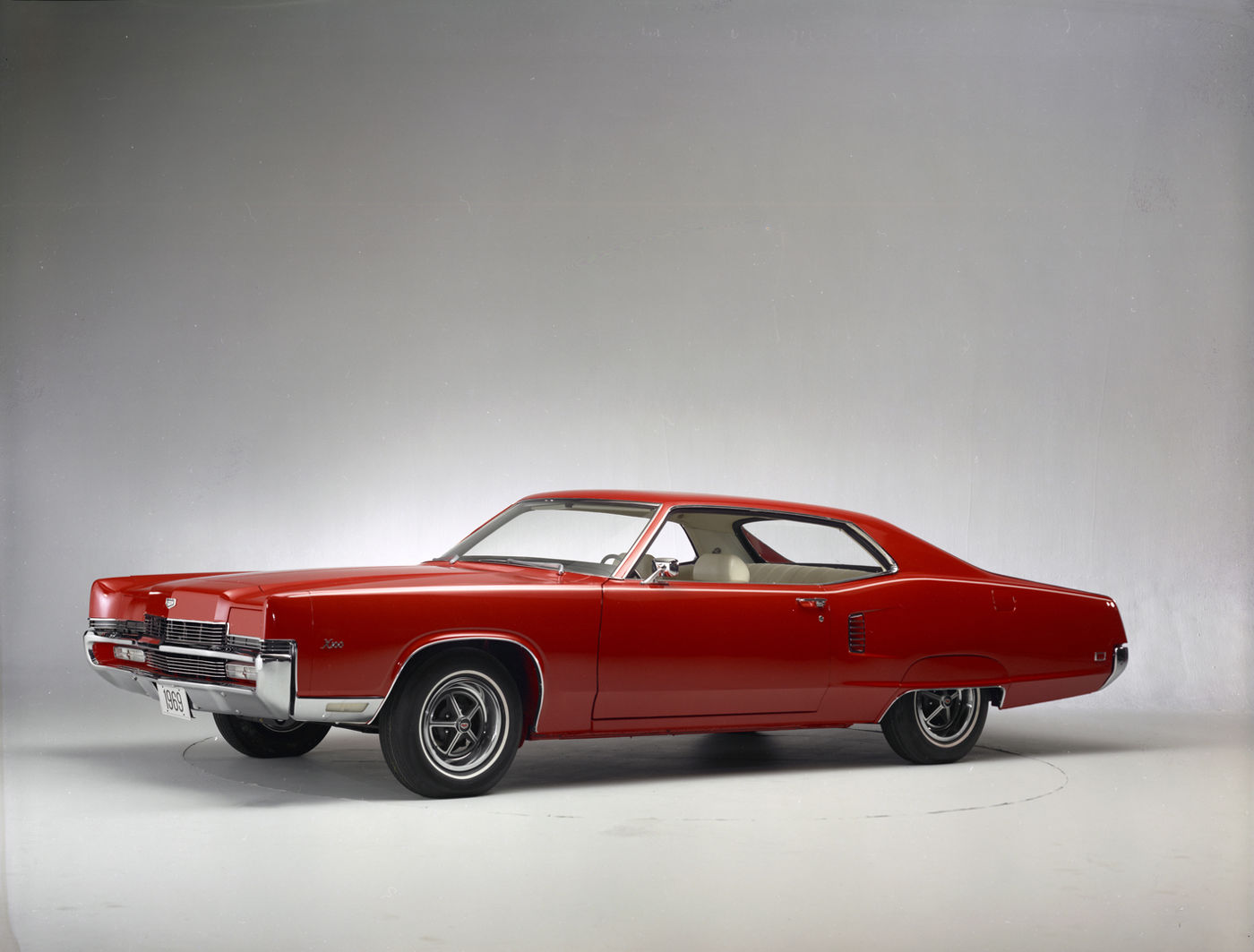
Car and Driver's December 1968 road test put a number on a car that was hard to classify. Mac's Motor City Garage reports that the magazine timed its Marauder X-100 from 0 to 60 mph in 7.8 seconds and through the quarter-mile in 16.0 seconds, with fuel consumption between 10 and 13 mpg. Those figures belong to the one car the magazine tested. They still framed the question that follows the X-100: was a 219-inch, two-ton Mercury hardtop with a 429 a muscle car, or a luxury car that happened to be fast?1,2
Mercury's own slogan for the year was “In Case Luxury Isn't Enough,” which Hooniverse's Jim Brennan quotes from the 1969 campaign. Brennan places the X-100 at the end of a run of new products: the Cougar in 1967, the Montego for 1968, and the Continental Mark III in the spring of 1969. The Marauder returned for 1969 as a distinct model and, in his account, the flagship of the Mercury line. Wikipedia describes it as a personal luxury car that replaced the performance-oriented S-55 and drew on the Mark III for inspiration.2,3
The name was older than the car. Diego Rosenberg, writing in the ClassicCars.com Journal, traces Marauder to 1958, when all of Mercury's V8s carried it and the 400-horsepower 430 was the Super Marauder. The FE-series 352, 390 and 406 wore the badge from 1961 to 1963, and 1963 was the first time the name went on a vehicle, a fastback-roof two-door hardtop in the Monterey Custom and S-55 lines. It spread to a four-door hardtop and more series in 1964. For 1969 it became a standalone model for the first time.4
Under the skin the new Marauder was a Ford. Mac's Motor City Garage notes that it rode a 121-inch wheelbase shared with the Galaxie and LTD, where other full-size Mercurys used 124 inches. The Truth About Cars describes the recipe as the Marquis front end joined to a reworked Galaxie 500 XL or GT body from the A-pillars back. Hooniverse puts the body about five inches shorter than the Marquis and calls it essentially the Galaxie 500 XL coupe. The roof carried flying buttresses around an upright rear window that Mercury called “tunneled.”1,5,2
The base Marauder and the X-100 were two versions of that one hardtop. According to The Truth About Cars, the base car came with a 280-horsepower 390 two-barrel and could be ordered with a 320-horsepower 429 two-barrel or the 360-horsepower 429 four-barrel. The X-100 took the four-barrel 429 as its only engine: 360 hp at 4,600 rpm and 480 lb-ft at 2,800 rpm on 10.5:1 compression, SAE gross ratings. The only transmission was the three-speed Select-Shift automatic, which Mac's Motor City Garage identifies as the C6. A 2.80 axle was standard and a 3.25 Traction-Lok was optional.5,2,3,1
The X-100's standard equipment was about appearance as much as speed. Hooniverse lists rear fender skirts, optional on the base car, and a matte-black “Sport Tone” finish on the tunneled rear deck that could be deleted for credit or replaced by a vinyl roof. Mac's Motor City Garage adds a three-spoke rim-blow steering wheel and 15-inch styled wheels on white-stripe belted tires. Hooniverse names them as Goodyear H70x15 tires on Kelsey-Hayes MagStar aluminum wheels. Inside, the X-100 used the Marquis dashboard, and buckets with a console could replace the front bench.2,1,5
What that cost depends on the source. Hooniverse and Mac's Motor City Garage both give a $4,091 base price for the X-100, but they disagree about what it was measured against. Hooniverse says it listed for $700 more than the base Marauder; Mac's says nearly $700 more than the roughly comparable Ford XL SportsRoof. Wikipedia lists the base Marauder at $3,351 and the X-100 at $4,074. The figures agree that an X-100 buyer paid roughly $700 over a plainer big two-door, and they do not agree on the exact list price.2,1,3
The production count is the clearest measure of what buyers made of it. Hooniverse gives 14,666 Marauders built for 1969, of which 5,635 were X-100s, so the X-100 accounted for about 38 percent of the model. Mac's Motor City Garage gives the same 5,635. The Truth About Cars reports 14,666 Marauders delivered and 5,636 X-100s, one car different. Wikipedia lists the base Marauder at 9,031 sales, which fits the Hooniverse split, but it repeats 9,031 for the X-100, which looks like a duplication. The 5,635 figure leads here, with the others noted.2,1,5,3
The sources do not agree on which rivals the X-100 was chasing. Hooniverse says the aim was sales from the Buick Wildcat and Pontiac Grand Prix. Mac's Motor City Garage puts it in the same class as the Chrysler 300 and Plymouth Fury GT. The Truth About Cars concludes that the Marauder was not really a muscle car at all but a personal luxury car aimed at buyers considering an Oldsmobile Toronado or Buick Riviera. Taken together, the comparisons place the X-100 among the large, powerful two-doors, well away from the mid-size muscle cars.2,1,5
The road-test figures show the car could run. Beyond the Car and Driver numbers relayed by Mac's Motor City Garage, Hooniverse gives 0 to 60 mph in 7.5 seconds, 0 to 100 in 19.9 seconds and a 126 mph top speed without naming the issue or the car tested, so those figures stay as reported, not measured. Hooniverse quotes the magazine as finding the car “extremely controllable in a wide range of situations,” while noting understeer and power steering it called unnervingly light. A competition suspension with stiffer springs and shocks was optional.1,2
The second year showed how short the market was. Hooniverse reports that the car came back little changed for 1970 and that production fell to 6,043 Marauders, 2,646 of them X-100s. The Truth About Cars gives 6,043 and 2,643. Either way, the X-100 held a larger share of a much smaller total, about 44 percent, while the model as a whole lost well over half its volume. Mac's Motor City Garage states that for 1971 the Marauder and X-100 were dropped as Mercury left the performance and personal-luxury categories.2,5,1
The name went dormant until the 2003 Marauder, which Rosenberg describes as a special full-size performance car based on the Grand Marquis. The 1969 X-100 is the car that connects the two. It carried the 1958 engine name onto a standalone model with a 429 as its only engine, and it found 5,635 buyers in its first year and fewer than half that number in its second. Mercury's slogan asked whether luxury was enough. On the evidence of those two production counts, relatively few buyers wanted the answer delivered as a full-size two-door hardtop with a 429 under the hood.4,2
Fact sheet · 1969 · United States
The numbers
1969 Mercury Marauder and Marauder X-100 — The Marauder name returned on a full-size hardtop, and the X-100 carried the 360 hp 429 four-barrel as its only engine.
Coverage: Partial — researched sections are shown; missing ones are not yet sourced. Researched through 2026-09-22.
Every figure is labeled with how sure we are. Reported means a manufacturer, registry, or reference figure we cite but have not reconciled against factory records ourselves. Disputed means credible sources disagree and both are shown. Rows are separately scoped; don't add them together unless the note says they make up a total.
Key facts
- X-100: 5,635 of 14,666 1969 Marauders (Hooniverse).2
Production
| What was counted | Count | Basis | Status |
|---|---|---|---|
| All 1969 Marauders2,6 Marauder and X-100 · 2-door hardtop · as published | 14,666 | built, model-year | Reported |
| What was counted | Count | Basis | Status |
|---|---|---|---|
| Marauder X-1002,6 X-100 · 2-door hardtop · 429 4V · automatic · as published Wikipedia gives 9,031 for the X-100, the same number it gives for the base car; see conflicts. | 5,635 | built, model-year | Disputed |
| Marauder (base)3,6 Marauder · 2-door hardtop · as published 9,031 + 5,635 = 14,666, but the two figures come from different sources and are not asserted to partition the total. | 9,031 | sold, model-year | Reported |
Rows are separately scoped; do not add them unless a note says they partition a total.
Prices when new
| Model | Price | Basis |
|---|---|---|
| Marauder 2-door hardtop3 | $3,351 | list price as published, 1969 model year |
| Marauder X-1003 | $4,074 | list price as published, 1969 model year |
Prices are the nominal dollars of the day, not adjusted for inflation.
Engines
| Engine | Factory rating | Availability | Built |
|---|---|---|---|
| 429 V8 4-bbl2,3 429 cu in · 4-barrel | 360 hp @ 4,600, 480 lb-ft @ 2,800 (SAE gross) | the only X-100 engine | Not yet sourced |
Ratings are the manufacturer's advertised figures under the standard shown (SAE gross before 1972, SAE net after). They are not dyno results, and gross and net ratings can't be compared directly.
Transmissions
| Transmission | Availability | Built |
|---|---|---|
| Select-Shift 3-speed automatic2 | the only X-100 transmission | Not yet sourced |
Options and packages
| Code | Option | Price | Installed |
|---|---|---|---|
|
Heavy-duty battery [Marauder optional; standard on X-100] | — | Not yet sourced |
|
High performance axle [optional, Marauder and X-100] | — | Not yet sourced |
|
Power brakes, front disc and rear drum [optional, Marauder and X-100] | — | Not yet sourced |
|
Power Twin Comfort lounge seats, 6-way [n/a Marauder; optional X-100] | — | Not yet sourced |
|
Power antenna [n/a Marauder and X-100] | — | Not yet sourced |
|
Bucket seats with console, Select-Shift console-mounted [Marauder optional; X-100 at no extra cost] | — | Not yet sourced |
|
Twin Comfort lounge seats [n/a Marauder; X-100 at no extra cost] | — | Not yet sourced |
|
Reclining front passenger seat [optional, Marauder and X-100] | — | Not yet sourced |
|
Rim-blow steering wheel with simulated woodgrain [Marauder optional; standard on X-100] | — | Not yet sourced |
|
Leather-and-vinyl interior [n/a Marauder; standard on X-100] | — | Not yet sourced |
|
Electric clock [Marauder optional; standard on X-100] | — | Not yet sourced |
|
Fender skirts [Marauder optional; standard on X-100] | — | Not yet sourced |
|
Complementary sports tone matte finish in tunnel window and rear deck area [Marauder optional; standard on X-100; n/a with vinyl roof] | — | Not yet sourced |
|
Two-tone paint [n/a Marauder and X-100] | — | Not yet sourced |
|
Styled aluminum wheels [Marauder optional; standard on X-100] | — | Not yet sourced |
|
Vinyl roof [optional; on X-100 only if the matte two-tone is deleted] | — | Not yet sourced |
|
Whisper-Aire conditioner [optional, Marauder and X-100] | — | Not yet sourced |
|
Combination AM radio / stereo-sonic tape system [optional, Marauder and X-100] | — | Not yet sourced |
|
Automatic ride control [optional, Marauder and X-100] | — | Not yet sourced |
Specifications
| Measure | Value | Applies to |
|---|---|---|
| Standard rear axle, X-1002 | 2.8 ratio | 3.25 Traction-Lok optional |
Where the sources disagree
Identification
Read a 1969 Mercury VIN
The VIN decoder runs in your browser and never sends the VIN anywhere. How the factory numbered this year's cars:
Same model year
Also in 1969
- AMC AMX The two-seat AMX's biggest year: 8,293 cars by the enthusiast production table, with a mid-year run of Big Bad colors and 52 Hurst-built Super Stock AMXs for NHRA drag racing.
- AMC Javelin Production fell to 40,675, but the 1969 Javelin added the Big Bad colors, with 2,282 cars painted blue, green or orange, plus the Mod package.
- AMC Rebel and Rebel Machine A base and SST Rebel with no convertible. The Big Bad colors were test-marketed through the New York–New Jersey 'Raider' hardtop. This is host-car context for the 1970 Machine.
- Buick Riviera Another record at 52,872 Rivieras; 5,272 had the GS handling option.
- Buick Skylark Gran Sport, GS and GSX GS production fell to 12,465, and the GS 400's Stage 1 package became a factory option while Stage 2 stayed a dealer item.
- Buick Wildcat 67,453 Wildcats; the last year of the 430.
- Chevrolet Chevelle and Malibu SS Super Sport became RPO Z25 option equipment, available for 1969 only on the 300 Deluxe coupes as well as Malibu sport coupe, convertible and El Camino.
- Chevrolet Chevy II and Nova SS is RPO Z26 per the source, with L48, L34 and L78 engines. Enthusiast-compiled production: 251,849 cars; Super Sport 17,564.
- Chevrolet El Camino SS SS 396 became RPO Z25 option equipment, orderable on the V8 Malibu El Camino (13680); the El Camino share of the 86,307 Z25s is not separately published.
- Chevrolet Impala SS Only the SS427 (RPO Z24) remains; the reported count ranges from 2,425 to about 2,455.
- Dodge Charger The second-generation Charger's peak-sales year added the SE package and the aero-bodied Charger 500 and Charger Daytona homologation cars, whose production totals are still disputed.
- Dodge Coronet R/T and Super Bee The Super Bee added a hardtop body and the 440 Six Pack, while the 440-powered Coronet R/T continued as the upscale hardtop and convertible.
- Dodge Dart GTS, Swinger and Demon The low-priced Swinger 340 arrived and outsold the GTS by more than two to one (16,637 against about 6,700), while a 375 hp 440 joined the GTS options.
- Ford Fairlane The Fairlane hardtop was the intermediate line's volume leader, while the Fairlane 500 SportsRoof shared its body with the Torino GT, Cobra and Talladega.
- Ford Ranchero GT The Ranchero GT carried Torino GT trim; 1,658 GTs were built, per reference-site counts in the Standard Catalog lineage.
- Ford Thunderbird Fifth-generation Thunderbird; only the whole-line production total was found.
- Ford Torino The Torino GT carried most of the line's volume, the 428 Cobra Jet was in its first full year, and the Talladega aero fastback was built in a short run at Atlanta to homologate a NASCAR nose.
- Mercury Comet and Cyclone The Cyclone fastback came as Cyclone and Cyclone CJ, mid-year Spoilers carried Dan Gurney and Cale Yarborough graphics, and the extended-nose Cyclone Spoiler II was built at Lorain for NASCAR homologation.
- Mercury Cougar A longer, restyled Cougar added a convertible, the Boss 302 arrived in April, and the Eliminator replaced the GT as the performance Cougar.
- Oldsmobile Cutlass, 4-4-2 and Hurst/Olds The 4-4-2 kept its 400 while the second Hurst/Olds, in white and gold with a 380 hp 455, went into production at about 900 cars.
- Plymouth Barracuda and 'Cuda The last A-body Barracuda introduced the 'Cuda name as a stripped performance package with a standard 340, alongside Formula S and a midyear 440.
- Plymouth GTX, Belvedere and Satellite The GTX shared the Road Runner's new Air Grabber scoop and Super Track Pack but sold 15,602 cars, fewer than a fifth of the cheaper Road Runner.
- Plymouth Road Runner A convertible joined the coupe and hardtop, the 440 Six Barrel arrived at mid-year, and the Road Runner reached its production peak of 84,420.
- Pontiac Firebird and Trans Am The last first-generation Firebird, and the mid-year debut of the Trans Am package: 697 cars by the commonly published count, eight of them convertibles.
- Pontiac GTO Three four-barrel 400s under one nameplate, and the first year of the Judge package built around Ram Air power.
- Pontiac Grand Prix A new 118-inch Grand Prix with the SJ and a 390 hp 428 HO: production more than tripled to 112,486.
- Pontiac Tempest and LeMans The last year of the OHC Sprint six and the 350 HO.
- Rambler American and SC/Rambler AMC and Hurst put the 315-hp 390 V8 and a close-ratio four-speed into the compact Rambler hardtop for NHRA F/Stock. 1,512 were built, and the split between the two paint schemes is disputed.