1969 · Mercury · United States
1969 Mercury Cougar Eliminator: A Spring Running Change That Built 2,250 Cars
A longer, restyled Cougar added a convertible, the Boss 302 arrived in April, and the Eliminator replaced the GT as the performance Cougar.
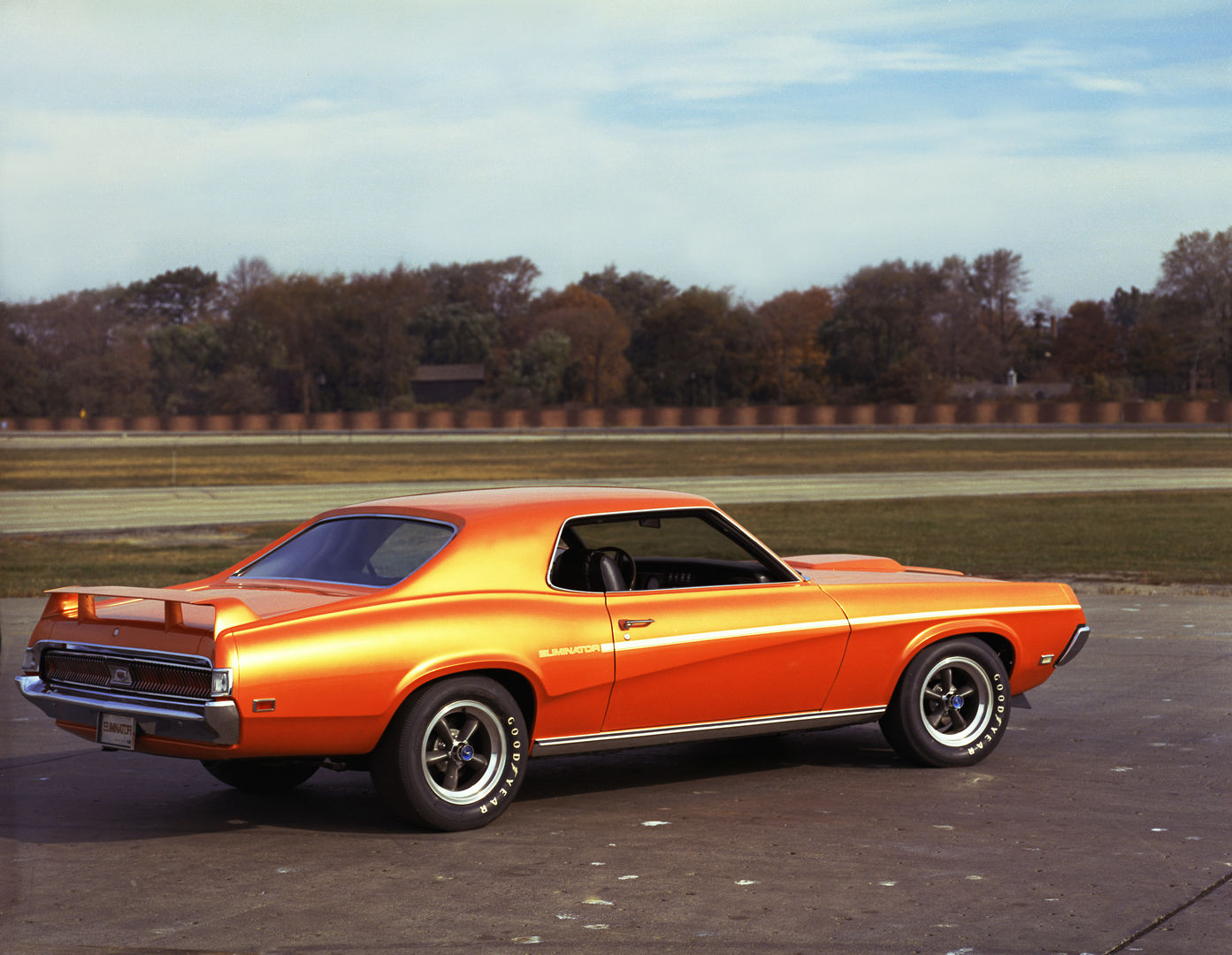
Mercury changed its performance Cougar in the middle of the model year. On April 1, 1969, the Eliminator replaced the GT-E as the performance-trim Cougar, introduced as a running change and as the Cougar that carried Mercury's Boss 302 engine; the VIN decoder dates the Boss 302's arrival in the Cougar to April 17. By the end of the year Mercury had built 2,250 Eliminators, a figure the Cougar Club of America's Marti Auto Works tables and Over-Drive share. Out of 100,085 Cougars built for 1969, that was about 2.2 percent, roughly one car in 44.1,2,3
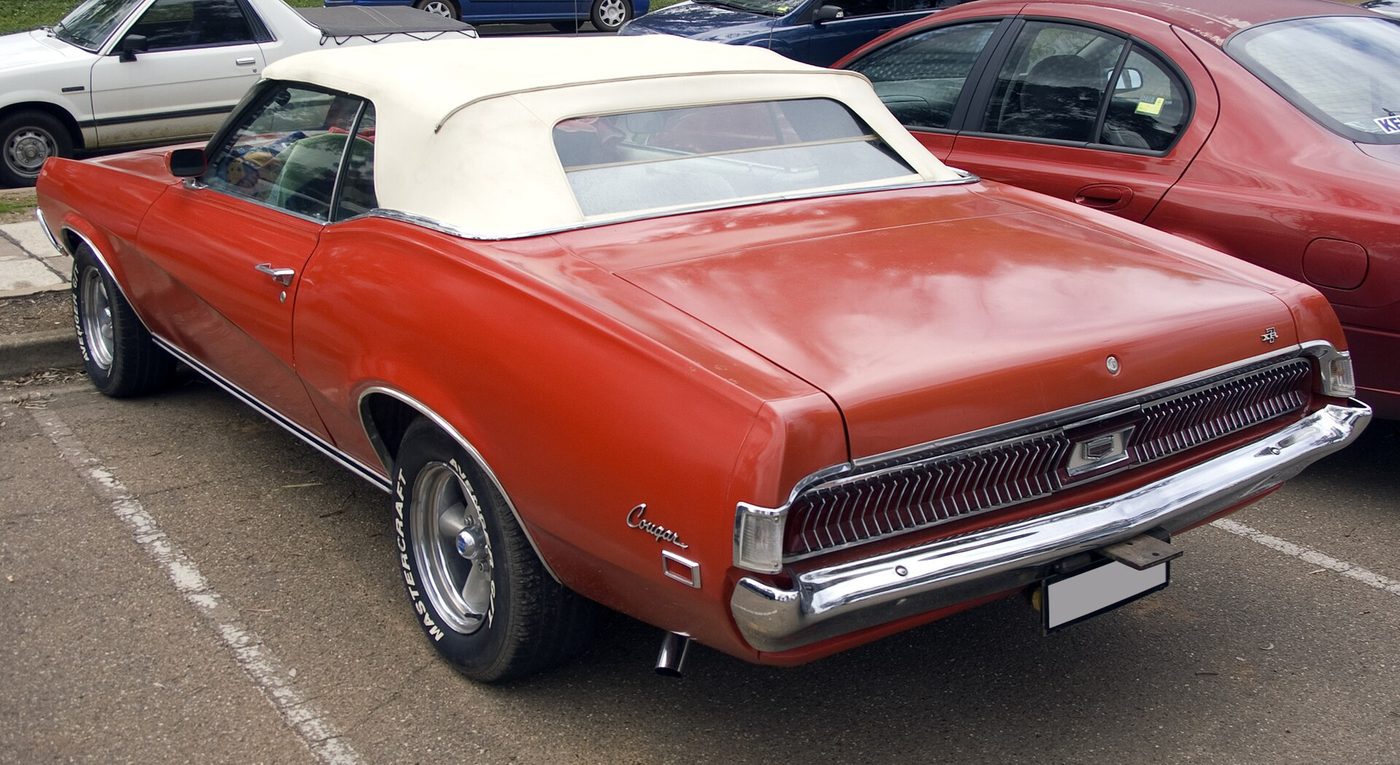
The car it arrived in had already been reworked. A mid-cycle revision for 1969 moved the body sides toward the popular Coke-bottle shape and deleted the vent windows, and the car grew longer and wider: 193.8 inches long, 74.2 wide and 111.1 inches between the wheels, with curb weights from 3,403 to 3,547 pounds depending on model, on E78-14 tires as standard and E70, F70 or FR70-14 tires as options. A convertible joined the line for the first time, in standard and XR-7 trim. The year also brought the 351 Windsor, which became the Cougar's standard V8 in two-barrel form.1,2
The engine list ran from mild to serious. The 351 two-barrel was rated at 250 horsepower, gross, and the 351 four-barrel at 290. The 390 four-barrel, rated at 320 horsepower, was in its last year in the Cougar. The Boss 302 carried a 290-horsepower rating at 5,800 rpm, and the 428 Cobra Jet, with or without Ram Air, was rated at 335. The sources do not agree on every detail: the decoder gives the 390's torque as 425 lb-ft at 2,800 rpm where Over-Drive gives 427 at 3,200, and it puts the Cobra Jet's peak at 5,200 rpm rather than 5,400. Behind them sat a three-speed manual as standard, a four-speed with its own close ratios of 2.78, 1.93, 1.36 and 1.00 for the Boss 302 and wider ratios for the big engines, or a Select-Shift automatic built as either the C-6 or the FMX.2,1
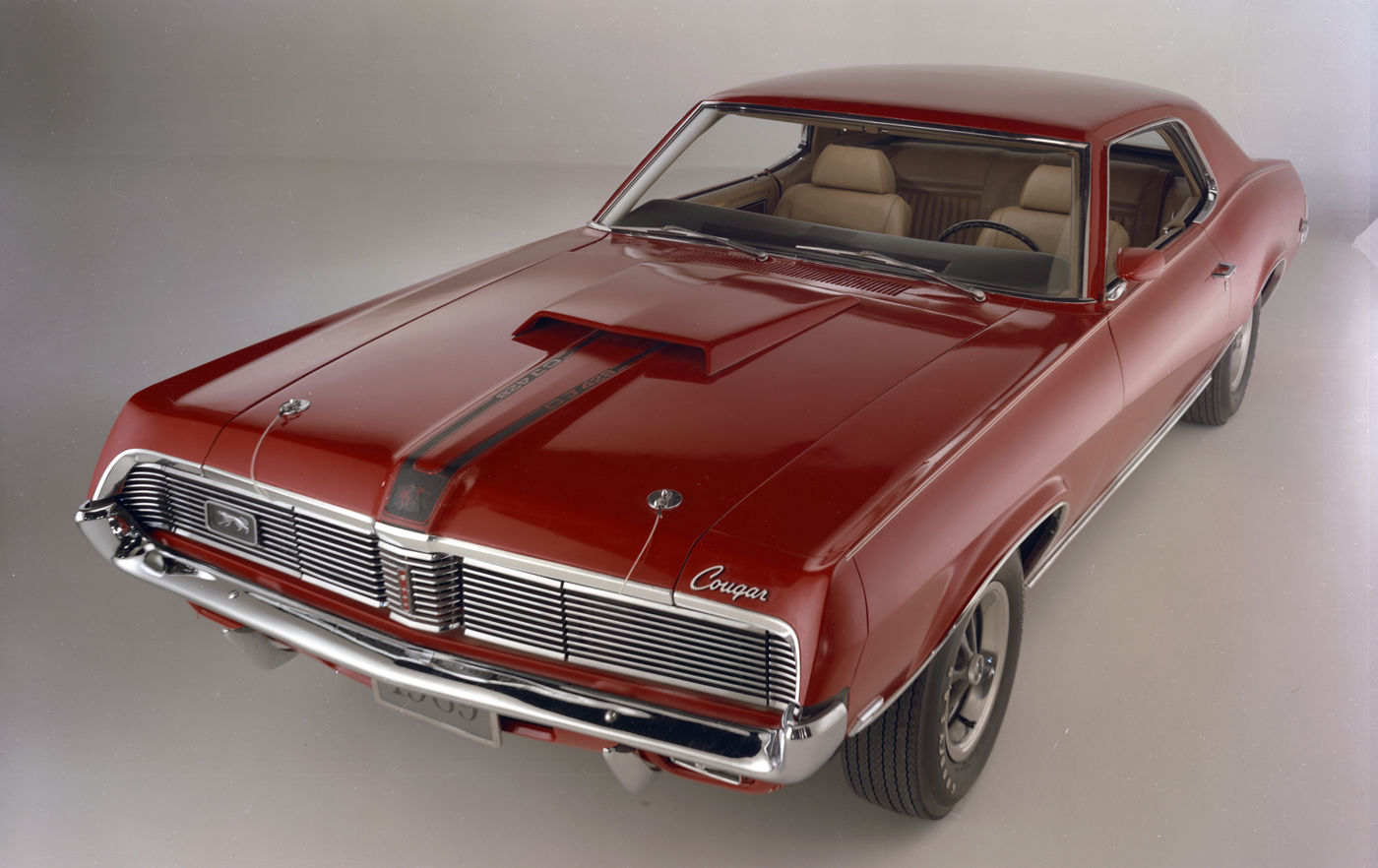
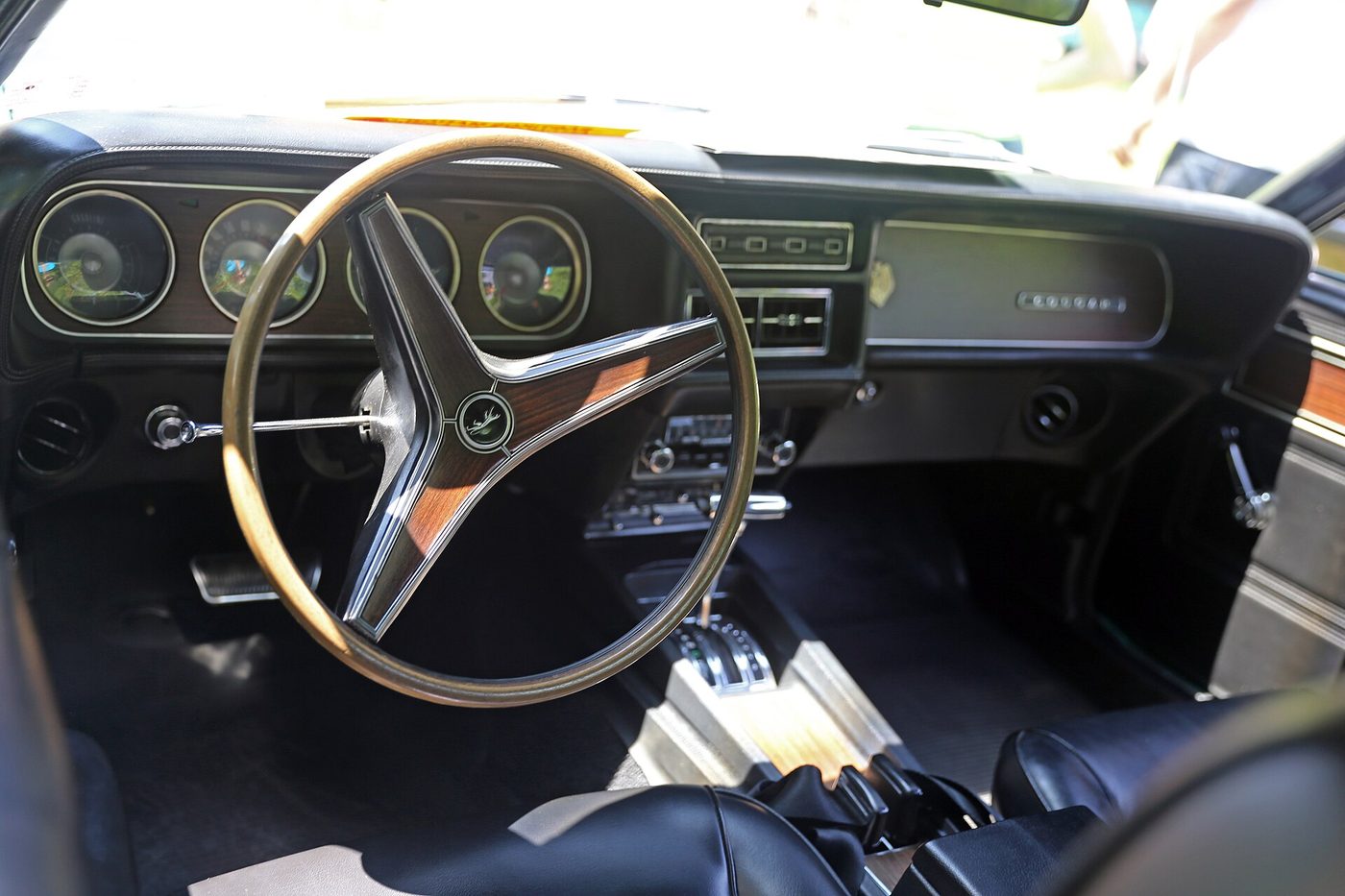
The Eliminator itself started from the plainest body. It was built on the standard, non-XR-7 hardtop, with high-back bucket seats, a camera-case dash with tachometer and warning lights, a front chin spoiler, a blacked-out grille, a performance axle and the 351 four-barrel with dual exhausts and a three-speed manual as the base drivetrain. The package also included spoilers, stripes, a hood scoop, styled steel wheels and a rally clock. The 390, the 428 and the Boss 302 were all available, and the Boss 302 came only with the Eliminator option.4,1
It was meant to be seen. The 1969 Eliminator came in four colors only: White, Bright Blue Metallic, Competition Orange and Bright Yellow, with interiors in black, blue, or white with black components. An engine split that adds to 2,250 has been printed only in a secondary news article. Of the total, 101 Eliminators were built for Hertz, about 4.5 percent.4,3,1
Mercury sold a far larger number of Cougars with a sporting look than with a sporting engine. The club's registry counts 16,142 Sports Special packages for 1969, in four versions: 10,409 of package A at $95.90, 5,413 of package B at $150.30, which added the interior decor group and a Rim-Blow steering wheel, 116 of package C at $123.10 with special handling, and 204 of package D at $177.60. That is about seven Sports Specials for every Eliminator. The same division that put a Boss 302 in the Eliminator found most of its buyers in a $96 package.5,3

The whole line was shrinking. The club counts 100,085 Cougars for 1969, against 113,741 in 1968 and 150,893 in the first year, a fall of about a third in two seasons. The five body codes add exactly to the total: 64,735 standard hardtops, 23,914 XR-7 hardtops, 1,616 bench-seat hardtops, 5,796 standard convertibles and 4,024 XR-7 convertibles. The new convertibles were 9,820 cars, just under one in ten. Wikipedia's table gives 100,069 in all, and Over-Drive gives 23,918 XR-7 hardtops and 66,331 standard hardtops; the club's rows are the more consistent, because they sum to their own total.3,6,1
Most buyers wanted comfort, and the option statistics show it. Of the 1969 Cougars, 92.4 percent had power steering, 89.4 percent an automatic transmission, 58.9 percent power brakes and 57 percent tinted glass. Power steering was a $99.80 option, power windows $104.90, an AM/FM stereo $185.30 and a sunroof with vinyl roof $459.80. On those figures about one Cougar in ten had a manual gearbox of any kind. The Eliminator, with a three-speed manual as its base transmission, started from the minority choice.1,4

The racing connection that had named the 1967 Dan Gurney Special was gone. Mercury had assigned Bud Moore to NASCAR's Grand Touring championship for 1968, and when he came back to Trans-Am in 1969 it was with Ford Mustangs; in 1970 his Mustangs won the championship with six victories. The Boss 302 that Mercury offered only in the Eliminator went into a Cougar with no Trans-Am team behind it; Moore's Trans-Am cars were now Mustangs. Over-Drive alone reports that two 1969 Cougars were built with the Boss 429, an engine absent from the decoder's Cougar engine table.7,4,1
The Eliminator survived one more year, and the numbers barely moved. The club counts 2,268 for 1970, 18 more than 1969, in a Cougar line that fell to 72,365. For 1970 the Eliminator came in seven colors, five of them named Competition, with a 351 Cleveland in place of the Windsor as the base engine and only the 428 and the Boss 302 as options. Against the 1970 total the Eliminator's share rose to about 3.1 percent, not because more people bought one but because fewer people bought Cougars at all.3,4
Fact sheet · 1969 · United States
The numbers
1969 Mercury Cougar: A longer, restyled Cougar added a convertible, the Boss 302 arrived in April, and the Eliminator replaced the GT as the performance Cougar.
Figures may describe different groups of cars. Add rows together only when the note says they make up a total.
Key facts
- Eliminator: 2,250 built for 1969 (club production page and Over-Drive Magazine agree).3,1
- Over-Drive Magazine says 101 Hertz Eliminators were built in 1969 and that two Cougars were produced with the Boss 429 engine.1
- As compiled, 92.4 percent of 1969 Cougars had power steering, 89.4 percent an automatic transmission, 58.9 percent power brakes and 57 percent tinted glass.1
Production
| What was counted | Built |
|---|---|
| All 1969 Cougars3 as published | 100,085 |
| What was counted | Built |
|---|---|
| Standard 2-door hardtop (65A)3 Standard · 2-door hardtop, 65A · as published | 64,735 |
| XR-7 2-door hardtop (65B)3 XR-7 · 2-door hardtop, 65B · as published | 23,914 |
| Standard 2-door hardtop with bench seat (65C)3 Standard · 2-door hardtop, 65C (bench seat) · as published | 1,616 |
| Standard convertible (76A)3,1 Standard · convertible, 76A · as published | 5,796 |
| XR-7 convertible (76B)3,1 XR-7 · convertible, 76B · as published | 4,024 |
| What was counted | Built |
|---|---|
| Eliminator (standard hardtop only)3,1,6 Eliminator · 2-door hardtop, 65A · 351 4V standard; 390 4V, Boss 302, 428 CJ optional · as published | 2,250 |
| Hertz Eliminators1,6 Eliminator (Hertz rental) · 2-door hardtop · Hertz fleet | 101 |
| Sports Special (packages A-D)3,5 Sports Special · as published | 16,142 |
| Sports Special, package A5 Sports Special A · as published | 10,409 |
| Sports Special, package B5 Sports Special B · as published | 5,413 |
| Sports Special, package C5 Sports Special C · as published | 116 |
| Sports Special, package D5 Sports Special D · as published | 204 |
| GT appearance group, standard Cougar8 GT (standard) · as published | 1,717 |
| GT appearance group, XR-78 GT (XR-7) · as published | 1,547 |
| What was counted | Built |
|---|---|
| Cougars with the Boss 429 engine1 Boss 429 · as published | 2 |
| Cougars with the Boss 302 engine8 Eliminator · 2-door hardtop · Boss 302 4V · as published The Boss 302 was an Eliminator-only engine, added in April 1969. | 168 |
| What was counted | Built |
|---|---|
| All 1969 Cougars with the 4-speed manual transmission8 4-speed manual · as published Whole-year installation count; not split by body or engine. | 3,102 |
Prices when new
| Model | Price | Price type |
|---|---|---|
| Cougar 2-door hardtop (65A and 65C)9 | $2,999 | factory price, 1969 model year |
| Cougar convertible (76A)9 | $3,365 | factory price, 1969 model year |
| Cougar XR-7 2-door hardtop (65B)9 | $3,298 | factory price, 1969 model year |
| Cougar XR-7 convertible (76B)9 | $3,578 | factory price, 1969 model year |
Prices are the nominal dollars of the day, not adjusted for inflation.
Engines
| Engine | Factory rating | Availability |
|---|---|---|
| H · 351 Windsor V8 2-bbl2,1 351 cu in · 2-barrel | 250 hp @ 4,600, 355 lb-ft @ 2,600 (SAE gross) | standard |
| M · 351 Windsor V8 4-bbl2,1 351 cu in · 4-barrel | 290 hp @ 4,800, 385 lb-ft @ 3,200 (SAE gross) | optional; standard in the Eliminator |
| S · 390 V8 4-bbl1,2 390 cu in · 4-barrel | 320 hp @ 4,600, 427 lb-ft @ 3,200 (SAE gross) | optional; last year in the Cougar |
| G · Boss 302 V8 4-bbl2,1 302 cu in · 4-barrel | 290 hp @ 5,800, 290 lb-ft @ 4,300 (SAE gross) | optional, Eliminator; added 1969-04-17 per the decoder |
| Q / R · 428 Cobra Jet V8 4-bbl (R = Ram Air)1,2 428 cu in · 4-barrel | 335 hp @ 5,400, 440 lb-ft @ 3,400 (SAE gross) | optional |
Ratings are published figures, not dyno results. Gross and net ratings aren't directly comparable.
Transmissions
| Transmission | Availability |
|---|---|
| 1 · 3-speed manual2,1 | standard; ratios 2.42, 1.61, 1.00 (351/390) |
| 5 / 6 · 4-speed manual (6 = close ratio)2,1 | optional; Boss 302 ratios 2.78, 1.93, 1.36, 1.00; 351/390/428 ratios 2.32, 1.69, 1.29, 1.00 |
| U / X · Select-Shift automatic (U = C-6, X = FMX)2,1 | optional; 351 ratios 2.40, 1.47, 1.00; 390/428 ratios 2.46, 1.46, 1.00 |
Options and packages
| Code | Option | Price | Installed |
|---|---|---|---|
Apackage |
Sports Special package A5 | $95.90 | 10,4095 |
Bpackage |
Sports Special package B (adds interior decor group and Rim-Blow wheel)5 | $150.30 | 5,4135 |
Cpackage |
Sports Special package C (adds special handling)5 | $123.10 | 1165 |
Dpackage |
Sports Special package D5 | $177.60 | 2045 |
| Eliminator (spoilers, blacked-out grille, stripes, hood scoop, styled steel wheels, tach and rally clock)4 | 2,2503 | ||
| GT appearance group1 | $168.40 | ||
| Decor group1 | $90.70 | ||
| Power steering1 | $99.80 | ||
| Power windows1 | $104.90 | ||
| Sunroof with vinyl roof1 | $459.80 | ||
| AM radio1 | $60.90 | ||
| AM/FM stereo radio1 | $185.30 | ||
| Styled steel wheels1 | $95.90 | ||
| Air conditioning1 | |||
| Deluxe front shoulder seat belts (except convertibles)1 | $15.60 | ||
| Deluxe seat belts, convertibles1 | $13 | ||
| Door edge guards1 | $5.20 | ||
| Dual exhausts1 | $31.10 | ||
| Front and rear rubber floor mats1 | $13 | ||
| Front bumper guards1 | $13 | ||
| Front head restraints1 | $17 | ||
| Full-width front seat with center armrest (hardtop only)1 | $24.70 | ||
| Heavy-duty battery1 | $7.80 | ||
| Hood lock pins1 | $7.80 | ||
| Interval windshield wipers1 | $16.90 | ||
| Left-hand remote-control mirror1 | $10.40 | ||
| Left-hand remote-control racing mirror1 | $13 | ||
| Radio, AM with stereophonic tape system1 | $195.60 | ||
| Ram-air induction (428 CJ, with hood scoop and F70-14 tires)1 | |||
| Rear seat speaker1 | $15.60 | ||
| Rear window defogger (hardtop)1 | $22.10 | ||
| Speed control1 | $71.30 | ||
| Sports console1 | $57.10 | ||
| Tilt-Away steering wheel1 | $68.70 | ||
| Tinted glass1 | $29.80 | ||
| Two-tone paint1 | $31.10 | ||
| Vinyl roof1 | $89.40 | ||
| Visual check panel (door-ajar and low-fuel lights)1 | $25.90 | ||
| Wheel covers, deluxe1 | $20.80 | ||
| Wheel covers, deluxe with spinners (over hubs)1 | $41.50 | ||
| Wheel covers, wire (over hubs)1 | $72.60 |
Paint
| Code | Color |
|---|---|
2 |
Light Ivy Yellow1 |
4 |
Medium Green1 |
A |
Black1 |
B |
Maroon1 |
C |
Dark Ivy Green1 |
E |
Light Aqua1 |
I |
Medium Lime1 |
M |
White (an Eliminator color)1,4 |
Q |
Medium Blue1 |
S |
Medium Gold1 |
T |
Red1 |
W |
Yellow1 |
Y |
Burnt Orange1 |
3 |
Competition Orange (Eliminator color)4 |
6 |
Bright Blue Metallic (Eliminator color)4 |
9 |
Bright Yellow (Eliminator color)4 |
D |
Pastel Gray (decoder code)10 |
F |
Dark Aqua Metallic (decoder code)10 |
P |
Medium Blue Metallic (decoder code)10 |
Color names are the factory's. We don't show color swatches, because a screen color is no guide for a restoration.
Interiors
| Code | Trim |
|---|---|
|
Eliminator: hi-back bucket seats in comfortweave vinyl; black, blue, or white with black components4 |
1A |
Charcoal Black Corinthian -- All Vinyl10 |
1B |
Lt. Blue Corinthian -- All Vinyl10 |
1D |
Dk. Red Corinthian -- All Vinyl10 |
1G |
Lt. Ivy Gold Corinthian -- All Vinyl10 |
2A |
Charcoal Black Corinthian Vinyl & Charcoal Black Levant Pattern Vinyl10 |
2B |
Lt. Blue Corinthian Vinyl & Lt. Blue Levant Pattern Vinyl10 |
2D |
Dk. Red Corinthian Vinyl & Dk. Red Levant Pattern Vinyl10 |
2F |
Med. Saddle Corinthian Vinyl & Med. Saddle Levant Pattern Vinyl10 |
2G |
Lt. Ivy Gold Corinthian Vinyl & Lt. Ivy Gold Levant Pattern Vinyl10 |
2K |
Lt. Aqua Corinthian Vinyl & Lt. Aqua Levant Pattern Vinyl10 |
2Y |
Lt. Nugget Gold Corinthian Vinyl & Lt. Nugget Gold Levant Pattern Vinyl10 |
4A |
Charcoal Black Corinthian Vinyl & Charcoal Black Levant Pattern Vinyl10 |
4B |
Lt. Blue Corinthian Vinyl & Lt. Blue Levant Pattern Vinyl10 |
4D |
Dk. Red Corinthian Vinyl & Dk. Red Levant Pattern Vinyl10 |
5A |
Charcoal Black Corinthian Vinyl & Charcoal Black Levant Pattern Vinyl10 |
5B |
Lt. Blue Corinthian Vinyl & Lt. Blue Levant Pattern Vinyl10 |
6A |
Charcoal Black Corinthian Vinyl & Charcoal Black Leather10 |
6B |
Dk. Blue Corinthian Vinyl & Dk. Blue Leather10 |
6D |
Dk. Red Corinthian Vinyl & Dk. Red Leather10 |
6F |
Med. Saddle Corinthian Vinyl & Med. Saddle Leather10 |
6G |
Lt. Ivy Gold Corinthian Vinyl & Lt. Ivy Gold Leather10 |
6K |
Lt. Aqua Corinthian Vinyl & Lt. Aqua Leather10 |
6Y |
Lt. Nugget Gold Corinthian Vinyl & Lt. Nugget Gold Leather10 |
8A |
Charcoal Black Corinthian Vinyl & Charcoal Black Clarion Knit Vinyl10 |
8B |
Dk. Blue Corinthian Vinyl & Dk. Blue Clarion Knit Vinyl10 |
8D |
Dk. Red Corinthian Vinyl & Dk. Red Clarion Knit Vinyl10 |
8F |
Med. Saddle Corinthian Vinyl & Med. Saddle Clarion Knit Vinyl10 |
AA |
White Corinthian -- All Vinyl with Black10 |
AB |
White Corinthian -- All Vinyl with Blue10 |
AD |
White Corinthian -- All Vinyl with Red10 |
AG |
White Corinthian -- All Vinyl with Ivy Gold10 |
BA |
White Corinthian Vinyl & White Levant Pattern Vinyl with Black10 |
BB |
White Corinthian Vinyl & White Levant Pattern Vinyl with Blue10 |
BD |
White Corinthian Vinyl & White Levant Pattern Vinyl with Red10 |
BG |
White Corinthian Vinyl & White Levant Pattern Vinyl with Ivy Gold10 |
BK |
White Corinthian Vinyl & White Levant Pattern Vinyl with Aqua10 |
BY |
White Corinthian Vinyl & White Levant Pattern Vinyl with Nugget Gold10 |
DA |
White Corinthian Vinyl & White Levant Pattern Vinyl with Black10 |
DB |
White Corinthian Vinyl & White Levant Pattern Vinyl with Blue10 |
DD |
White Corinthian Vinyl & White Levant Pattern Vinyl with Red10 |
EA |
White Corinthian Vinyl & White Levant Pattern Vinyl with Black10 |
EB |
White Corinthian Vinyl & White Levant Pattern Vinyl with Blue10 |
FA |
White Corinthian Vinyl & White Leather with Black10 |
FB |
White Corinthian Vinyl & White Leather with Blue10 |
FD |
White Corinthian Vinyl & White Leather with Red10 |
FG |
White Corinthian Vinyl & White Leather with Ivy Gold10 |
FK |
White Corinthian Vinyl & White Leather with Aqua10 |
FY |
White Corinthian Vinyl & White Leather with Nugget Gold10 |
KD |
Dk. Red Corinthian Vinyl & Dk. Red Shelby Check Pattern Cloth10 |
KY |
Lt. Nugget Gold Corinthian Vinyl & Lt. Nugget Gold Shelby Check Pattern Cloth10 |
SD |
Dk. Red Corinthian Vinyl & Dk. Red Shelby Check Pattern Cloth10 |
SY |
Lt. Nugget Gold Corinthian Vinyl & Lt. Nugget Gold Shelby Check Pattern Cloth10 |
Specifications
| Measure | Value | Applies to |
|---|---|---|
| Wheelbase1 | 111.1 in | all |
| Overall length1 | 193.8 in | all |
| Overall width1 | 74.2 in | all |
| Overall height1 | 51.5 in | hardtop |
| Tread, front and rear1 | 58.5 in | all |
| Curb weight range1 | 3,403-3,547 lb | varies by model |
| Tires1 | E78-14 standard; E70-14, F70-14, FR70-14 optional size | all |
| Shipping weight, 65A/65C hardtop9 | 3,380 lb | Over-Drive table |
| Shipping weight, 76A convertible9 | 3,499 lb | Over-Drive table |
| Shipping weight, 65B XR-7 hardtop9 | 3,420 lb | Over-Drive table |
| Shipping weight, 76B XR-7 convertible9 | 3,539 lb | Over-Drive table |
Identification
- Body codes
- 65A standard hardtop, 65B XR-7 hardtop, 65C standard hardtop with bench seat, 76A standard convertible, 76B XR-7 convertible.3,1
- VIN engine codes
- Fifth VIN character: H 351 2V, M 351 4V, S 390 4V, G Boss 302, Q 428 CJ, R 428 CJ Ram Air.2
Where the sources disagree
1969 standard and XR-7 hardtop production
Identification
Read a 1969 Mercury VIN
The VIN decoder runs in your browser and never sends the VIN anywhere. How the factory numbered this year's cars:
Same model year
Also in 1969
- AMC AMX The two-seat AMX's biggest year: 8,293 cars by the enthusiast production table, with a mid-year run of Big Bad colors and 52 Hurst-built Super Stock AMXs for NHRA drag racing.
- AMC Javelin Production fell to 40,675, but the 1969 Javelin added the Big Bad colors, with 2,282 cars painted blue, green or orange, plus the Mod package.
- AMC Rebel and Rebel Machine A base and SST Rebel with no convertible. The Big Bad colors were test-marketed through the New York–New Jersey 'Raider' hardtop. This is host-car context for the 1970 Machine.
- Buick Riviera Another record at 52,872 Rivieras; 5,272 had the GS handling option.
- Buick Skylark Gran Sport, GS and GSX Stage 1 became a factory GS 400 option, alongside distinct GS 350 and California GS choices; output, base-price and convertible-count disputes remain visible.
- Buick Wildcat 67,453 Wildcats; the last year of the 430.
- Chevrolet Chevelle and Malibu SS Super Sport became RPO Z25 option equipment, available for 1969 only on the 300 Deluxe coupes as well as Malibu sport coupe, convertible and El Camino.
- Chevrolet Chevy II and Nova SS is RPO Z26 per the source, with L48, L34 and L78 engines. Enthusiast-compiled production: 251,849 cars; Super Sport 17,564.
- Chevrolet El Camino SS SS 396 became RPO Z25 option equipment on the V8 Malibu El Camino, with 396s up to 375 hp; 86,307 Z25s across eligible models.
- Chevrolet Impala SS Only the SS427 (RPO Z24) remains; the reported count ranges from 2,425 to about 2,455.
- Dodge Charger The second-generation Charger's peak-sales year added the SE package and the aero-bodied Charger 500 and Charger Daytona homologation cars, whose production totals are still disputed.
- Dodge Coronet R/T and Super Bee The Super Bee added a hardtop body and the 440 Six Pack, while the 440-powered Coronet R/T continued as the upscale hardtop and convertible.
- Dodge Dart GTS, Swinger and Demon The low-priced Swinger 340 arrived and outsold the GTS by more than two to one (16,637 against about 6,700), while a 375 hp 440 joined the GTS options.
- Ford Fairlane The Fairlane hardtop was the intermediate line's volume leader, while the Fairlane 500 SportsRoof shared its body with the Torino GT, Cobra and Talladega.
- Ford Ranchero GT A second year of Torino GT trim on the Ranchero: 1,658 GTs, with a separate line of 727 listed with bucket seats.
- Ford Thunderbird Fifth-generation Thunderbird; only the whole-line production total was found.
- Ford Torino The Torino GT carried most of the line's volume, the 428 Cobra Jet was in its first full year, and the Talladega aero fastback was built in a short run at Atlanta to homologate a NASCAR nose.
- Mercury Comet and Cyclone The Cyclone fastback came as Cyclone and Cyclone CJ, mid-year Spoilers carried Dan Gurney and Cale Yarborough graphics, and the extended-nose Cyclone Spoiler II was built at Lorain for NASCAR homologation.
- Mercury Marauder and S-55 The Marauder name returned on a full-size hardtop, and the X-100 carried the 360 hp 429 four-barrel as its only engine.
- Oldsmobile Cutlass, 4-4-2 and Hurst/Olds The 4-4-2 kept its 400 while the second Hurst/Olds, in white and gold with a 380 hp 455, went into production at about 900 cars.
- Plymouth Barracuda and 'Cuda The last A-body Barracuda introduced the 'Cuda name as a stripped performance package with a standard 340, alongside Formula S and a midyear 440.
- Plymouth GTX, Belvedere and Satellite The GTX shared the Road Runner's new Air Grabber scoop and Super Track Pack but sold 15,602 cars, fewer than a fifth of the cheaper Road Runner.
- Plymouth Road Runner A convertible joined the coupe and hardtop, the 440 Six Barrel arrived at mid-year, and the Road Runner reached its production peak of 84,420.
- Pontiac Firebird and Trans Am The last first-generation Firebird, and the mid-year debut of the Trans Am package: 697 cars by the commonly published count, eight of them convertibles.
- Pontiac GTO Three four-barrel 400s under one nameplate, and the first year of the Judge package built around Ram Air power.
- Pontiac Grand Prix A new 118-inch Grand Prix with the SJ and a 390 hp 428 HO: production more than tripled to 112,486.
- Pontiac Tempest and LeMans The last year of the OHC Sprint six and the 350 HO.
- Rambler American and SC/Rambler AMC and Hurst put the 315-hp 390 V8 and a close-ratio four-speed into the compact Rambler hardtop for NHRA F/Stock. 1,512 were built, and the split between the two paint schemes is disputed.