1969 · Pontiac · United States
1969 Pontiac GTO: Three 400s and the Judge’s Loud Entrance
Three 400s separated by twenty advertised horsepower, and a Judge package loud enough that people still remember the stripes better than the engine codes.
United States · researched through July 26, 2026
Power-team selector
Choose the exact GTO
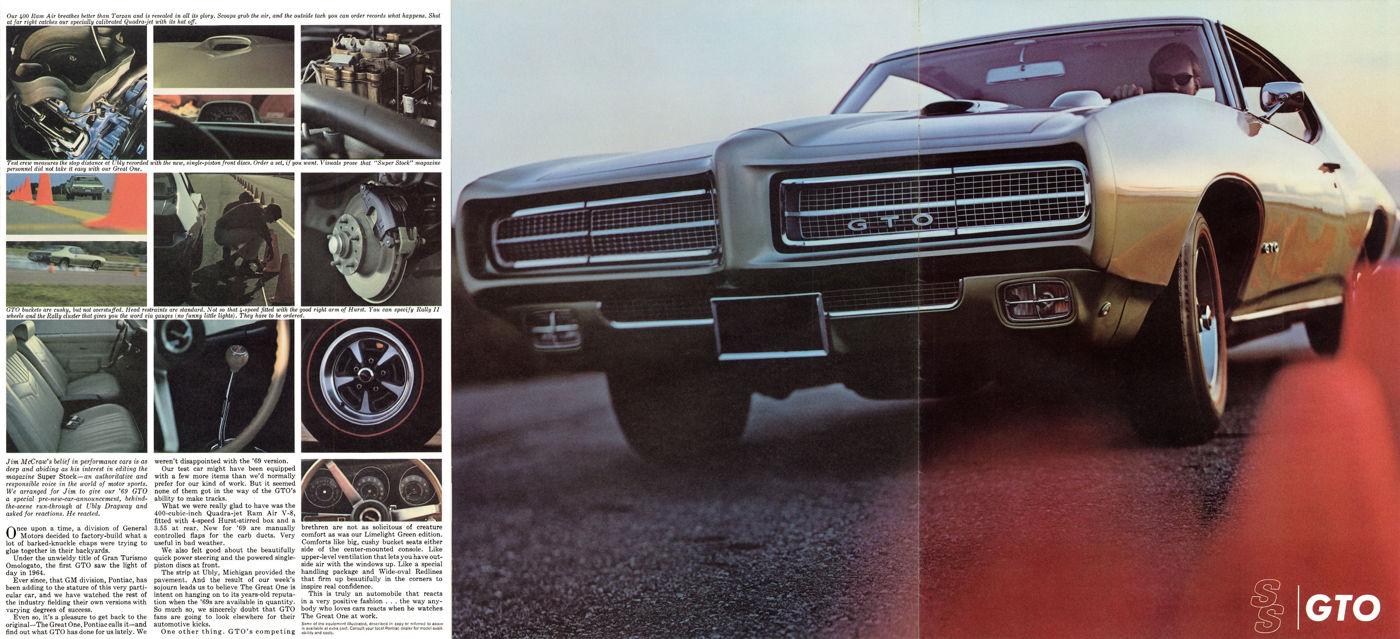
Pontiac’s 1969 GTO story begins with three engines that shared a displacement and refused to mean the same thing. The full-line brochure lists a standard 400, a Ram Air 400, and Ram Air IV. All use a 4.12-inch bore, 3.75-inch stroke, 10.75:1 compression, a Quadrajet four-barrel, and premium fuel. That family resemblance makes it tempting to write one specification and attach three names. Pontiac’s own power-team chart resists the shortcut: output peaks, torque peaks, valve-train descriptions, air systems, transmissions, and axle recommendations change as the buyer moves through the order sheet.
The standard GTO 400 was advertised at 350 horsepower at 5,000 rpm and 445 lb-ft at 3,000. Pontiac emphasized low-back-pressure dual exhaust, and the selected comparison configuration pairs the engine with a four-speed manual. This was not a consolation engine waiting beneath the famous options. It was the foundation of the regular GTO proposition, with substantial torque arriving lower than in either Ram Air version. The selector keeps its factory name and does not call every air-scoop-equipped appearance package a different engine.
The next branch is called “Ram Air” in the inspected 1969 Pontiac literature. Later enthusiasts commonly say Ram Air III, a useful modern alias, but replacing the source’s wording would make the record seem cleaner than the artifact. Pontiac rated this version at 366 horsepower at 5,100 rpm and the same 445 lb-ft at 3,600. Functional scoops, a special camshaft and valve train, and a Power-Flex fan distinguished the package. Moving the torque peak upward was part of its character even though the published maximum did not change.
Ram Air IV moved the peaks again: 370 horsepower at 5,500 rpm and 445 lb-ft at 3,900. Pontiac described a high-output, long-overlap camshaft, heavy-duty springs, free-flow dual exhaust, and functional induction. The full-line chart restricts it to a close-ratio four-speed or Turbo Hydra-Matic and shows a 3.90 standard axle, with 4.33 as a special choice. The release selects the close-ratio manual. It does not attach that transmission or axle to the two lower engines merely because they occupy the same brochure table.
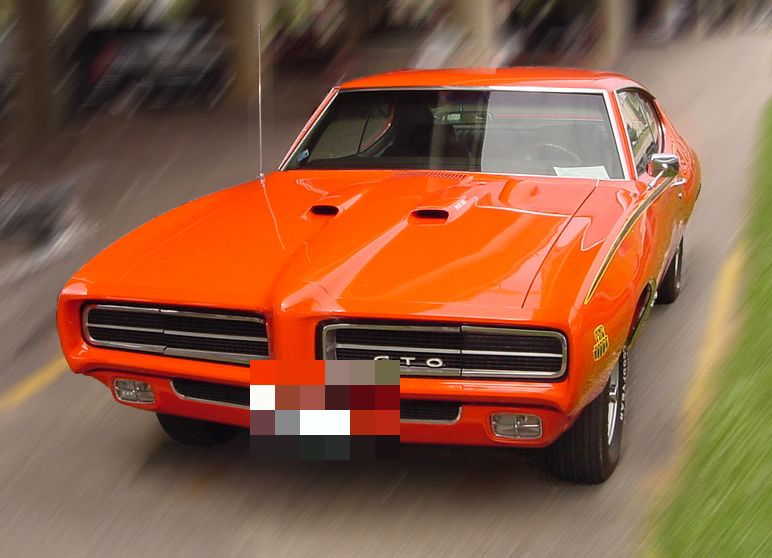
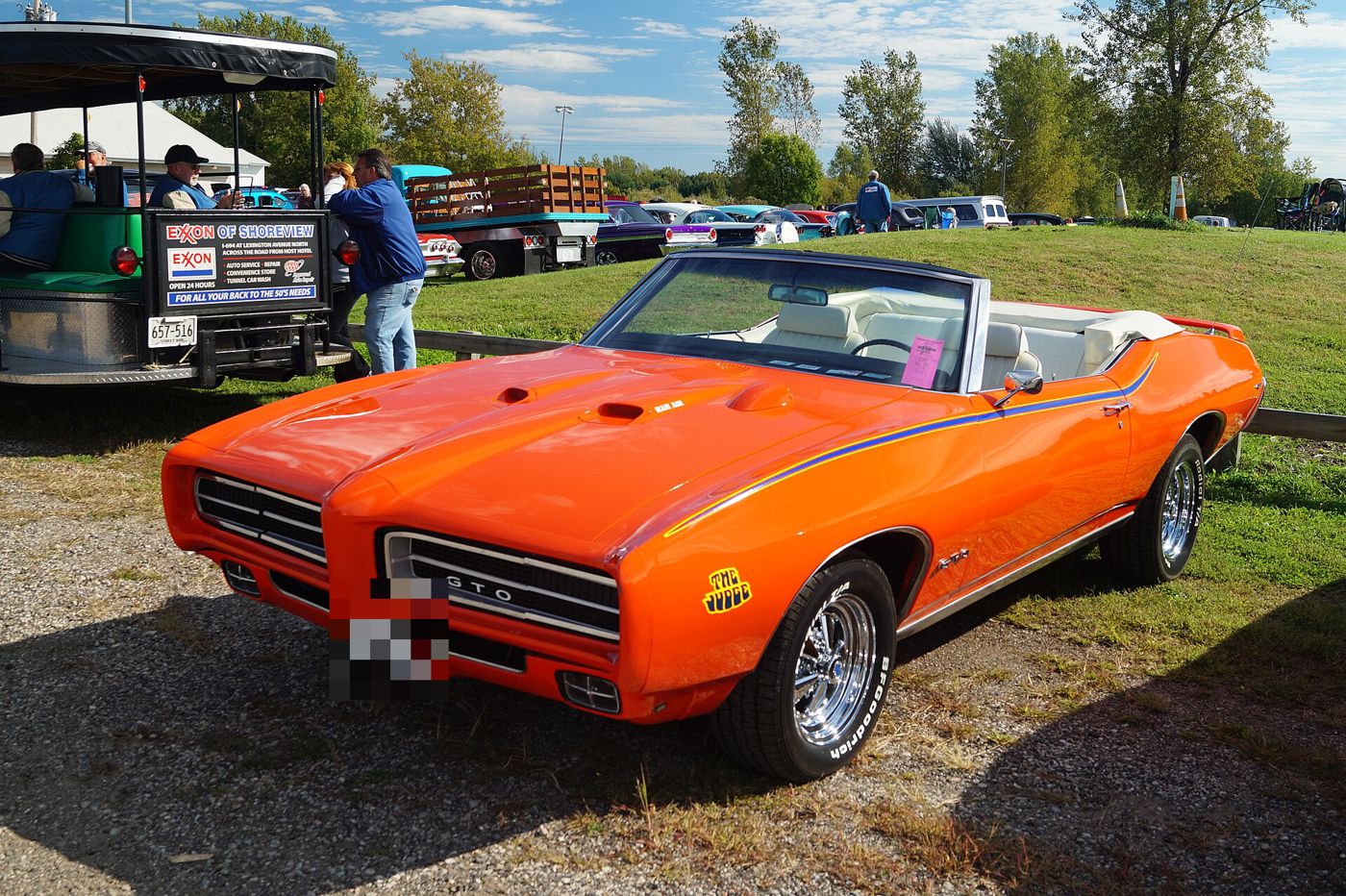
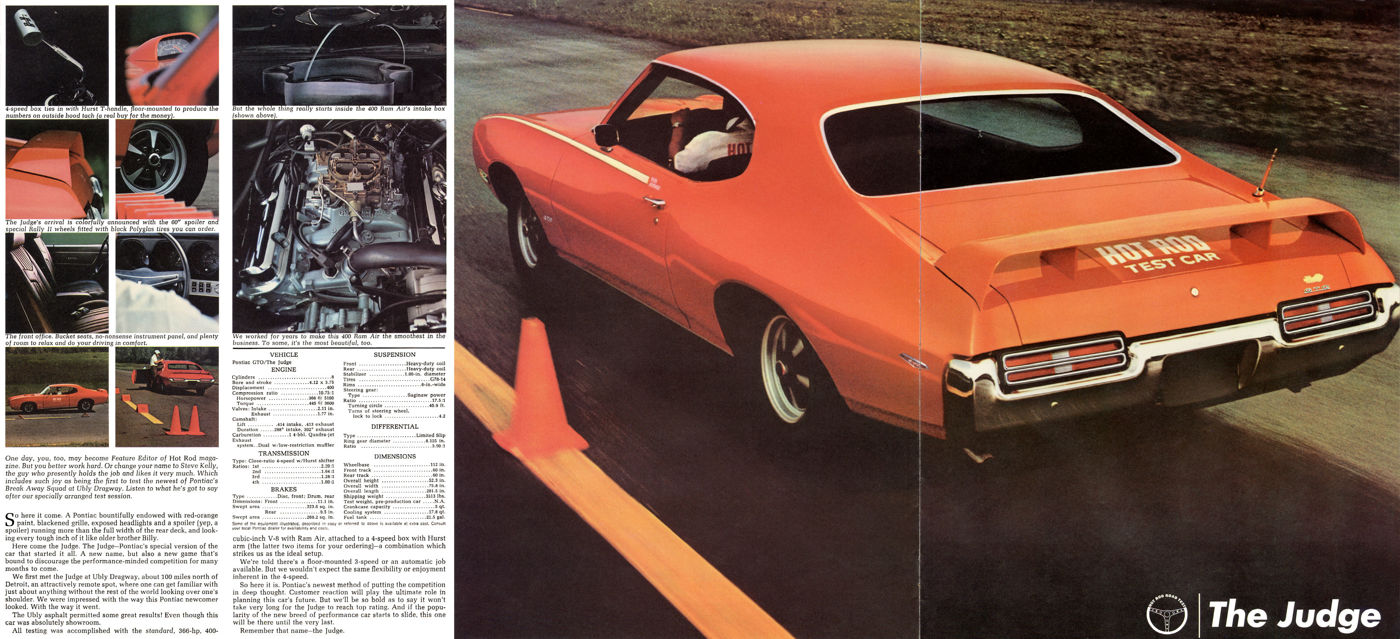
Then the Judge arrived in color, graphics, and advertising language designed to be noticed. It was a factory package built around the GTO and the 366-horsepower Ram Air engine, not a fourth engine family. Pontiac’s performance booklet gives a close-ratio four-speed, 3.90 limited-slip axle, 112-inch wheelbase, 201.5-inch length, and a 3,513-pound shipping weight. “Shipping” remains attached to the number. It is not silently compared with another car’s curb weight or an FIA form’s no-fuel competition definition.
Pontiac also arranged a demonstration at Ubly Dragway and presented the Judge as showroom stock. That event belongs in the story because it shows how the division wanted the car understood: not just as paint and a name, but as a machine whose performance could be staged in public. It does not become an independent road test merely because timed runs were involved. Pontiac selected the venue, supplied the vehicle, and published the account. The resulting claims live in a manufacturer-arranged evidence category rather than a neutral magazine measurement field.
The Judge’s identity can distract from the quieter engineering differences among the three 400s. A comparison reader should be able to select standard GTO, Ram Air, or Ram Air IV and see the rpm, transmission, induction, and axle distinctions before encountering the graphics. That structure also helps authentication. Scoops, spoilers, stripes, and badges can be reproduced. A surviving car needs its own factory and vehicle records before an exterior appearance proves the engine or package underneath.
Production numbers remain outside this first release unless a factory accounting record defines the population. A brochure proves that Pontiac advertised a configuration, not how many left the line. An option total needs a date, body scope, market, and method; a surviving-car registry answers a different question. The same caution applies to claims that one version was deliberately underrated. Pontiac’s published values are stored as period advertised output. Any dynamometer or track number must retain the actual engine, preparation, method, conditions, and source.
The GTO’s 1969 rivals were equally varied. A Chevelle SS 396 L35 delivered its gross-rated 325 horsepower through a four-speed; a Road Runner 383 advertised 335; a 4-4-2 began at 350; and buyers could move into Hemi, W-30, and other specialized branches. Comparing those cars only by the largest horsepower number would miss Pontiac’s three carefully spaced torque peaks and the different equipment around them. The GTO page therefore feeds a configuration selector rather than announcing a winner.
By 1969 Pontiac had turned the GTO from a provocative option into a family of choices and then added the Judge as a public exclamation point. The deeper story is not the slogan. It is the way one 400-cubic-inch architecture could serve a broad-torque street car, a functional Ram Air step, and a more demanding Ram Air IV combination. Preserving Pontiac’s names, its advertised figures, and the limits of its demonstration material lets the noise remain entertaining without allowing it to drown out the order form.
That order form also offers a disciplined path for later evidence. A dated factory bulletin can refine when equipment changed; a build sheet can authenticate one car; an independent magazine test can document one observed result; and a production ledger can define an option population. None needs to overwrite the others. The GTO record is strongest when each source answers its own question and retains its date.
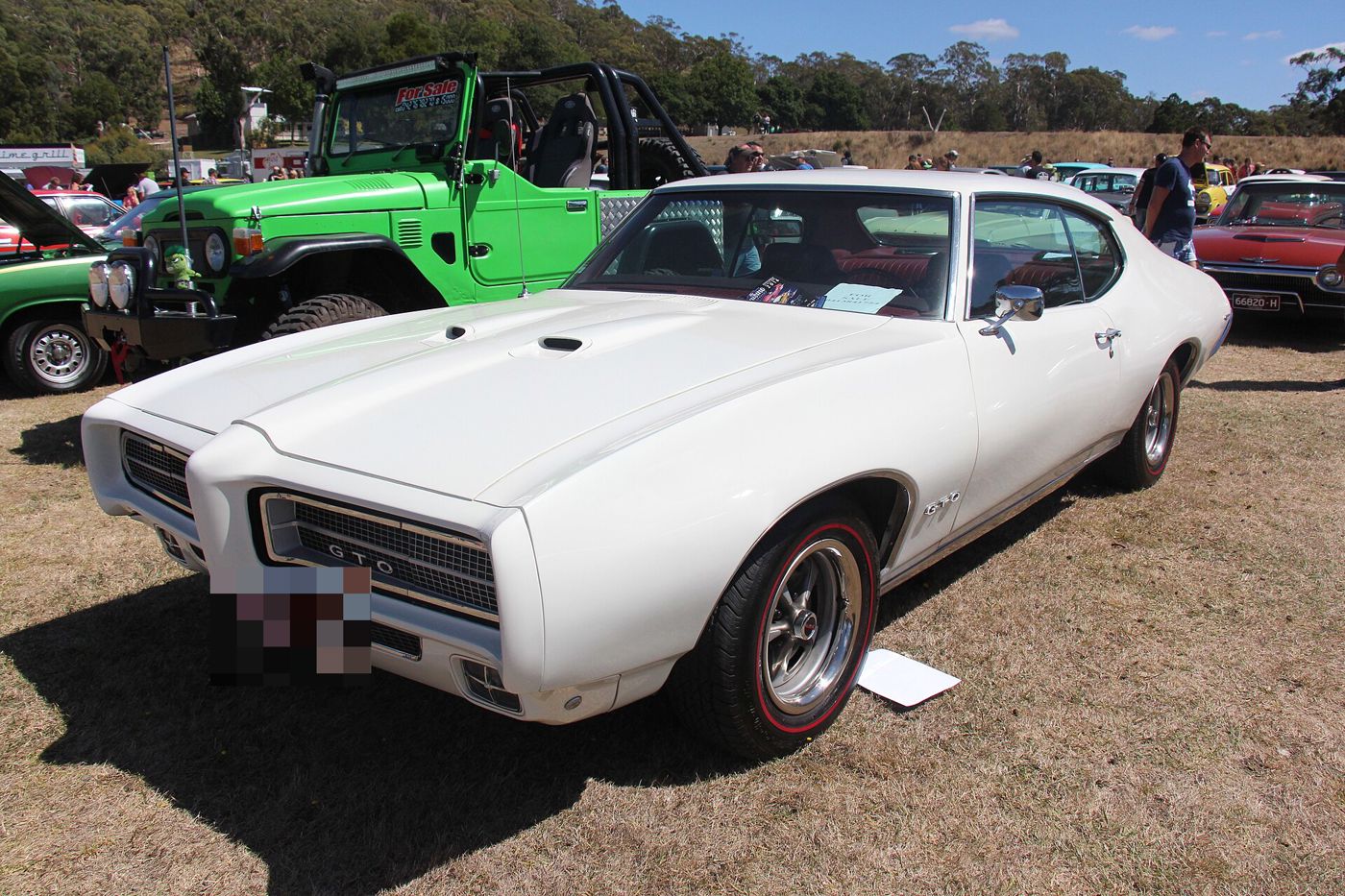
The distinction matters to owners as much as historians. A restored Judge may correctly reproduce every visible cue without proving how the car was born, while an ordinary-looking GTO may retain decisive paperwork. The page therefore treats visual inspection as depiction review, not authentication. Photography can show hardware and design, but publication captions will never use stripes, scoops, or a spoiler alone to certify Ram Air, Ram Air IV, Judge, transmission, or factory originality.
Fact sheet · 1969 · United States
The numbers
1969 Pontiac GTO — Three four-barrel 400s under one nameplate, and the first year of the Judge package built around Ram Air power.
Coverage: Partial — researched sections are shown; missing ones are not yet sourced. Researched through 2026-09-22.
Every figure is labeled with how sure we are. Reported means a manufacturer, registry, or reference figure we cite but have not reconciled against factory records ourselves. Disputed means credible sources disagree and both are shown. Rows are separately scoped; don't add them together unless the note says they make up a total.
Key facts
Production
| What was counted | Count | Basis | Status |
|---|---|---|---|
| GTO total, all bodies, Judge included1,2 GTO incl. Judge · not stated by source Both pages present the same Standard Catalog lineage figure; they are not independent confirmations. | 72,287 | built, model-year | Reported |
| What was counted | Count | Basis | Status |
|---|---|---|---|
| GTO two-door hardtop (excluding Judge)1,2 GTO · 2-door hardtop · not stated by source Listed alongside a separate Judge hardtop row; the source totals treat the four body rows as partitioning 72,287. | 58,126 | built, model-year | Reported |
| GTO convertible (excluding Judge)1,2 GTO · convertible · not stated by source | 7,328 | built, model-year | Reported |
| What was counted | Count | Basis | Status |
|---|---|---|---|
| GTO Judge two-door hardtop3,1 GTO Judge · 2-door hardtop · not stated by source Classic Industries attributes its Judge figures to Pontiac Historic Services documentation. | 6,725 | built, model-year | Reported |
| GTO Judge convertible3,1 GTO Judge · convertible · not stated by source | 108 | built, model-year | Reported |
| GTO Judge, all bodies3 GTO Judge · not stated by source Stated by the source as a total, not summed here. | 6,833 | built, model-year | Reported |
| What was counted | Count | Basis | Status |
|---|---|---|---|
| GTO and Judge, synchromesh (manual) transmission5 GTO including Judge · 400 · manual (synchromesh) · not stated by source | 31,433 | built, model-year | Reported |
| GTO and Judge, automatic transmission5 GTO including Judge · 400 · automatic · not stated by source With the manual row this sums to the 72,287 total. | 40,854 | built, model-year | Reported |
| What was counted | Count | Basis | Status |
|---|---|---|---|
| GTO and Judge with Ram Air III (codes YZ or WS)5 GTO including Judge · 400 Ram Air (III) · not stated by source | 8,941 | built, model-year | Reported |
| GTO and Judge with Ram Air IV (codes XP or WW)5 GTO including Judge · 400 Ram Air IV · not stated by source | 759 | built, model-year | Reported |
The four body rows (hardtop, convertible, Judge hardtop, Judge convertible) are presented by the sources as partitioning the 72,287 total. The hardtop and convertible rows exclude Judges.
No attributed engine, transmission, axle, paint, or trim counts were found. Unattributed figures are listed under unpublishedLeads.
Prices when new
| Model | Price | Basis |
|---|---|---|
| List price, GTO Judge hardtop as tested by Car Life (list, FOB factory)4 | $3,493 | list price FOB factory as printed in the road-test data panel, 1969-03 |
| Price as tested, Car Life Judge (Ram Air IV, four-speed, discs, power steering, radio, hood tach, Polyglas tires)4 | $4,439 | equipped as tested, as printed, 1969-03 |
Prices are the nominal dollars of the day, not adjusted for inflation.
Engines
| Engine | Factory rating | Availability | Built |
|---|---|---|---|
| 400 4-bbl (standard GTO) 400 cu in · Rochester Quadrajet 4-barrel | 350 hp @ 5,000, 445 lb-ft @ 3,000 (SAE gross) | standard, GTO (Judge excluded) | Not yet sourced |
| 400 Ram Air (later called Ram Air III) 400 cu in · Rochester Quadrajet 4-barrel, functional hood scoops | 366 hp @ 5,100, 445 lb-ft @ 3,600 (SAE gross) | optional GTO; standard Judge | Not yet sourced |
| 400 Ram Air IV4 400 cu in · Rochester Quadrajet 4-barrel, functional hood scoops | 370 hp @ 5,500, 445 lb-ft @ 3,900 (SAE gross) | optional GTO and Judge; close-ratio four-speed or Turbo Hydra-Matic only | Not yet sourced |
| 400 2-bbl economy2 400 cu in · Rochester 2-barrel | 265 hp @ 4,600, 397 lb-ft @ 2,400 (SAE gross) | GTO with automatic only, per secondary fact sheet | Not yet sourced |
Ratings are the manufacturer's advertised figures under the standard shown (SAE gross before 1972, SAE net after). They are not dyno results, and gross and net ratings can't be compared directly.
Transmissions
| Transmission | Availability | Built |
|---|---|---|
| Close-ratio four-speed manual (Hurst T-handle shifter on Judge)4 | optional; one of two transmissions listed for Ram Air IV | Not yet sourced |
| Turbo Hydra-Matic three-speed automatic | optional | Not yet sourced |
Options and packages
| Code | Option | Price | Installed |
|---|---|---|---|
|
The Judge package2 | $332 | 6,8333 Reported |
|
Ram Air IV engine (on Judge)4 | $390 | Not yet sourced |
|
Front disc brakes4 | $64 | Not yet sourced |
|
Four-speed transmission4 | $195 | Not yet sourced |
|
Power steering4 | $100 | Not yet sourced |
|
Polyglas tires4 | $72 | Not yet sourced |
|
AM radio4 | $61 | Not yet sourced |
|
Hood-mounted tachometer4 | $63 | Not yet sourced |
Paint
| Code | Color | Built |
|---|---|---|
10 |
Starlight Black2 | Not yet sourced |
40 |
Mayfair Maize2 | Not yet sourced |
50 |
Cameo Ivory2 | Not yet sourced |
51 |
Liberty Blue2 | Not yet sourced |
52 |
Matador Red2 | Not yet sourced |
53 |
Warwick Blue2 | Not yet sourced |
55 |
Crystal Turquoise2 | Not yet sourced |
57 |
Midnight Green2 | Not yet sourced |
59 |
Limelight Green2 | Not yet sourced |
61 |
Expresso Brown2 | Not yet sourced |
63 |
Champagne2 | Not yet sourced |
65 |
Antique Gold2 | Not yet sourced |
67 |
Burgundy2 | Not yet sourced |
69 |
Palladium Silver2 | Not yet sourced |
72 |
Carousel Red2 | Not yet sourced |
73 |
Verdoro Green2 | Not yet sourced |
Color names are the factory's. We don't show color swatches, because a screen color is no guide for a restoration.
Interiors
| Code | Trim | Built |
|---|---|---|
238,258,268 |
Black (vinyl, per the page's key) [LeMans & GTO trim list]6 | Not yet sourced |
250,260 |
Blue (vinyl, per the page's key) [LeMans & GTO trim list]6 | Not yet sourced |
252,262 |
Gold (vinyl, per the page's key) [LeMans & GTO trim list]6 | Not yet sourced |
254 |
Red (vinyl, per the page's key) [LeMans & GTO trim list]6 | Not yet sourced |
256,266 |
Green (vinyl, per the page's key) [LeMans & GTO trim list]6 | Not yet sourced |
257,267 |
Parchment (vinyl, per the page's key) [LeMans & GTO trim list]6 | Not yet sourced |
Specifications
| Measure | Value | Applies to |
|---|---|---|
| Wheelbase | 112 in | GTO and Judge, all bodies |
| Overall length | 201.5 in | Judge |
| Shipping weight | 3,513 lb | Judge hardtop as described in the performance booklet |
| Bore x stroke, all GTO 400s | 4.12 x 3.75 in | 400 V8 |
| Compression ratio, four-barrel 400s | 10.75:1 | 400, Ram Air, Ram Air IV |
| Standard axle, Ram Air IV | 3.9 ratio | Ram Air IV; 4.33 listed as special |
Period road tests
| Test | Car tested | Result |
|---|---|---|
| Car Life, 1969-0340-60 mph | Judge hardtop, 400 Ram Air IV (370 hp gross), four-speed, 3.55 limited-slip, G70x14 Polyglastest weight 4,030 lb; shift points 6,000 rpm | 6.2 s |
| Car Life, 1969-0340-100 mph | Judge hardtop, 400 Ram Air IV (370 hp gross), four-speed, 3.55 limited-slip, G70x14 Polyglastest weight 4,030 lb | 15.3 s |
| Car Life, 1969-034standing quarter mile | Judge hardtop, 400 Ram Air IV (370 hp gross), four-speed, 3.55 limited-slip, G70x14 Polyglastrap speed 97.8 mph; test weight 4,030 lb | 14.45 s |
| Car Life, 1969-034top speed | Judge hardtop, 400 Ram Air IV (370 hp gross), four-speed, 3.55 limited-slip, G70x14 Polyglasat 5,800 rpm | 124 mph |
| Car Life, 1969-034curb weight | Judge hardtop, 400 Ram Air IV, four-speed, 3.55as reported by magazine | 3,735 lb |
| Car Life, 1969-034fuel consumption, normal conditions | Judge hardtop, 400 Ram Air IV, four-speed, 3.557.8 mpg under test conditions | 9-11 mpg |
A road test result belongs to the one car that was tested, with its engine, gearing, tires, and conditions. It is not a figure for every car of the year.
Identification
- Body (cowl) plate
- Body (cowl) plate riveted to the top left cowl under the hood. It carries the build date (month 01-12 and week A-E), the style number (year, series and body style), the body number (assembly-plant prefix and production sequence), the trim code, the lower and upper paint codes, and factory accessory codes. The page's example plate reads: Build Date 12B; Style 69-26267; Body BL 8XX; Trim 568; Paint 65; ACC. 12B A31.6
- Body-plate assembly-plant codes
- ATL = Atlanta, GA; PON = Pontiac, MI; BAL = Baltimore, MD; LOR = Lordstown, OH; BC = Southgate, CA; NOR = Norwood, OH; E = Linden, NJ; X = Kansas City, KS; FRA = Framingham, MA; Z = Fremont, CA; LOS = Van Nuys, CA; OS = Oshawa, Ont. CAN.6
Identification
Read a 1969 Pontiac VIN
The VIN decoder runs in your browser and never sends the VIN anywhere. How the factory numbered this year's cars:
Same model year
Also in 1969
- AMC AMX The two-seat AMX's biggest year: 8,293 cars by the enthusiast production table, with a mid-year run of Big Bad colors and 52 Hurst-built Super Stock AMXs for NHRA drag racing.
- AMC Javelin Production fell to 40,675, but the 1969 Javelin added the Big Bad colors, with 2,282 cars painted blue, green or orange, plus the Mod package.
- AMC Rebel and Rebel Machine A base and SST Rebel with no convertible. The Big Bad colors were test-marketed through the New York–New Jersey 'Raider' hardtop. This is host-car context for the 1970 Machine.
- Buick Riviera Another record at 52,872 Rivieras; 5,272 had the GS handling option.
- Buick Skylark Gran Sport, GS and GSX GS production fell to 12,465, and the GS 400's Stage 1 package became a factory option while Stage 2 stayed a dealer item.
- Buick Wildcat 67,453 Wildcats; the last year of the 430.
- Chevrolet Chevelle and Malibu SS Super Sport became RPO Z25 option equipment, available for 1969 only on the 300 Deluxe coupes as well as Malibu sport coupe, convertible and El Camino.
- Chevrolet Chevy II and Nova SS is RPO Z26 per the source, with L48, L34 and L78 engines. Enthusiast-compiled production: 251,849 cars; Super Sport 17,564.
- Chevrolet El Camino SS SS 396 became RPO Z25 option equipment, orderable on the V8 Malibu El Camino (13680); the El Camino share of the 86,307 Z25s is not separately published.
- Chevrolet Impala SS Only the SS427 (RPO Z24) remains; the reported count ranges from 2,425 to about 2,455.
- Dodge Charger The second-generation Charger's peak-sales year added the SE package and the aero-bodied Charger 500 and Charger Daytona homologation cars, whose production totals are still disputed.
- Dodge Coronet R/T and Super Bee The Super Bee added a hardtop body and the 440 Six Pack, while the 440-powered Coronet R/T continued as the upscale hardtop and convertible.
- Dodge Dart GTS, Swinger and Demon The low-priced Swinger 340 arrived and outsold the GTS by more than two to one (16,637 against about 6,700), while a 375 hp 440 joined the GTS options.
- Ford Fairlane The Fairlane hardtop was the intermediate line's volume leader, while the Fairlane 500 SportsRoof shared its body with the Torino GT, Cobra and Talladega.
- Ford Ranchero GT The Ranchero GT carried Torino GT trim; 1,658 GTs were built, per reference-site counts in the Standard Catalog lineage.
- Ford Thunderbird Fifth-generation Thunderbird; only the whole-line production total was found.
- Ford Torino The Torino GT carried most of the line's volume, the 428 Cobra Jet was in its first full year, and the Talladega aero fastback was built in a short run at Atlanta to homologate a NASCAR nose.
- Mercury Comet and Cyclone The Cyclone fastback came as Cyclone and Cyclone CJ, mid-year Spoilers carried Dan Gurney and Cale Yarborough graphics, and the extended-nose Cyclone Spoiler II was built at Lorain for NASCAR homologation.
- Mercury Cougar A longer, restyled Cougar added a convertible, the Boss 302 arrived in April, and the Eliminator replaced the GT as the performance Cougar.
- Mercury Marauder and S-55 The Marauder name returned on a full-size hardtop, and the X-100 carried the 360 hp 429 four-barrel as its only engine.
- Oldsmobile Cutlass, 4-4-2 and Hurst/Olds The 4-4-2 kept its 400 while the second Hurst/Olds, in white and gold with a 380 hp 455, went into production at about 900 cars.
- Plymouth Barracuda and 'Cuda The last A-body Barracuda introduced the 'Cuda name as a stripped performance package with a standard 340, alongside Formula S and a midyear 440.
- Plymouth GTX, Belvedere and Satellite The GTX shared the Road Runner's new Air Grabber scoop and Super Track Pack but sold 15,602 cars, fewer than a fifth of the cheaper Road Runner.
- Plymouth Road Runner A convertible joined the coupe and hardtop, the 440 Six Barrel arrived at mid-year, and the Road Runner reached its production peak of 84,420.
- Pontiac Firebird and Trans Am The last first-generation Firebird, and the mid-year debut of the Trans Am package: 697 cars by the commonly published count, eight of them convertibles.
- Pontiac Grand Prix A new 118-inch Grand Prix with the SJ and a 390 hp 428 HO: production more than tripled to 112,486.
- Pontiac Tempest and LeMans The last year of the OHC Sprint six and the 350 HO.
- Rambler American and SC/Rambler AMC and Hurst put the 315-hp 390 V8 and a close-ratio four-speed into the compact Rambler hardtop for NHRA F/Stock. 1,512 were built, and the split between the two paint schemes is disputed.