1969 · Chevrolet · United States
1969 Chevrolet Nova: The Name Loses the Chevy II, the SS Finds Its Buyers
SS is RPO Z26 per the source, with L48, L34 and L78 engines. Enthusiast-compiled production: 251,849 cars; Super Sport 17,564.
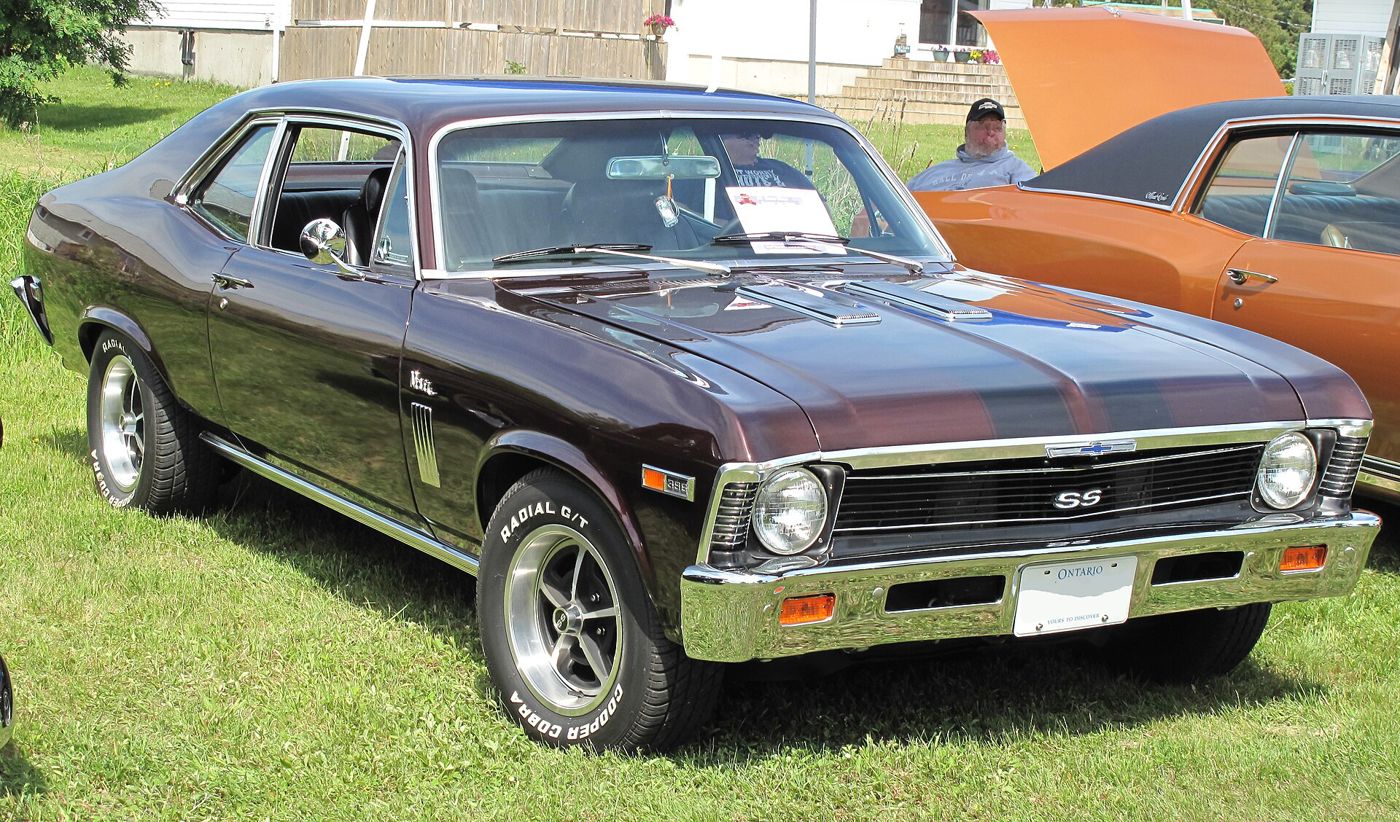

For 1969 Chevrolet took the words Chevy II off its compact. The car was now simply the Chevrolet Nova, and the trunk badge changed from 'Chevy II by Chevrolet' to 'Nova by Chevrolet.' The rename came on a car that had just been rebuilt: the 1968 body on a 111-inch wheelbase, with a front subframe engineered to take the 396. In 1968 that combination had found only 5,571 Super Sport buyers. In 1969 Chevrolet built 17,564, more than three times as many, and the compact big-block became a real part of Chevrolet's performance line.1,2,3,4
The Super Sport was RPO Z26 on the two-door V-8 Nova, style 11427 on the cowl tag, and the cars were built at Willow Run, Michigan. The SS option cost $312, unchanged from 1968, and the package now brought front disc brakes as standard equipment. The base SS engine, the L48 350, went from 295 to 300 hp. Above it sat the same two 396s as before: the L34 at 350 hp and the L78 at 375 hp, both SAE gross. The new Turbo Hydra-Matic 350 (M38) joined the heavier 400 on the 1969 transmission list.4,1
Below the Super Sport, the Nova was still the sensible compact it had always been. Its engines ran from a 90 hp 153 four through 140 and 155 hp sixes and the 200 hp 307 to two ordinary 350s, the L65 at 250 hp and the LM1 at 255. The line grew to 251,849 cars, 68,297 more than 1968; Wikipedia's table rounds it to 251,900. Two-doors were 182,379, about 72 percent, and roughly one two-door in ten was a Super Sport. Six-cylinder cars were 157,353, about 62 percent, and Powerglide went into 148,360. V-8s rose to 88,393, about 35 percent of the line, up from about 26 percent the year before.4,1
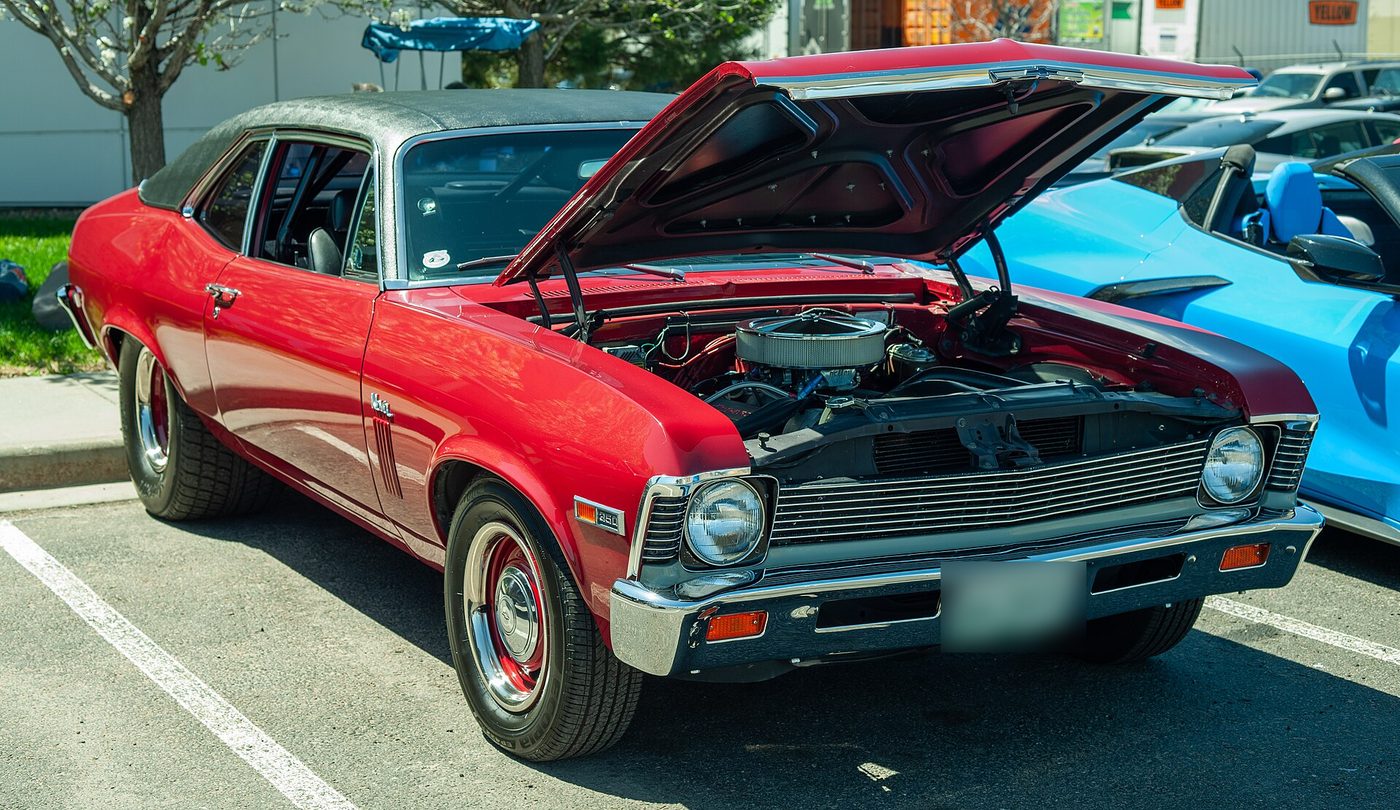

Inside those totals the performance car had grown up. The 17,564 Super Sports were about 7 percent of all Novas, up from 3 percent in 1968. Chevrolet installed 7,209 396 engines, eight times the 901 of the year before. SS396.com, citing RPO data, splits the Super Sports into 10,356 L48 350s, 1,947 L34 396s and 5,262 L78 396s. Its two 396 figures add exactly to NovaResource's 7,209, while its three engine counts total 17,565, one more than the SS figure both publish. Read against the SS total, about 30 percent of 1969 Nova Super Sports had the 375 hp L78.4,2
That L78 share is the striking number of the year. Chevelle option counts show 86,307 SS 396 packages for 1969 and 9,486 L78 engines in them, about 11 percent. The Nova's 5,262 L78s were more than half as many as the Chevelle's, in a Super Sport line one-fifth the size. The mid-size SS buyer mostly took the milder 396s, 59,786 of them L35s. Among Nova buyers who paid for a big-block, nearly three in four took the solid-lifter L78.5,2,4
The order form paired engines and transmissions by rule. The 396 came with the three- and four-speed manuals or the Turbo Hydra-Matic 400, and the 307 and 350 with Powerglide, the manuals or the new Turbo Hydra-Matic 350. The four- and six-cylinder cars could also have Torque-Drive, a semi-automatic based on the Powerglide. Chevrolet built 21,559 Torque-Drive Novas for 1969, up from 9,990, a reminder that the same body served buyers who wanted a cheaper automatic as well as those who wanted the M22 four-speed known as the Rock Crusher.1,6,4
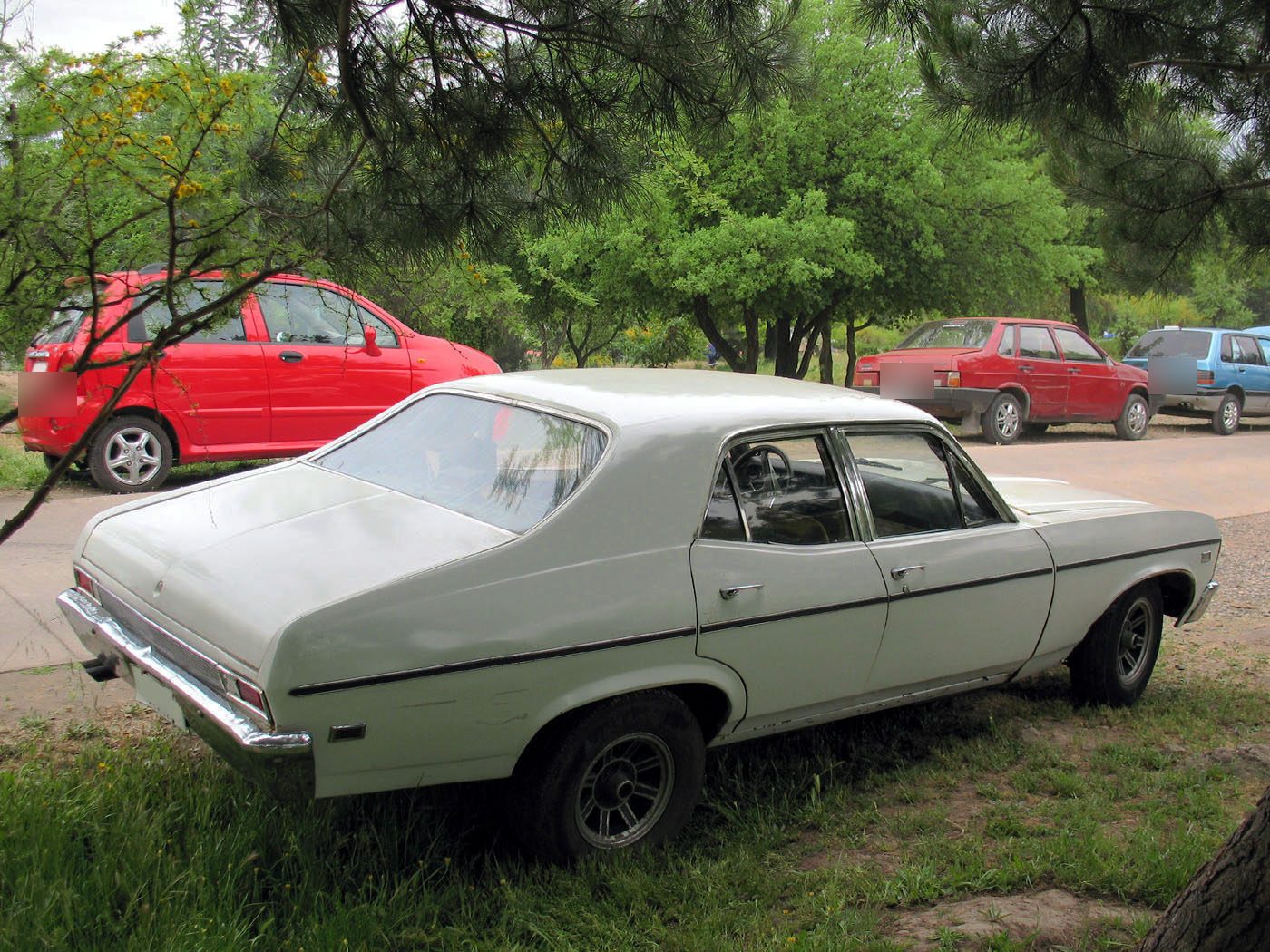

The transmission counts tell the same story from the driveline. Chevrolet put 682 M22 heavy-duty four-speeds in 1969 Novas, four times the 167 of 1968, plus 3,751 close-ratio M21s and 10,036 wide-ratio M20s. The new Turbo Hydra-Matic 350 went into 27,704 cars, and the big Turbo Hydra-Matic 400 into 1,411, up from 98. These counts include the Canadian Acadian, which is folded into the 1968 through 1971 engine and transmission counts, so they describe the whole line rather than Chevrolet-badged Super Sports alone.4
The Nova also changed what an ordinary buyer could get. Subtracting SS396.com's 10,356 SS 350s from NovaResource's 18,485 350 engines leaves about 8,100 350s outside the Super Sport, the L65 and LM1 in plain two- and four-door Novas, with the caveat that the two counts come from different compilations. A shopper who wanted a quiet compact with a small-block and a Turbo Hydra-Matic 350 could now have one without stripes or badges. The 307 was never offered with a four-barrel; the 350 came in two-barrel and four-barrel forms for Novas without the SS.4,2,6
The compact field around the Nova had become crowded. Dodge's new, low-priced Dart Swinger 340 reached 16,637 cars, close to the Nova's whole Super Sport total, and outsold the Dart GTS, about 6,700, by more than two to one. Plymouth introduced the 'Cuda, a 340 package that Car Life called a pocket Road Runner and timed at 14.93 seconds for the quarter mile with a four-speed. American Motors and Hurst put a 315 hp 390 into a Rambler hardtop and built 1,512 SC/Ramblers aimed at NHRA F/Stock. Beyond the showroom, Don Yenko's dealership converted Novas with 427s, a dealer conversion rather than a Chevrolet model.7,8,9,10,1,2
The peak for the big-block Nova was brief. Chevrolet built 19,558 Super Sports for 1970 but only 5,567 big-block engines, and 1970 was the last year for the SS 396, by then actually a 402. After that the Nova Super Sport would be a small-block car, and the next headline Nova from a dealer, the 1970 Yenko Deuce, used the high-output 350 it shared with the Z28 Camaro and LT1 Corvette. In 1969, though, the arithmetic was at its best: 17,564 Super Sports, 7,209 396s and 5,262 L78s in a car that a year earlier had still worn the Chevy II name. It was the year the compact's performance buyers finally showed up in numbers.4,1,2
Fact sheet · 1969 · United States
The numbers
1969 Chevrolet Nova: SS is RPO Z26 per the source, with L48, L34 and L78 engines. Enthusiast-compiled production: 251,849 cars; Super Sport 17,564.
Figures may describe different groups of cars. Add rows together only when the note says they make up a total.
Key facts
Production
| What was counted | Built |
|---|---|
| Chevy II / Nova, all series4 US tabulation (source does not state geography) | 251,849 |
| What was counted | Built |
|---|---|
| Super Sport4 Super Sport · US tabulation (source does not state geography) | 17,564 |
| What was counted | Built |
|---|---|
| 2-door (source column "2 Door Sedan")4 2-door (source column "2 Door Sedan") · US tabulation (source does not state geography) | 182,379 |
| 4-door sedan4 4-door sedan · US tabulation (source does not state geography) | 69,470 |
| What was counted | Built |
|---|---|
| Four-cylinder cars4 L4 · US tabulation (source does not state geography) | 6,103 |
| Six-cylinder cars4 L6 · US tabulation (source does not state geography) | 157,353 |
| V8 cars4 V8 · US tabulation (source does not state geography) | 88,393 |
| 153 I4 engines installed4 153 I4 · US tabulation (source does not state geography) | 6,103 |
| 230 I6 engines installed4 230 I6 · US tabulation (source does not state geography) | 94,215 |
| 250 I6 engines installed4 250 I6 · US tabulation (source does not state geography) | 68,509 |
| 307 V8 engines installed4 307 V8 · US tabulation (source does not state geography) | 64,207 |
| 350 V8 engines installed4 350 V8 · US tabulation (source does not state geography) | 18,485 |
| 396 V8 engines installed4 396 V8 · US tabulation (source does not state geography) | 7,209 |
| What was counted | Built |
|---|---|
| 3-speed manual installed4 3-speed manual · US tabulation (source does not state geography) | 45,225 |
| M20 4-speed installed4 M20 4-speed · US tabulation (source does not state geography) | 10,036 |
| M21 4-speed installed4 M21 4-speed · US tabulation (source does not state geography) | 3,751 |
| M22 4-speed installed4 M22 4-speed · US tabulation (source does not state geography) | 682 |
| Torque Drive installed4 Torque Drive · US tabulation (source does not state geography) | 21,559 |
| M35 Powerglide installed4 M35 Powerglide · US tabulation (source does not state geography) | 148,360 |
| M38 Turbo Hydra-Matic 350 installed4 M38 Turbo Hydra-Matic 350 · US tabulation (source does not state geography) | 27,704 |
| M40 Turbo Hydra-Matic 400 installed4 M40 Turbo Hydra-Matic 400 · US tabulation (source does not state geography) | 1,411 |
Engines
| Engine | Factory rating | Availability |
|---|---|---|
| 153 I44 153 cu in · 1-barrel carburetor | 90 hp @ 4,000, 152 lb-ft @ 2,400 (SAE gross) | offered |
| L26 · 230 I6 (L26)4 230 cu in · 1-barrel carburetor | 140 hp @ 4,400, 220 lb-ft @ 1,600 (SAE gross) | offered |
| L22 · 250 I6 (L22)4 250 cu in · 1-barrel carburetor | 155 hp @ 4,200, 235 lb-ft @ 1,600 (SAE gross) | offered |
| L14 · 307 V8 (L14)4 307 cu in · 2-barrel carburetor | 200 hp @ 4,600, 300 lb-ft @ 2,400 (SAE gross) | offered |
| L65 · 350 V8 (L65)4 350 cu in · 2-barrel carburetor | 250 hp @ 4,800, 345 lb-ft @ 2,800 (SAE gross) | offered |
| LM1 · 350 V8 (LM1)4 350 cu in · 4-barrel carburetor | 255 hp @ 4,800, 365 lb-ft @ 3,200 (SAE gross) | offered |
| L48 · 350 V8 (L48)4 350 cu in · 4-barrel carburetor | 300 hp @ 4,800, 380 lb-ft @ 3,200 (SAE gross) | offered |
| L34 · 396 V8 (L34)4 396 cu in · 4-barrel carburetor | 350 hp @ 5,200, 415 lb-ft @ 3,400 (SAE gross) | offered |
| L78 · 396 V8 (L78)4 396 cu in · 4-barrel carburetor | 375 hp @ 5,600, 415 lb-ft @ 3,600 (SAE gross) | offered |
Ratings are published figures, not dyno results. Gross and net ratings aren't directly comparable.
Transmissions
| Transmission | Availability | Built |
|---|---|---|
| 3-speed manual4 | offered | 45,2254 |
| M20 · M20 4-speed4 | offered | 10,0364 |
| M21 · M21 4-speed4 | offered | 3,7514 |
| M22 · M22 4-speed4 | offered | 6824 |
| Torque Drive4 | offered | 21,5594 |
| M35 · M35 Powerglide4 | offered | 148,3604 |
| M38 · M38 Turbo Hydra-Matic 3504 | offered | 27,7044 |
| M40 · M40 Turbo Hydra-Matic 4004 | offered | 1,4114 |
Options and packages
| Code | Option |
|---|---|
Z26RPO |
Super Sport with 350 cu in V8 (RPO L48) or 396 cu in V8 (RPO L34, L78), coupe only: special hood ornaments, black-painted grille and rear panel trim plate, hood insulator, black steering wheel, shroud and column, SS steering-wheel, grille and rear-panel emblems, E70-14 red-stripe wide-oval tires on 14x7 wheels, engine dress items, special front and rear springs and rear shocks, power front disc brakes |
ZJ1RPO |
Custom Interior (blue, green, dark green and black) |
A51RPO |
Bucket front seats (black, blue, red; coupe only) |
ZJ3RPO |
Special Interior Group |
C08RPO |
Vinyl roof (black, parchment, midnight green, dark blue, dark brown) |
B90RPO |
Bright scalp moldings (sedan only) |
ZJ5RPO |
Exterior Decor Package |
ZJ2RPO |
Custom Exterior (coupe version adds body-side paint stripe and black lower paint) |
Paint
| Code | Color |
|---|---|
10 |
Tuxedo Black4 |
40 |
Butternut Yellow4 |
50 |
Dover White4 |
51 |
Dusk Blue4 |
52 |
Garnet Red4 |
53 |
Glacier Blue4 |
55 |
Azure Turquoise4 |
57 |
Fathom Green4 |
59 |
Frost Lime4 |
61 |
Burnished Brown4 |
63 |
Champagne4 |
65 |
Olympic Gold4 |
67 |
Burgundy4 |
69 |
Cortez Silver4 |
71 |
LeMans Blue4 |
79 |
Rallye Green4 |
Color names are the factory's. We don't show color swatches, because a screen color is no guide for a restoration.
Interiors
| Code | Trim |
|---|---|
731 |
Black vinyl bench (standard)4 |
732 |
Black vinyl bench (custom)4 |
733 |
Black vinyl buckets4 |
735 |
Medium Blue cloth bench (standard)4 |
736 |
Medium Blue cloth bench (custom)4 |
737 |
Medium Blue vinyl buckets4 |
742 |
Medium Green cloth bench (standard)4 |
743 |
Medium Green cloth bench (custom)4 |
744 |
Midnight Green cloth bench (custom)4 |
745 |
Midnight Green vinyl bench (custom)4 |
746 |
Medium Red vinyl buckets4 |
Identification
- Cowl tag series and body codes
- Cowl-tag series: 11 Nova L4, 13 Nova L6, 14 Nova V8; body 27 = 2-door, 69 = 4-door sedan. Super Sport is RPO Z26 on the 2-door V8 (style 11427).4
- Assembly plants (cowl-tag codes)
- WRN Willow Run MI4
Identification
Read a 1969 Chevrolet VIN
The VIN decoder runs in your browser and never sends the VIN anywhere. How the factory numbered this year's cars:
Same model year
Also in 1969
- AMC AMX The two-seat AMX's biggest year: 8,293 cars by the enthusiast production table, with a mid-year run of Big Bad colors and 52 Hurst-built Super Stock AMXs for NHRA drag racing.
- AMC Javelin Production fell to 40,675, but the 1969 Javelin added the Big Bad colors, with 2,282 cars painted blue, green or orange, plus the Mod package.
- AMC Rebel and Rebel Machine A base and SST Rebel with no convertible. The Big Bad colors were test-marketed through the New York–New Jersey 'Raider' hardtop. This is host-car context for the 1970 Machine.
- Buick Riviera Another record at 52,872 Rivieras; 5,272 had the GS handling option.
- Buick Skylark Gran Sport, GS and GSX Stage 1 became a factory GS 400 option, alongside distinct GS 350 and California GS choices; output, base-price and convertible-count disputes remain visible.
- Buick Wildcat 67,453 Wildcats; the last year of the 430.
- Chevrolet Chevelle and Malibu SS Super Sport became RPO Z25 option equipment, available for 1969 only on the 300 Deluxe coupes as well as Malibu sport coupe, convertible and El Camino.
- Chevrolet El Camino SS SS 396 became RPO Z25 option equipment on the V8 Malibu El Camino, with 396s up to 375 hp; 86,307 Z25s across eligible models.
- Chevrolet Impala SS Only the SS427 (RPO Z24) remains; the reported count ranges from 2,425 to about 2,455.
- Dodge Charger The second-generation Charger's peak-sales year added the SE package and the aero-bodied Charger 500 and Charger Daytona homologation cars, whose production totals are still disputed.
- Dodge Coronet R/T and Super Bee The Super Bee added a hardtop body and the 440 Six Pack, while the 440-powered Coronet R/T continued as the upscale hardtop and convertible.
- Dodge Dart GTS, Swinger and Demon The low-priced Swinger 340 arrived and outsold the GTS by more than two to one (16,637 against about 6,700), while a 375 hp 440 joined the GTS options.
- Ford Fairlane The Fairlane hardtop was the intermediate line's volume leader, while the Fairlane 500 SportsRoof shared its body with the Torino GT, Cobra and Talladega.
- Ford Ranchero GT A second year of Torino GT trim on the Ranchero: 1,658 GTs, with a separate line of 727 listed with bucket seats.
- Ford Thunderbird Fifth-generation Thunderbird; only the whole-line production total was found.
- Ford Torino The Torino GT carried most of the line's volume, the 428 Cobra Jet was in its first full year, and the Talladega aero fastback was built in a short run at Atlanta to homologate a NASCAR nose.
- Mercury Comet and Cyclone The Cyclone fastback came as Cyclone and Cyclone CJ, mid-year Spoilers carried Dan Gurney and Cale Yarborough graphics, and the extended-nose Cyclone Spoiler II was built at Lorain for NASCAR homologation.
- Mercury Cougar A longer, restyled Cougar added a convertible, the Boss 302 arrived in April, and the Eliminator replaced the GT as the performance Cougar.
- Mercury Marauder and S-55 The Marauder name returned on a full-size hardtop, and the X-100 carried the 360 hp 429 four-barrel as its only engine.
- Oldsmobile Cutlass, 4-4-2 and Hurst/Olds The 4-4-2 kept its 400 while the second Hurst/Olds, in white and gold with a 380 hp 455, went into production at about 900 cars.
- Plymouth Barracuda and 'Cuda The last A-body Barracuda introduced the 'Cuda name as a stripped performance package with a standard 340, alongside Formula S and a midyear 440.
- Plymouth GTX, Belvedere and Satellite The GTX shared the Road Runner's new Air Grabber scoop and Super Track Pack but sold 15,602 cars, fewer than a fifth of the cheaper Road Runner.
- Plymouth Road Runner A convertible joined the coupe and hardtop, the 440 Six Barrel arrived at mid-year, and the Road Runner reached its production peak of 84,420.
- Pontiac Firebird and Trans Am The last first-generation Firebird, and the mid-year debut of the Trans Am package: 697 cars by the commonly published count, eight of them convertibles.
- Pontiac GTO Three four-barrel 400s under one nameplate, and the first year of the Judge package built around Ram Air power.
- Pontiac Grand Prix A new 118-inch Grand Prix with the SJ and a 390 hp 428 HO: production more than tripled to 112,486.
- Pontiac Tempest and LeMans The last year of the OHC Sprint six and the 350 HO.
- Rambler American and SC/Rambler AMC and Hurst put the 315-hp 390 V8 and a close-ratio four-speed into the compact Rambler hardtop for NHRA F/Stock. 1,512 were built, and the split between the two paint schemes is disputed.