1969 · Pontiac · United States
1969 Pontiac Firebird Trans Am: The Name Pontiac Rented for Five Dollars a Car
The last first-generation Firebird, and the mid-year debut of the Trans Am package: 697 cars by the commonly published count, eight of them convertibles.
United States · researched through 2026-09-22
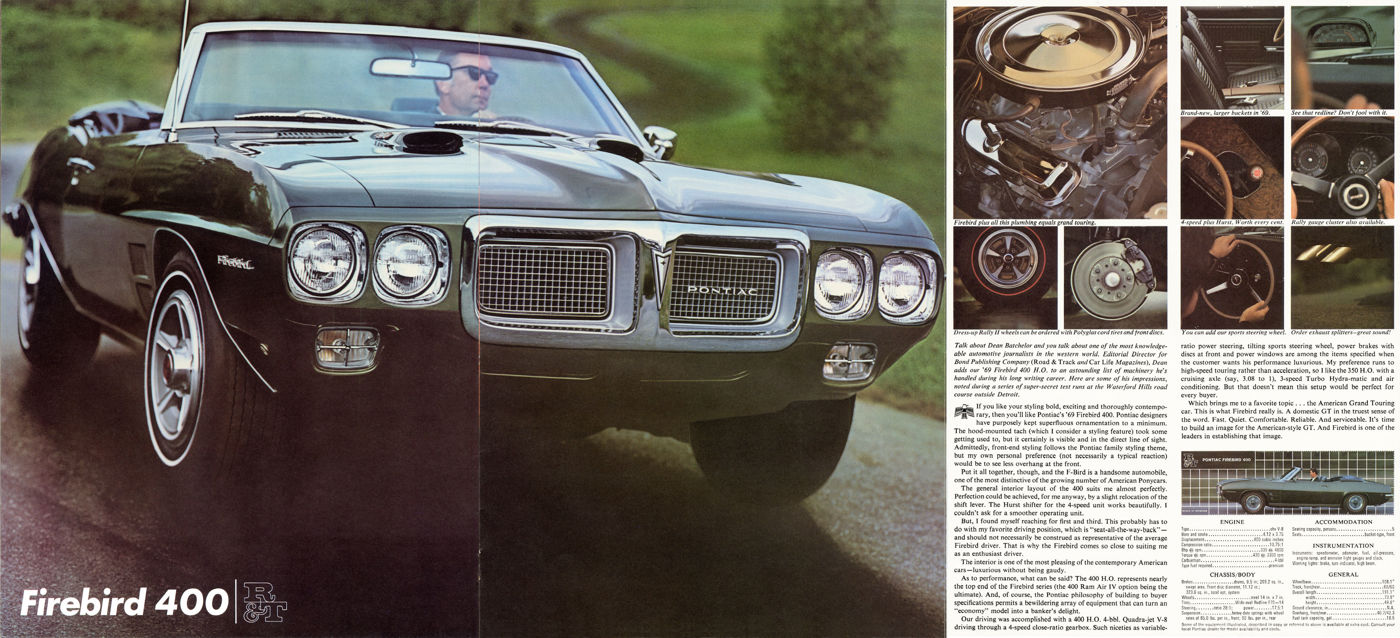
Pontiac did not own the name it put on its new Firebird at the Chicago Auto Show. The Trans Am package that the division introduced there, partway through the 1969 model year, borrowed its title from the Sports Car Club of America's Trans-American road-racing series, and Old Cars Weekly records that Pontiac paid the SCCA a royalty of $5 for every car that wore it. That small invoice tells the whole story in miniature. Pontiac wanted the standing of a road-racing championship in which its Firebirds were chasing factory Camaros and Mustangs, and it was willing to pay for the words before it had earned them on the track.1,2
The brief behind the car, as the Pontiac Preservation Association's hall-of-fame biography of engineer Herb Adams tells it, came from John Z. DeLorean in a meeting with Adams and Bill Collins: build a Firebird better than the Camaro Z/28 that Chevrolet was expected to field. The biography gives the instruction as “No detailed instructions, just get it done.” That is a retrospective account from an organization honoring Adams, and it is told here as one. It credits Adams with engineering work that led to the production 1969 Trans Am and to the first second-generation cars, and it puts Collins in the same room. The Trans Am was a team product, not a lone inventor's car.3
What the buyer actually got was mostly chassis. The June 1969 CARS introduction prints the specification: Pontiac's 400-cubic-inch Ram Air V-8, rated at 335 gross horsepower at 5,000 rpm and 430 lb-ft at 3,400 rpm, with a single Quadrajet and 10.75:1 compression; a heavy-duty three-speed floor shift; a 3.55:1 axle; front disc brakes; variable-ratio power steering; a one-inch front stabilizer; and F70-14 tires on seven-inch rims, with a rear deck air foil and stripes to announce it. Over-Drive Magazine's fact sheet, compiled from Pontiac literature, gives the package code as WS4. The one engine upgrade was the Ram Air IV 400, which Motor Trend's engine table lists at 345 gross horsepower at 5,400 rpm.2,4,5
It came in one color scheme. Every regular 1969 Trans Am, Old Cars Weekly reports, was Cameo White with blue stripes; the exception was a silver prototype. It was not cheap, either. The same account puts the WS4 package at about $725, a Trans Am sport coupe's window sticker at around $3,556 and a convertible's base price at about $3,770, with the Ram Air IV another $390 on top. For scale, Motor Trend's March 1969 comparison listed the six-cylinder Firebird hardtop at $2,814 before options. A Trans Am coupe therefore stickered more than $700 above the entry Firebird, and the premium bought a firmer chassis, bigger brakes, a louder hood and a borrowed racing name.1,5
Very few buyers paid it. The commonly published count is 697 Trans Ams, 689 coupes and eight convertibles. Three separately compiled tables agree on those numbers, but none names a primary record, and Over-Drive Magazine notes that Pontiac did not keep production records by option package. Even the denominator is argued over by small margins: Over-Drive Magazine prints 87,709 Firebirds for 1969, The Pontiac Trans Am Page 87,708, and MuscleCarClub 88,708, a figure exactly 1,000 higher that looks like a transcription slip but is kept in view rather than quietly discarded. Against either of the lower totals, the Trans Am was about eight-tenths of one percent of Firebird production. The eight convertibles sat beside 11,649 other Firebird convertibles on Over-Drive's count.6,7,8,4
Engines divide the 697 cleanly: 55 Ram Air IV cars, every one a coupe, and 642 with the standard Ram Air 400 that Pontiac people later called the Ram Air III, 634 coupes plus all eight convertibles. Transmissions do not divide cleanly at all. The Pontiac Trans Am Page gives the Ram Air IV coupes as 46 manual and nine automatic and the Ram Air III coupes as 520 manual and 114 automatic. MuscleCarClub prints the identical numbers with the columns reversed. Old Cars Weekly sides with the second reading, saying 114 of the Ram Air III cars had a manual gearbox, though it folds four convertibles into that 114, which does not square with 634 coupes. No factory table has been read to settle the question, so both versions stand.7,8,1,4
The car arrived late and was built in a hurry. The earliest production Trans Am that Old Cars Weekly could document, VIN 223379L118850, was assembled at Van Nuys on April 29, 1969, and the first Norwood-built example followed on May 29. The whole run therefore fit into the tail of the first-generation Firebird's final model year. Motor Trend's March 1969 pony-car comparison, printed before the Trans Am reached buyers, shows what an ordinary Firebird was: its test car, a 350 two-barrel hardtop with automatic and a 2.78 axle, took 10.0 seconds to reach 60 mph and ran the quarter mile in 17.0 seconds at 81 mph. Those numbers belong to that car alone, but they measure the gap the Trans Am was meant to open.1,5
On the track the name still belonged to other people's cars. The 1969 over-two-liter Trans-Am championship was fought out between factory Mustangs and Penske's Camaros, and the final manufacturers' table in the SCCA result sheets reads Chevrolet 78, Ford 64, Pontiac 32 and American Motors 13. Pontiac's points did not come from a Pontiac engine. The Firebirds that raced used Chevrolet power: Jerry Titus's T/G Racing car, backed by Canadian businessman Terry Godsall, was a converted Camaro carrying a Chevrolet 302, legal, DrivingLine explains, because Firebirds were sold in Canada with Chevrolet engines. Titus and Jon Ward won the Trans-Am class at the 1969 Daytona 24 Hours and finished third overall.9,10
Pontiac did build an engine for the class. Old Cars Weekly describes a 303-cubic-inch V-8 designed to fit the Trans-American displacement limit, of which only 25 were built and sold to competitors as replacements for the factory-installed 400. The silver prototype carried one, and the same article reports that Motor Trend tested it for its October 1969 issue, recording 0-60 mph in 8.83 seconds and a 16.37-second quarter mile at 93.5 mph. Those are one prototype's numbers with an engine no showroom buyer could order, and they say nothing about a production Trans Am. They do show the gap between the race program the CARS introduction alluded to and the 400-cubic-inch street car the dealers actually sold.1,2
The first-season numbers were thin, but the package outlived them. Adams's biography traces the 1970 Trans Am's shaker hood scoop to his Firebird Sprint Turismo experiment, in which carburetors that would not fit under the first-generation hood led him to cut an opening and have prototyping build an aluminum scoop. He believes, the biography adds, that Ford and Dodge saw the magazine story and reached the market with shaker scoops of their own for 1970. The 1969 car was also the last first-generation Firebird and the last Firebird convertible of that generation; the 1970 second generation came as a coupe only. From 697 white cars and a $5 royalty, the Trans Am name ran on to the 2002 model year.3,4,11
Fact sheet · 1969 · United States
The numbers
1969 Pontiac Firebird and Trans Am — The last first-generation Firebird, and the mid-year debut of the Trans Am package: 697 cars by the commonly published count, eight of them convertibles.
Coverage: Partial — researched sections are shown; missing ones are not yet sourced. Researched through 2026-09-22.
Every figure is labeled with how sure we are. Reported means a manufacturer, registry, or reference figure we cite but have not reconciled against factory records ourselves. Disputed means credible sources disagree and both are shown. Rows are separately scoped; don't add them together unless the note says they make up a total.
Key facts
- Trans Am production: 689 coupes and 8 convertibles (697 total), as published in two separately compiled tables.6,8
- 55 Trans Ams had the Ram Air IV, all coupes; the other 642 had the Ram Air (HO) 400.4,7
- Motor Trend's Firebird 350 (two-barrel, automatic, 2.78 axle) ran 0-60 mph in 10.0 s and the quarter mile in 17.0 s at 81 mph in its March 1969 five-car comparison.5
- 1969 was the last model year of the first-generation body and the last with a convertible Firebird in that generation; the 1970 second generation was coupe-only.4,11
Production
| What was counted | Count | Basis | Status |
|---|---|---|---|
| Firebird total, all bodies, Trans Am included7 not stated by source Over-Drive Magazine prints 87,709 and MuscleCarClub 88,708; see conflicts. | 87,708 | built, model-year | Disputed |
| What was counted | Count | Basis | Status |
|---|---|---|---|
| Firebird two-door hardtop coupe (excluding Trans Am)6 Firebird · 2-door hardtop coupe · not stated by source Other tables print 75,362 or 76,362; see conflicts. | 75,363 | built, model-year | Disputed |
| Firebird convertible (excluding Trans Am)6,8 Firebird · convertible · not stated by source | 11,649 | built, model-year | Reported |
| What was counted | Count | Basis | Status |
|---|---|---|---|
| Trans Am coupe6,8,7 Trans Am (WS4) · 2-door hardtop coupe · not stated by source Three secondary tables agree; none names a primary record, so the figure stays reported. | 689 | built, model-year | Reported |
| Trans Am convertible6,8,7 Trans Am (WS4) · convertible · not stated by source | 8 | built, model-year | Reported |
| Trans Am, all bodies7 Trans Am (WS4) · not stated by source Printed as a total by the source; equals 689 coupes plus 8 convertibles. | 697 | built, model-year | Reported |
| What was counted | Count | Basis | Status |
|---|---|---|---|
| Trans Am with Ram Air IV 400 (all coupes)4,7,8 Trans Am · 2-door hardtop coupe · 400 Ram Air IV · not stated by source The sources disagree on the transmission split; see conflicts. | 55 | built, model-year | Reported |
| Trans Am coupe with Ram Air (HO) 4007,8 Trans Am · 2-door hardtop coupe · 400 Ram Air (HO), later called Ram Air III · not stated by source MuscleCarClub labels this engine 'L76 HO 400'; the site's code label is not adopted. | 634 | built, model-year | Reported |
| What was counted | Count | Basis | Status |
|---|---|---|---|
| Trans Am convertible, Ram Air (HO) 400, manual7 Trans Am · convertible · 400 Ram Air (HO) · manual · not stated by source Single uncited source. | 4 | built, model-year | Reported |
| Trans Am convertible, Ram Air (HO) 400, automatic7 Trans Am · convertible · 400 Ram Air (HO) · automatic · not stated by source Single uncited source. | 4 | built, model-year | Reported |
| Firebird and Trans Am, manual transmission7 manual · not stated by source Single uncited source; with the automatic row it sums to that source's 87,708 total. | 20,840 | built, model-year | Reported |
| Firebird and Trans Am, automatic transmission7 automatic · not stated by source Single uncited source. | 66,868 | built, model-year | Reported |
Hardtop, convertible, Trans Am coupe and Trans Am convertible are printed by Over-Drive Magazine as partitioning its 87,709 total; the hardtop and convertible rows exclude Trans Ams.
The Trans Am engine rows (55 Ram Air IV + 634 HO coupes + 8 HO convertibles) partition 697 in the Pontiac Trans Am Page table.
Coupe transmission splits are disputed and appear only under conflicts. No paint, trim, axle or option installation counts were found in a source this pass could read.
Prices when new
| Model | Price | Basis |
|---|---|---|
| Base price, Firebird hardtop coupe (six-cylinder)5 | $2,814 | base price as printed by Motor Trend, 1969-03 |
| Option price, Firebird 350 two-barrel V-8 engine5 | $110.88 | option price as printed by Motor Trend, 1969-03 |
| Option price, Turbo Hydra-Matic transmission5 | $227.04 | option price as printed by Motor Trend, 1969-03 |
| Option price, air conditioning5 | $375.99 | option price as printed by Motor Trend, 1969-03 |
| Factory price, Firebird two-door hardtop6 | $2,781 | factory list price as compiled, 1969 model year |
| Factory price, Firebird convertible6 | $2,996 | factory list price as compiled, 1969 model year |
| Factory price, Trans Am coupe6 | $3,556 | factory list price as compiled, 1969 model year |
| Factory price, Trans Am convertible6 | $3,770 | factory list price as compiled, 1969 model year |
Prices are the nominal dollars of the day, not adjusted for inflation.
Engines
| Engine | Factory rating | Availability | Built |
|---|---|---|---|
| 250 OHC six, one-barrel5 250 cu in · 1-barrel | 175 hp @ 4,800 (SAE gross (advertised)) | standard, Firebird | Not yet sourced |
| 250 OHC six, four-barrel (Sprint), automatic rating5 250 cu in · 4-barrel | 215 hp @ 5,200 (SAE gross (advertised)) | optional | Not yet sourced |
| 250 OHC six, four-barrel (Sprint), manual rating5 250 cu in · 4-barrel | 230 hp @ 5,400 (SAE gross (advertised)) | optional | Not yet sourced |
| 350 V-8, two-barrel5 350 cu in · 2-barrel | 265 hp @ 4,600, 355 lb-ft @ 2,800 (SAE gross (advertised)) | optional (Firebird 350) | Not yet sourced |
| 350 HO V-8, four-barrel5 350 cu in · 4-barrel | 325 hp @ 5,100 (SAE gross (advertised)) | optional (Firebird 350 HO) | Not yet sourced |
| 400 V-8, four-barrel5 400 cu in · 4-barrel | 330 hp @ 4,800 (SAE gross (advertised)) | optional (Firebird 400) | Not yet sourced |
| 400 Ram Air (HO), later called Ram Air III2,5 400 cu in · Quadrajet 4-barrel, Ram Air | 335 hp @ 5,000, 430 lb-ft @ 3,400 (SAE gross (advertised)) | standard, Trans Am; optional Firebird 400 | 6427 Reported |
| L67 · 400 Ram Air IV5,8 400 cu in · Quadrajet 4-barrel, Ram Air | 345 hp @ 5,400 (SAE gross (advertised)) | optional, Firebird 400 and Trans Am | 557 Reported |
Ratings are the manufacturer's advertised figures under the standard shown (SAE gross before 1972, SAE net after). They are not dyno results, and gross and net ratings can't be compared directly.
Transmissions
| Transmission | Availability | Built |
|---|---|---|
| Heavy-duty 3-speed manual, floor shift (Trans Am standard; 2.42/1.61/1.00)2 | standard, Trans Am | Not yet sourced |
| 3-speed Turbo Hydra-Matic automatic5 | optional | Not yet sourced |
Options and packages
| Code | Option | Price | Installed |
|---|---|---|---|
WS4UPC |
Trans Am package4 | — | 6977 Reported |
Paint
| Code | Color | Built |
|---|---|---|
10 |
Starlight Black4 | Not yet sourced |
40 |
Mayfair Maize4 | Not yet sourced |
50 |
Cameo Ivory4 | Not yet sourced |
51 |
Liberty Blue4 | Not yet sourced |
52 |
Matador Red4 | Not yet sourced |
53 |
Warwick Blue4 | Not yet sourced |
55 |
Crystal Turquoise4 | Not yet sourced |
57 |
Midnight Green4 | Not yet sourced |
59 |
Limelight Green4 | Not yet sourced |
61 |
Expresso Brown4 | Not yet sourced |
63 |
Champagne4 | Not yet sourced |
65 |
Antique Gold4 | Not yet sourced |
67 |
Burgundy4 | Not yet sourced |
69 |
Palladium Silver4 | Not yet sourced |
72 |
Carousel Red4 | Not yet sourced |
73 |
Verdoro Green4 | Not yet sourced |
76 |
Goldenrod Yellow4 | Not yet sourced |
87 |
Windward Blue4 | Not yet sourced |
Color names are the factory's. We don't show color swatches, because a screen color is no guide for a restoration.
Specifications
| Measure | Value | Applies to |
|---|---|---|
| Wheelbase2,5 | 108.1 in | all bodies |
| Overall length2,5 | 191.1 in | hardtop coupe |
| Overall width2 | 73.9 in | hardtop coupe |
| Overall height2 | 49.6 in | hardtop coupe |
| Front and rear track2 | 60 in | Trans Am |
| Shipping weight, Trans Am2 | 3,375 lb | Trans Am coupe, approximate as printed |
| Curb weight, Firebird 350 test car5 | 3,642 lb | Motor Trend test car, 350 2-bbl automatic |
| Fuel capacity2,5 | 18.5 US gal | all |
| Trans Am axle ratio2 | 3.55 :1 | Trans Am standard |
| Trans Am tires2 | F70-14 on 7-in rims | Trans Am |
| Shipping weight, Firebird two-door hardtop6 | 3,051 lb | Firebird two-door hardtop |
| Shipping weight, Firebird convertible6 | 3,346 lb | Firebird convertible |
Period road tests
| Test | Car tested | Result |
|---|---|---|
| Motor Trend, 1969-0350-60 mph | Firebird 350 hardtop, 350 2-bbl 265 hp, 3-speed automatic, 2.78:1two aboard | 10 s |
| Motor Trend, 1969-035Standing quarter mile | Firebird 350 hardtop, 350 2-bbl 265 hp, 3-speed automatic, 2.78:1two aboard | 17.0 s at 81 mph |
| Motor Trend, 1969-035Stopping distance from 60 mph | Firebird 350 hardtop, 350 2-bbl 265 hp, 3-speed automatic, 2.78:1power drum brakes | 147 ft |
| Motor Trend, 1969-035Fuel economy range | Firebird 350 hardtop, 350 2-bbl 265 hp, 3-speed automatic, 2.78:1 | 10.7 to 14.5 mpg |
A road test result belongs to the one car that was tested, with its engine, gearing, tires, and conditions. It is not a figure for every car of the year.
Identification
- Body style numbers
- Hardtop coupe body number 22337 and convertible 22367 as printed in the compiled production table; the Trans Am used the same body numbers.6
Where the sources disagree
1969 Firebird hardtop production and model total
The 87,708/87,709 pair differs by one unit and is shown as disputed. MuscleCarClub's 76,362 is 1,000 higher than every other table and is most likely a transcription slip, but it is kept here rather than silently dropped.
1969 Trans Am transmission split
- Ram Air IV coupes: 46 manual, 9 automatic; Ram Air HO coupes: 520 manual, 114 automatic7
- Ram Air IV: 9 manual, 46 automatic; HO: 114 manual, 520 automatic8
The two sources print identical numbers with the columns reversed. Neither names a primary record, so neither split is shown as a production row. A Pontiac Historic Services or Rotella table would settle it.
1969 Firebird base hardtop price
- $2,781 (compiled factory price; identical to the same table's 1968 figure)6
- $2,814 (base price, six-cylinder hardtop)5
Both shown. The compiled table repeats its 1968 hardtop and convertible prices exactly, which suggests a carried-over row; the period magazine figure is contemporary.
Identification
Read a 1969 Pontiac VIN
The VIN decoder runs in your browser and never sends the VIN anywhere. How the factory numbered this year's cars:
Same model year
Also in 1969
- AMC AMX The two-seat AMX's biggest year: 8,293 cars by the enthusiast production table, with a mid-year run of Big Bad colors and 52 Hurst-built Super Stock AMXs for NHRA drag racing.
- AMC Javelin Production fell to 40,675, but the 1969 Javelin added the Big Bad colors, with 2,282 cars painted blue, green or orange, plus the Mod package.
- AMC Rebel and Rebel Machine A base and SST Rebel with no convertible. The Big Bad colors were test-marketed through the New York–New Jersey 'Raider' hardtop. This is host-car context for the 1970 Machine.
- Buick Riviera Another record at 52,872 Rivieras; 5,272 had the GS handling option.
- Buick Skylark Gran Sport, GS and GSX GS production fell to 12,465, and the GS 400's Stage 1 package became a factory option while Stage 2 stayed a dealer item.
- Buick Wildcat 67,453 Wildcats; the last year of the 430.
- Chevrolet Chevelle and Malibu SS Super Sport became RPO Z25 option equipment, available for 1969 only on the 300 Deluxe coupes as well as Malibu sport coupe, convertible and El Camino.
- Chevrolet Chevy II and Nova SS is RPO Z26 per the source, with L48, L34 and L78 engines. Enthusiast-compiled production: 251,849 cars; Super Sport 17,564.
- Chevrolet El Camino SS SS 396 became RPO Z25 option equipment, orderable on the V8 Malibu El Camino (13680); the El Camino share of the 86,307 Z25s is not separately published.
- Chevrolet Impala SS Only the SS427 (RPO Z24) remains; the reported count ranges from 2,425 to about 2,455.
- Dodge Charger The second-generation Charger's peak-sales year added the SE package and the aero-bodied Charger 500 and Charger Daytona homologation cars, whose production totals are still disputed.
- Dodge Coronet R/T and Super Bee The Super Bee added a hardtop body and the 440 Six Pack, while the 440-powered Coronet R/T continued as the upscale hardtop and convertible.
- Dodge Dart GTS, Swinger and Demon The low-priced Swinger 340 arrived and outsold the GTS by more than two to one (16,637 against about 6,700), while a 375 hp 440 joined the GTS options.
- Ford Fairlane The Fairlane hardtop was the intermediate line's volume leader, while the Fairlane 500 SportsRoof shared its body with the Torino GT, Cobra and Talladega.
- Ford Ranchero GT The Ranchero GT carried Torino GT trim; 1,658 GTs were built, per reference-site counts in the Standard Catalog lineage.
- Ford Thunderbird Fifth-generation Thunderbird; only the whole-line production total was found.
- Ford Torino The Torino GT carried most of the line's volume, the 428 Cobra Jet was in its first full year, and the Talladega aero fastback was built in a short run at Atlanta to homologate a NASCAR nose.
- Mercury Comet and Cyclone The Cyclone fastback came as Cyclone and Cyclone CJ, mid-year Spoilers carried Dan Gurney and Cale Yarborough graphics, and the extended-nose Cyclone Spoiler II was built at Lorain for NASCAR homologation.
- Mercury Cougar A longer, restyled Cougar added a convertible, the Boss 302 arrived in April, and the Eliminator replaced the GT as the performance Cougar.
- Mercury Marauder and S-55 The Marauder name returned on a full-size hardtop, and the X-100 carried the 360 hp 429 four-barrel as its only engine.
- Oldsmobile Cutlass, 4-4-2 and Hurst/Olds The 4-4-2 kept its 400 while the second Hurst/Olds, in white and gold with a 380 hp 455, went into production at about 900 cars.
- Plymouth Barracuda and 'Cuda The last A-body Barracuda introduced the 'Cuda name as a stripped performance package with a standard 340, alongside Formula S and a midyear 440.
- Plymouth GTX, Belvedere and Satellite The GTX shared the Road Runner's new Air Grabber scoop and Super Track Pack but sold 15,602 cars, fewer than a fifth of the cheaper Road Runner.
- Plymouth Road Runner A convertible joined the coupe and hardtop, the 440 Six Barrel arrived at mid-year, and the Road Runner reached its production peak of 84,420.
- Pontiac GTO Three four-barrel 400s under one nameplate, and the first year of the Judge package built around Ram Air power.
- Pontiac Grand Prix A new 118-inch Grand Prix with the SJ and a 390 hp 428 HO: production more than tripled to 112,486.
- Pontiac Tempest and LeMans The last year of the OHC Sprint six and the 350 HO.
- Rambler American and SC/Rambler AMC and Hurst put the 315-hp 390 V8 and a close-ratio four-speed into the compact Rambler hardtop for NHRA F/Stock. 1,512 were built, and the split between the two paint schemes is disputed.