1969 · Plymouth · United States
1969 Plymouth Barracuda: The Year 'Cuda Became a Name
The last A-body Barracuda introduced the 'Cuda name as a stripped performance package with a standard 340, alongside Formula S and a midyear 440.
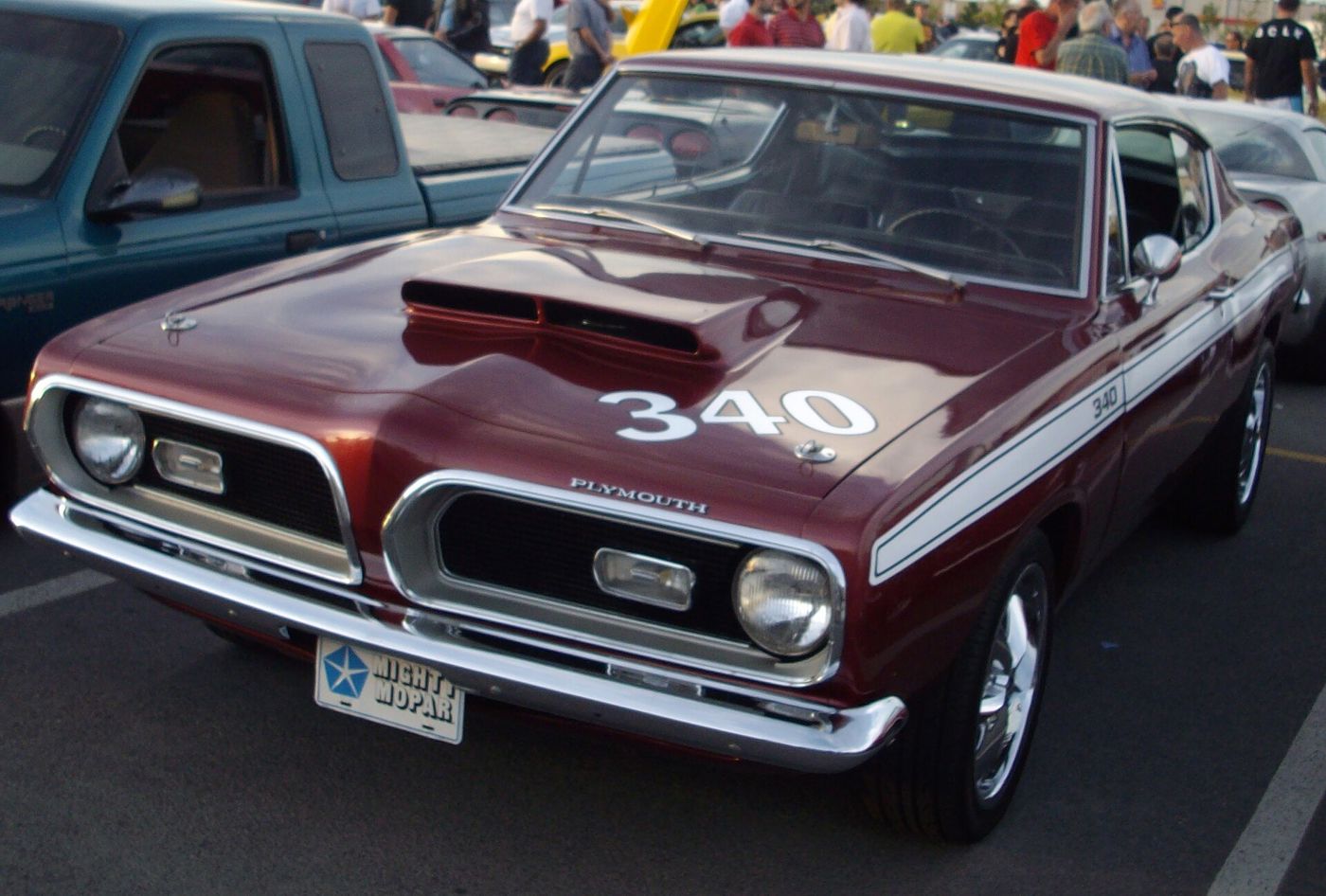

Car Life's November 1968 road test opens at a drag strip with a challenge. Another magazine had brought one of Europe's new big-engined sedans, a car the writers called a "SuperGerman," to the track on the same day Car Life was there with a 1969 'Cuda 340. Car Life's staff asked whether the visitors would care to step over to the starting line. They would. The 'Cuda won three runs out of three, gaining a few feet off the line and pulling away once both cars were in high gear. Car Life admitted the import was geared for cruising and loaded with luxury equipment, but noted it cost something like $10,000 more.1
The magazine's headline called the car "Plymouth's Pocket Road Runner," and the comparison was exact. For 1969, Car Life explained, the familiar abbreviation 'cuda became a model name. The 'Cuda came with a spartan interior and bench seat, but with the 340 V8, a four-speed manual, stiffer springs, bigger shock absorbers, wide steel wheels, oversize tires, decorative hood scoops and special paint on the hood and lower body. Like the Road Runner, it put money into the engine and the chassis and not into trim. It was built only as a hardtop or fastback; the convertible was already more expensive, the magazine said, so there was no 'Cuda convertible.1
That left Plymouth with three ways to buy a fast Barracuda in the last year of the A-body car. Car Life called it "a little confusing." A buyer could start with a plain Barracuda and add the good parts; order the top-of-the-line Formula S, which came with the bigger engines, a handling package, more interior trim and semi-bucket seats; or order a 'Cuda and dress it up as far as he liked. Plymouth's marketing people gave the magazine the business case: building 10,000 'Cudas to sell off dealers' floors would be cheaper for the factory and the dealers than handling 10,000 special orders for plain Barracudas with big engines.1,2
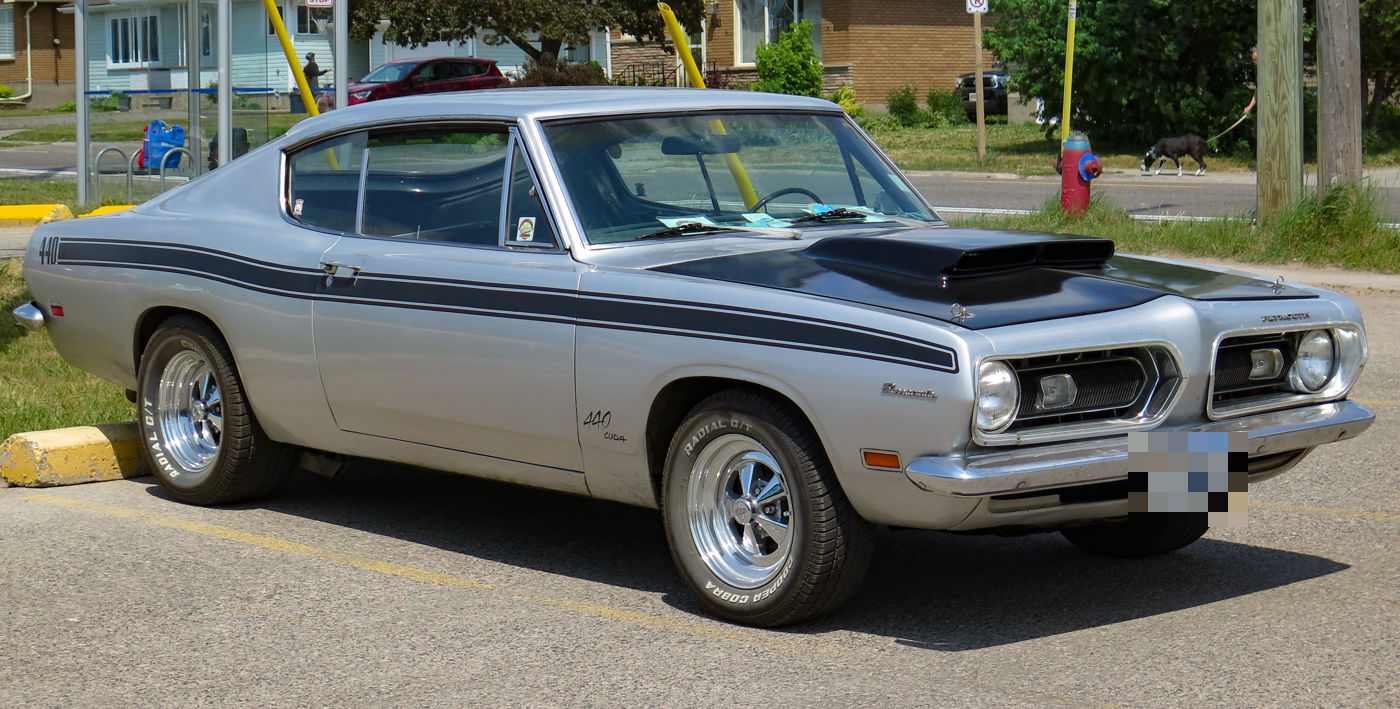

The 10,000 never came close. Plymouth shipped 666 'Cuda 340s, 196 automatics and 470 four-speeds, and 472 'Cuda 383s, 309 automatics and 163 four-speeds, for 1,138 in all. Formula S packages ran to 1,839 with the 340 and 718 with the 383. Those are cars shipped during a year rather than built for a model year, but on either count the 'Cuda looks like a thousand-car idea that was planned as a ten-thousand-car one.3,1
Under the hood, Plymouth offered a full ladder. The 225 Six was standard at 145 horsepower and the 318 V8 optional at 230. The 340 four-barrel carried a rating of 275 horsepower at 5,000 rpm and 340 lb-ft at 3,200, and Car Life pointed out that NHRA factored it at 310, which the magazine offered as proof that even NHRA was impressed. The 383 was rated at 330 horsepower at 5,200 rpm, and a 440 four-barrel, added during the year, at 375 horsepower and 480 lb-ft. The Formula S package cost $212 with the 340, $251 with the 383 and $351 with the 440; the four-speed was $188.1,2
Car Life's test car was a 'Cuda 340 fastback with the four-speed, a 3.91 limited-slip axle, E70-14 Goodyear Polyglas tires, power steering, power front disc brakes and semi-bucket seats, so it was, the writers said, fancier than the standard package. It weighed 3,470 pounds at the curb and 3,650 as tested. It reached 60 mph in 7.1 seconds and ran the quarter-mile in 14.93 seconds at 96.63 mph, with shifts at 6,000 rpm, and averaged 12.8 mpg on test. The magazine noted that those quarter-mile times beat the 383 Road Runner it had tested the year before. Prices had not been announced when the test ran.1
The handling earned as much praise as the speed. Car Life found very good handling with mild understeer and none of the determined front-end plow of several big-engine pony cars; the 'Cuda could be driven through corners with the front pushing, all four wheels sliding or the tail hung out under power. The disc-brake car pulled 27 ft/sec/sec on its first hard stop and still 20 by the sixth, with only slight swerving. Car Life also remarked that the previous year's test Barracuda had not made its list of Ten Most Satisfying Test Cars, and suggested that this year could be different.1
The wider Barracuda line was shrinking. Over-Drive's production table and period trade figures give 31,987 Barracudas for 1969: 17,788 fastbacks, 12,757 hardtops and only 1,442 convertibles. Plymouth had built 62,534 for 1967 and 45,412 for 1968, so it built about half as many Barracudas as it had two years earlier. Peter Sessler and Zazarine print a lower 27,392. List prices started at $2,674 for a six-cylinder hardtop and $2,780 for a V8 hardtop, $2,813 for a V8 fastback and $3,082 for a V8 convertible. Buyers could choose Barracuda Orange, Limelight or Scorch Red, or special-order Bahama Yellow and Rallye Green.2,4,5,6
The Barracuda's racing reputation was being made by cars that no showroom sold. Hemi-powered factory Darts and Barracudas had been a highlight of Super Stock at the U.S. Nationals in Indianapolis since 1968, when Arlen Vanke's Barracuda chased down Wally Booth's Camaro in the Super Stock final. In 1969, future Pro Stock star Ronnie Sox drove his red, white and blue Barracuda to the win. Those were Hemi race cars built under a factory drag-racing program, not 'Cuda 340s off a dealer's floor, but they tied the Barracuda name to the strip in exactly the year Plymouth began selling a street 'Cuda.7,8
The stripped 1969 package turned out to be a pilot for something much larger. When Plymouth launched the new E-body for 1970, its Rapid Transit System catalog headlined the car "'Cuda. The R.T.S. presents the ultimate Barracuda," offered it with five engines from the 340 to the 440 Six Barrel and the 426 Hemi, and claimed a chassis virtually the same as its intermediate supercars'. The name Car Life had watched Plymouth turn from an abbreviation into a model had become the top of the line. The first 'Cuda, meanwhile, was a clever idea that, counted by shipments, reached dealers a little over a thousand times.1,3
Fact sheet · 1969 · United States
The numbers
1969 Plymouth Barracuda: The last A-body Barracuda introduced the 'Cuda name as a stripped performance package with a standard 340, alongside Formula S and a midyear 440.
Figures may describe different groups of cars. Add rows together only when the note says they make up a total.
Key facts
Production
| What was counted | Built |
|---|---|
| All 1969 Barracudas4,5,9,2 | 31,987 |
| All 1969 Barracudas (Sessler)6,3 | 27,392 |
| What was counted | Built |
|---|---|
| Barracuda fastback (BH29)2,9 Barracuda · fastback · six and V8 | 17,788 |
| Barracuda hardtop coupe (BH23)2,9 Barracuda · hardtop coupe · six and V8 | 12,757 |
| Barracuda convertible (BH27)2,9 Barracuda · convertible · six and V8 | 1,442 |
| What was counted | Count | Counted as |
|---|---|---|
| Formula S 340 package, hardtop3 Formula S · hardtop coupe · 340 | 325 | shipped |
| Formula S 340 package, convertible3 Formula S · convertible · 340 | 83 | shipped |
| Formula S 340 package, fastback3 Formula S · fastback · 340 | 1,431 | shipped |
| Formula S 383 package, hardtop3 Formula S · hardtop coupe · 383 | 98 | shipped |
| Formula S 383 package, convertible3 Formula S · convertible · 383 | 17 | shipped |
| Formula S 383 package, fastback3 Formula S · fastback · 383 | 603 | shipped |
| What was counted | Count | Counted as |
|---|---|---|
| 340 'Cuda automatic, hardtop3 'Cuda · hardtop coupe · 340 · automatic | 30 | shipped |
| 340 'Cuda automatic, fastback3 'Cuda · fastback · 340 · automatic | 166 | shipped |
| 340 'Cuda four-speed, hardtop3 'Cuda · hardtop coupe · 340 · 4-speed manual | 68 | shipped |
| 340 'Cuda four-speed, fastback3 'Cuda · fastback · 340 · 4-speed manual | 402 | shipped |
| 383 'Cuda automatic, hardtop3 'Cuda · hardtop coupe · 383 · automatic | 61 | shipped |
| 383 'Cuda automatic, fastback3 'Cuda · fastback · 383 · automatic | 248 | shipped |
| 383 'Cuda four-speed, hardtop3 'Cuda · hardtop coupe · 383 · 4-speed manual | 33 | shipped |
| 383 'Cuda four-speed, fastback3 'Cuda · fastback · 383 · 4-speed manual | 130 | shipped |
| Barracuda 383 automatic (non-'Cuda), hardtop3 Barracuda · hardtop coupe · 383 · automatic | 45 | shipped |
| Barracuda 383 automatic (non-'Cuda), convertible3 Barracuda · convertible · 383 · automatic | 10 | shipped |
| Barracuda 383 automatic (non-'Cuda), fastback3 Barracuda · fastback · 383 · automatic | 272 | shipped |
| Barracuda 383 four-speed (non-'Cuda), hardtop3 Barracuda · hardtop coupe · 383 · 4-speed manual | 53 | shipped |
| Barracuda 383 four-speed (non-'Cuda), convertible3 Barracuda · convertible · 383 · 4-speed manual | 7 | shipped |
| Barracuda 383 four-speed (non-'Cuda), fastback3 Barracuda · fastback · 383 · 4-speed manual | 331 | shipped |
Prices when new
| Model | Price | Price type |
|---|---|---|
| Barracuda hardtop, six2 | $2,674 | factory price, 1969 model year |
| Barracuda hardtop, V82 | $2,780 | factory price, 1969 model year |
| Barracuda fastback, six2 | $2,707 | factory price, 1969 model year |
| Barracuda fastback, V82 | $2,813 | factory price, 1969 model year |
| Barracuda convertible, six2 | $2,976 | factory price, 1969 model year |
| Barracuda convertible, V82 | $3,082 | factory price, 1969 model year |
Prices are the nominal dollars of the day, not adjusted for inflation.
Engines
| Engine | Factory rating | Availability |
|---|---|---|
| 225 Six2 225 cu in · 1-barrel | 145 hp @ 4,000, 215 lb-ft @ 2,400 (gross (period advertised)) | standard |
| 318 V82 318 cu in · 2-barrel | 230 hp @ 4,400, 340 lb-ft @ 2,400 (gross (period advertised)) | optional |
| 340 V8 4-bbl1 340 cu in · 4-barrel (Carter) | 275 hp @ 5,000, 340 lb-ft @ 3,200 (gross (Car Life 'rated bhp')) | standard, 'Cuda 340; Formula S option |
| 383 V8 4-bbl2 383 cu in · 4-barrel | 330 hp @ 5,200, 410 lb-ft @ 3,600 (as listed by Over-Drive) | Formula S and 'Cuda option |
| 440 V8 4-bbl2 440 cu in · 4-barrel | 375 hp @ 4,600, 480 lb-ft @ 3,200 (as listed by Over-Drive) | 'Cuda option (Formula S 440 package price listed) |
Ratings are published figures, not dyno results. Gross and net ratings aren't directly comparable.
Transmissions
| Transmission | Availability |
|---|---|
| 3-speed manual2 | standard |
| 4-speed manual (V8 only)2 | optional |
| TorqueFlite automatic2 | optional ($199-$227 by engine) |
Options and packages
| Code | Option | Price |
|---|---|---|
A53sales code |
Formula S package with 3402 | $212 |
A53sales code |
Formula S package with 3832 | $251 |
A53sales code |
Formula S package with 4402 | $351 |
| Front disc brakes2 | $49 | |
| Air conditioning2 | $361 | |
| Floral vinyl roof ('Mod Top')2 | $96 | |
| Barracuda Sport Group (except cars with 'Cuda package)2 | $51 | |
| Color-keyed carpet mats2 | $11 | |
| Console (with bucket seats)2 | $53 | |
| Dual head rests (standard after January 1, 1969)2 | $27 | |
| Floral interior, Barracuda hardtop, with buckets and 'Cuda2 | $113 | |
| Fold-down rear seat, Barracuda fastback2 | $65 | |
| 'Formula S' option package, Barracuda 383 (as listed)2 | $222 | |
| 'Formula S' package, Barracuda 383 convertible (as listed)2 | $198 | |
| Heavy-duty suspension package2 | $14 | |
| Interior Decor Group (fastback): fold-down rear seat, wood-grained door and quarter trim, door map pouches, bright pedal trim, rear compartment carpet, luxury vinyl bucket seats, rear armrests and ashtrays, wheelhouse carpets2 | $181 | |
| Performance gauges (without clock or tachometer)2 | $17 | |
| Power brakes2 | $43 | |
| Power steering2 | $85 | |
| AM radio2 | $62 | |
| AM/FM radio2 | $135 | |
| Rallye gauge cluster2 | $6 | |
| Sport stripes paint treatment2 | $26 | |
| Tachometer (V8)2 | $50 | |
| Tinted glass, all windows2 | $33 | |
| Tinted windshield2 | $21 | |
| Vinyl roof (hardtop only)2 | $79 | |
| Wheel covers, bolt-on design2 | $45 | |
| Wheel covers, Deluxe2 | $22 | |
| Wheel covers, wire2 | $67 | |
| Wheelhouse liners (except convertible)2 | $47 | |
| Heavy-duty alternator2 | $15 | |
| Sure-Grip positive-traction rear axle2 | $45 | |
| 'Cuda performance package: black hood stripes, twin hood scoops, lower-body paint treatment, with 340 or 383 V8 and 4-speed or TorqueFlite | ||
| Red plastic wheelhouse liners | ||
| Locking gas cap | ||
| Heavy-duty battery | ||
| Trailer-towing equipment | ||
| Undercoating | ||
| Electric clock | ||
| Glove box lock | ||
| Auxiliary lighting group | ||
| Right outside mirror | ||
| Rear shoulder belts | ||
| Whitewall tires | ||
| Vinyl roof covering in black, white, green or tan | ||
| Variable-speed windshield wipers | ||
| Bumper guards |
Paint
| Code | Color |
|---|---|
A4 |
Silver2 |
B3 |
Ice Blue2 |
B5 |
Blue Fire2 |
B7 |
Jamaica Blue2 |
F3 |
Frost Green2 |
F5 |
Limelight2 |
F8 |
Ivy Green2 |
L1 |
Sand Pebble Beige2 |
Q5 |
Seafoam Turquoise2 |
R4 |
Barracuda Orange2 |
R6 |
Scorch Red2 |
T3 |
Honey Bronze2 |
T5 |
Bronze Fire2 |
T7 |
Saddle Bronze2 |
W1 |
Alpine White2 |
X9 |
Black Velvet2 |
Y2 |
Sunfire Yellow2 |
Y3 |
Yellow Gold2 |
Y4 |
Spanish Gold2 |
999 |
Bahama Yellow (special order)2 |
999 |
Orange (special order)2 |
999 |
Rallye Green (special order)2 |
Color names are the factory's. We don't show color swatches, because a screen color is no guide for a restoration.
Interiors
| Trim |
|---|
| Standard all-vinyl front bucket seats (standard; bench or buckets, not both)2 |
| 'Sportseat': full-width all-vinyl front bench seat with folding center armrest, a no-cost alternative to buckets |
| Deluxe Interior Decor option: specially trimmed contour buckets, simulated walnut trim panels, door map pouches, bright pedal trim, rear armrests and ashtrays; carpeted wheelhousings in the fastback ( on fastback, as listed)2 |
| Floral interior (Barracuda hardtop, with buckets and 'Cuda; as listed)2 |
Specifications
| Measure | Value | Applies to |
|---|---|---|
| Wheelbase1,2 | 108 in | all bodies |
| Overall length1 | 192.8 in | all bodies |
| Overall width1 | 69.6 in | all bodies |
| Curb weight, 'Cuda 340 fastback test car1 | 3,470 lb | Car Life test car |
Period road tests
| Test | Car tested | Result |
|---|---|---|
| Car Life, 1968-1110-60 mph | 'Cuda 340 fastback, four-speed, 3.91:1 limited-slip, E70-14 Polyglas, power steering and power front disc brakes, semi-bucket seats; 3,650 lb test weightShifts at 6,000 rpm | 7.1 s |
| Car Life, 1968-111standing quarter-mile | 'Cuda 340 fastback, four-speed, 3.91:196.63 mph trap speed | 14.93 s |
| Car Life, 1968-111fuel economy, test conditions | 'Cuda 340 fastback, four-speed, 3.91:1Car Life test conditions; normal 11-14 mpg | 12.8 mpg |
A road test result belongs to the one car that was tested, with its engine, gearing, tires, and conditions. It is not a figure for every car of the year.
Identification
- Series and body codes (as reported)
- Series EB1-H (six) and EB2-H (V8); bodies BH23 hardtop coupe, BH29 fastback coupe, BH27 convertible.2
Where the sources disagree
Identification
Read a 1969 Plymouth VIN
The VIN decoder runs in your browser and never sends the VIN anywhere. How the factory numbered this year's cars:
Read next
The people and races behind the 1969 Plymouth Barracuda and 'Cuda
- 1969 Mopar Choices Cross-marque story
- Every Plymouth Barracuda and 'Cuda year 1964–1974
Same model year
Also in 1969
- AMC AMX The two-seat AMX's biggest year: 8,293 cars by the enthusiast production table, with a mid-year run of Big Bad colors and 52 Hurst-built Super Stock AMXs for NHRA drag racing.
- AMC Javelin Production fell to 40,675, but the 1969 Javelin added the Big Bad colors, with 2,282 cars painted blue, green or orange, plus the Mod package.
- AMC Rebel and Rebel Machine A base and SST Rebel with no convertible. The Big Bad colors were test-marketed through the New York–New Jersey 'Raider' hardtop. This is host-car context for the 1970 Machine.
- Buick Riviera Another record at 52,872 Rivieras; 5,272 had the GS handling option.
- Buick Skylark Gran Sport, GS and GSX Stage 1 became a factory GS 400 option, alongside distinct GS 350 and California GS choices; output, base-price and convertible-count disputes remain visible.
- Buick Wildcat 67,453 Wildcats; the last year of the 430.
- Chevrolet Chevelle and Malibu SS Super Sport became RPO Z25 option equipment, available for 1969 only on the 300 Deluxe coupes as well as Malibu sport coupe, convertible and El Camino.
- Chevrolet Chevy II and Nova SS is RPO Z26 per the source, with L48, L34 and L78 engines. Enthusiast-compiled production: 251,849 cars; Super Sport 17,564.
- Chevrolet El Camino SS SS 396 became RPO Z25 option equipment on the V8 Malibu El Camino, with 396s up to 375 hp; 86,307 Z25s across eligible models.
- Chevrolet Impala SS Only the SS427 (RPO Z24) remains; the reported count ranges from 2,425 to about 2,455.
- Dodge Charger The second-generation Charger's peak-sales year added the SE package and the aero-bodied Charger 500 and Charger Daytona homologation cars, whose production totals are still disputed.
- Dodge Coronet R/T and Super Bee The Super Bee added a hardtop body and the 440 Six Pack, while the 440-powered Coronet R/T continued as the upscale hardtop and convertible.
- Dodge Dart GTS, Swinger and Demon The low-priced Swinger 340 arrived and outsold the GTS by more than two to one (16,637 against about 6,700), while a 375 hp 440 joined the GTS options.
- Ford Fairlane The Fairlane hardtop was the intermediate line's volume leader, while the Fairlane 500 SportsRoof shared its body with the Torino GT, Cobra and Talladega.
- Ford Ranchero GT A second year of Torino GT trim on the Ranchero: 1,658 GTs, with a separate line of 727 listed with bucket seats.
- Ford Thunderbird Fifth-generation Thunderbird; only the whole-line production total was found.
- Ford Torino The Torino GT carried most of the line's volume, the 428 Cobra Jet was in its first full year, and the Talladega aero fastback was built in a short run at Atlanta to homologate a NASCAR nose.
- Mercury Comet and Cyclone The Cyclone fastback came as Cyclone and Cyclone CJ, mid-year Spoilers carried Dan Gurney and Cale Yarborough graphics, and the extended-nose Cyclone Spoiler II was built at Lorain for NASCAR homologation.
- Mercury Cougar A longer, restyled Cougar added a convertible, the Boss 302 arrived in April, and the Eliminator replaced the GT as the performance Cougar.
- Mercury Marauder and S-55 The Marauder name returned on a full-size hardtop, and the X-100 carried the 360 hp 429 four-barrel as its only engine.
- Oldsmobile Cutlass, 4-4-2 and Hurst/Olds The 4-4-2 kept its 400 while the second Hurst/Olds, in white and gold with a 380 hp 455, went into production at about 900 cars.
- Plymouth GTX, Belvedere and Satellite The GTX shared the Road Runner's new Air Grabber scoop and Super Track Pack but sold 15,602 cars, fewer than a fifth of the cheaper Road Runner.
- Plymouth Road Runner A convertible joined the coupe and hardtop, the 440 Six Barrel arrived at mid-year, and the Road Runner reached its production peak of 84,420.
- Pontiac Firebird and Trans Am The last first-generation Firebird, and the mid-year debut of the Trans Am package: 697 cars by the commonly published count, eight of them convertibles.
- Pontiac GTO Three four-barrel 400s under one nameplate, and the first year of the Judge package built around Ram Air power.
- Pontiac Grand Prix A new 118-inch Grand Prix with the SJ and a 390 hp 428 HO: production more than tripled to 112,486.
- Pontiac Tempest and LeMans The last year of the OHC Sprint six and the 350 HO.
- Rambler American and SC/Rambler AMC and Hurst put the 315-hp 390 V8 and a close-ratio four-speed into the compact Rambler hardtop for NHRA F/Stock. 1,512 were built, and the split between the two paint schemes is disputed.