1967 · Plymouth · United States
1967 Plymouth Belvedere GTX: The 440 Super Commando Gets a Suit
Plymouth's first GTX put a 375-hp 440 Super Commando in a dressed-up Belvedere hardtop and convertible, with the 426 Hemi as the only engine option.
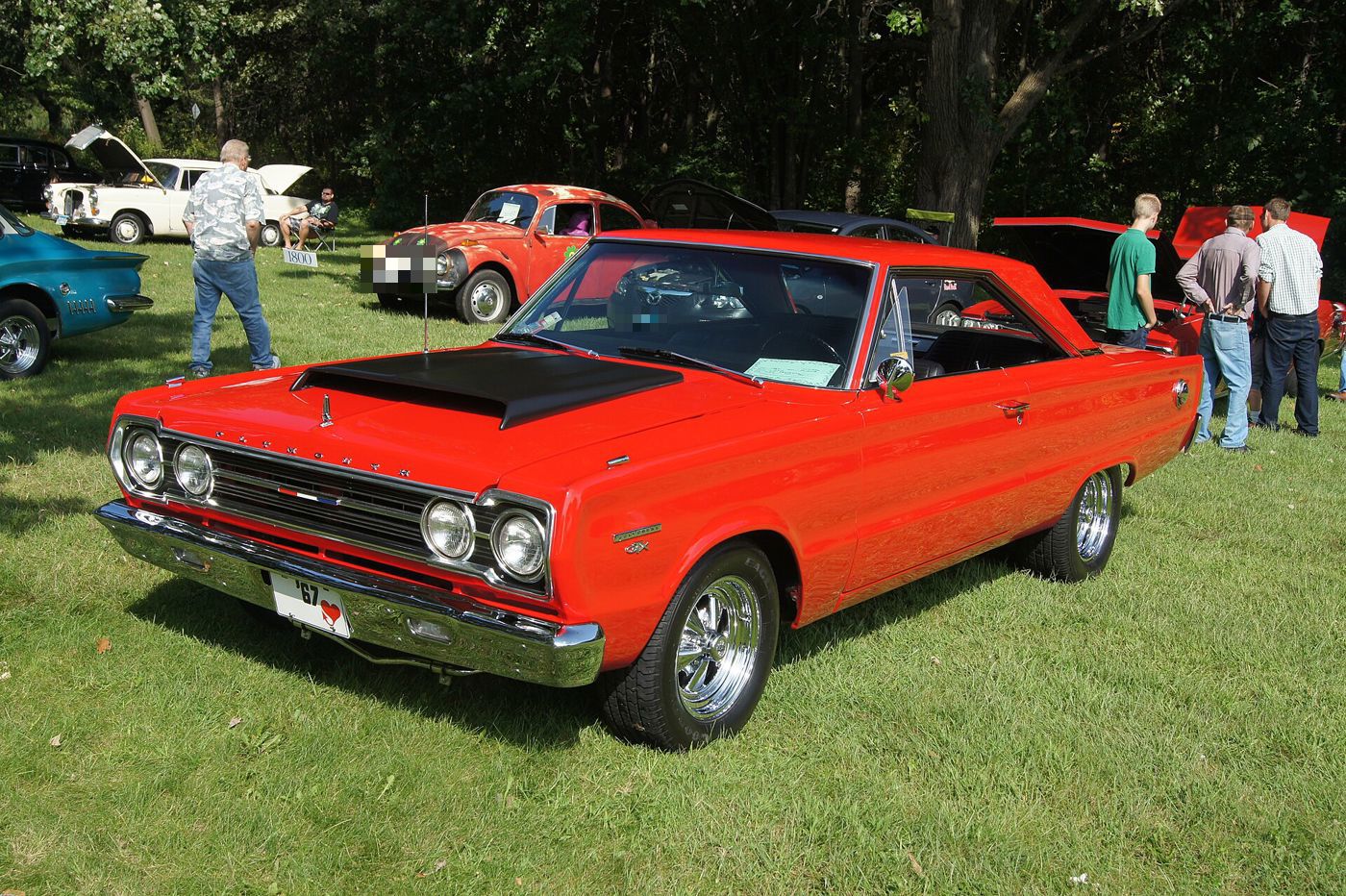

Car and Driver tested the first GTX before Plymouth had even published its price. The November 1966 report estimated about $3,900 for a hardtop with the 440, TorqueFlite, a 3.23 axle and front disc brakes, and then measured it: 60 mph in 6.0 seconds, the quarter-mile in 14.4 seconds at 98 mph, and 118 mph observed. The brakes told a less flattering story. The first stop from 80 mph took 318 feet, the discs then faded, and the magazine could not complete a practical 80-to-0 series. That mix of speed and unfinished business is a fair summary of Plymouth's new car.1
The GTX was Plymouth's answer to the cars already selling the idea. Plymouth designed and marketed it as a pure performance model, built to compete with General Motors and Ford muscle cars, and in Ate Up With Motor's words it was Plymouth's own GTO rival, new for 1967. It was not a stripped car. Plymouth built it as a Belvedere-based two-door hardtop, body RS23, and convertible, RS27, in series CR2-P, trimmed to the level of the luxury Satellite and then given the big 440 as its standard engine.2,3
The standard-equipment list reads like a promise that performance did not have to mean austerity. The GTX carried everything a Satellite carried, then front bucket seats with a console or a center armrest seat, a chrome Pit Stop gas cap, Red Streak 7.75x14 tires, dual hood scoops, dual sport stripes, stainless lower body trim and heavy-duty brakes, suspension and battery. It also had a blacked-out grille and special rear trim. The GTX came dressed; the scoops on its hood were simulated, and the power underneath them was not.2
The power was the 440 Super Commando, rated 375 horsepower at 4,600 rpm and 480 lb-ft at 3,200, SAE gross. It had a hotter camshaft, with 268 degrees of intake and 284 degrees of exhaust duration and 0.450 and 0.465 inches of lift, a larger four-barrel carburetor, bigger valves, lower-restriction exhaust manifolds, dual exhausts and a dual-snorkel air cleaner. The carburetor was a Carter AFB four-barrel. The only optional engine was the 426 Street Hemi, rated 425 horsepower and 490 lb-ft, at $564. There was no smaller engine: every GTX had either the 440 or the Hemi.2,4,1
The drivetrain was built around the choice of gearbox. The heavy-duty TorqueFlite automatic was the standard transmission, and a four-speed manual was the alternative. Car Life reported that the two were not simply interchangeable: four-speed cars received a 9.75-inch ring gear, against 8.75 inches with the TorqueFlite, plus firmer torsion bars and six-leaf rear springs. The car rode Plymouth's 116-inch intermediate wheelbase at an overall length of 200.5 inches, and its shipping weights were 3,535 pounds for the hardtop and 3,615 pounds for the convertible, factory figures rather than scale readings.2,4
The price put the GTX well above the car it was built from. The GTX hardtop listed at $3,178 and the convertible at $3,418, against $2,747 and $2,986 for the Satellite hardtop and convertible, a difference of $431 on the hardtop. Car Life's test hardtop listed at exactly $3,178 FOB and cost $3,649 as tested, with a limited-slip 3.23 axle and power disc brakes. Car and Driver's pre-release figure of about $3,900 was an estimate for its own equipped car, not a list price. For the $431, the GTX buyer got the 440 without having to order it, along with the heavy-duty running gear.2,4,1
Car Life's test explains why two magazines could report different GTXs honestly. Its hardtop weighed 4,240 pounds as tested, 231 pounds more than Car and Driver's 4,009, and it reached 60 mph in 6.6 seconds and ran the quarter-mile in 15.2 seconds at 97 mph. It reached a top speed of 120 mph at 5,000 rpm. Both cars had the 440 and TorqueFlite with a 3.23 axle; the weight, the equipment and the test conditions differed between the two magazines' cars. Each set of numbers belongs to its own car, and neither is the GTX's number. Together they show how far equipment and test weight could move a result for the same engine and gearbox.4,1
The production count comes with its own warning label. The usual figures are 12,010 GTX hardtops and 680 convertibles, 12,690 in all, but they were estimated from dealer sales and are close rather than exact; rounded, that is about 12,000 hardtops delivered and about 680 convertibles built. Most records fold the GTX into the Satellite totals, 18,318 hardtops and 1,370 convertibles. On those figures, convertibles were about one GTX in nineteen, 680 of 12,690.2
The GTX also went drag racing as a showroom advertisement. In 1967 Sox & Martin moved away from the altered-wheelbase A/FX cars the team had run for two seasons, and Chrysler racing boss Bob Cahill put the reason plainly: “The last time I checked, we don't sell Fuel Altered Funny Cars.” Alongside a Hemi Belvedere II campaigned as an RO package car, the team raced a 440-powered GTX to promote Plymouth's new muscle car. The Belvedere II, not the GTX, won that year at the NHRA SpringNationals in Bristol, Tennessee, and the team credits that victory with launching its touring Supercar Clinic program.5
The first GTX set the terms for what came next at Plymouth. One year later the division launched the Road Runner on the same intermediate body, $559 cheaper than an equivalent GTX, with a standard 383 using the 440's heads and camshaft. The GTX stayed the dressed-up car with the bigger standard engine, and the Road Runner became the plain one with the cartoon horn. In 1967, though, the GTX stood alone: about 12,690 cars by a dealer-sales estimate, a 375-horsepower standard 440 and a Hemi option, and a road test that ran out of brakes.3,2,1
Fact sheet · 1967 · United States
The numbers
1967 Plymouth Belvedere GTX: Plymouth's first GTX put a 375-hp 440 Super Commando in a dressed-up Belvedere hardtop and convertible, with the 426 Hemi as the only engine option.
Figures may describe different groups of cars. Add rows together only when the note says they make up a total.
Key facts
- Car Life reported that GTX four-speed cars received a 9.75-inch ring gear versus 8.75 inches with the TorqueFlite, plus firmer torsion bars and six-leaf rear springs.4
- Car and Driver's test car could not complete a practical 80-0 mph stopping series; the first stop took 318 ft and the discs then faded.1
Production
| What was counted | Count | Counted as |
|---|---|---|
| GTX 2-door hardtop (RS23)2 GTX · 2-door hardtop | 12,010 | estimated |
| GTX convertible (RS27)2 GTX · convertible | 680 | estimated |
| Satellite 2-door hardtop (RP23)2 Satellite · 2-door hardtop | 18,318 | |
| Satellite convertible (RP27)2 Satellite · convertible | 1,370 |
| What was counted | Count | Counted as |
|---|---|---|
| GTX model total2 GTX | 12,690 | estimated |
| What was counted | Count | Counted as |
|---|---|---|
| GTX with 426 Street Hemi6 GTX · 426 Hemi | 720 |
Prices when new
| Model | Price | Price type |
|---|---|---|
| GTX 2-door hardtop2,4 | $3,178 | factory price, 1967 model year |
| GTX convertible2 | $3,418 | factory price, 1967 model year |
| Satellite 2-door hardtop2 | $2,747 | factory price, 1967 model year |
| Satellite convertible2 | $2,986 | factory price, 1967 model year |
Prices are the nominal dollars of the day, not adjusted for inflation.
Engines
| Engine | Factory rating | Availability |
|---|---|---|
| 440 Super Commando 4-bbl2,4 440 cu in · single 4-barrel (Carter AFB) | 375 hp @ 4,600, 480 lb-ft @ 3,200 (SAE gross) | standard in GTX |
| 426 Hemi2,1 426 cu in · two 4-barrels | 425 hp @ 5,000, 490 lb-ft @ 4,000 (SAE gross) | optional in GTX |
| 383 4-bbl2 383 cu in · single 4-barrel | 325 hp @ 4,800, 425 lb-ft @ 2,800 (SAE gross) | optional in other Belvedere/Satellite models |
Ratings are published figures, not dyno results. Gross and net ratings aren't directly comparable.
Transmissions
| Transmission | Availability |
|---|---|
| TorqueFlite three-speed automatic2,4 | standard choice in GTX (or four-speed); $206 with other V-8s in the Belvedere range |
| Four-speed manual2,4 | standard choice in GTX (or TorqueFlite); $188 elsewhere in the range |
Options and packages
| Option | Price |
|---|---|
| 4-speed manual floor-shift transmission (fact sheet prices it for "all except GTX"; GTX price not given)2 | $188 |
| Street Hemi 426 CID 425 hp dual four-barrel V-82 | $564 |
| Sure-Grip heavy-duty rear axle, GTX2 | $139 |
| Heavy-duty alternator2 | $11 |
| Heavy-duty battery2 | $21 |
| Air conditioning2 | $355 |
| Buffed paint2 | $21 |
| Cleaner Air package, V-82 | $25 |
| Disc brakes, V-82 | $70 |
| Electric clock2 | $15 |
| Front and rear bumper guards2 | $31 |
| GTX front seat with folding center armrest2 | $53 |
| GTX sport stripes2 | $31 |
| Headrests with bucket seats, pair2 | $42 |
| Power brakes2 | $42 |
| Power steering2 | $90 |
| Power windows, two-door2 | $100 |
| Road wheels2 | $77 |
| Satellite and GTX tachometer2 | $49 |
| Tinted glass, all windows2 | $40 |
| Tinted glass, windshield only2 | $21 |
| Trans-audio AM radio2 | $57 |
| Trans-audio AM/FM radio2 | $127 |
| Twin front shoulder belts2 | $26 |
| Variable-speed wipers2 | $5 |
| Vinyl roof (hardtop)2 | $75 |
| Wood-grained Deluxe steering wheel2 | $26 |
Paint
| Color |
|---|
| Silver2 |
| Mauve2 |
| Bright Blue2 |
| Black2 |
| Medium Blue2 |
| Light Blue2 |
| Dark Blue2 |
| Light Green2 |
| Dark Green2 |
| Dark Copper2 |
| Light Turquoise2 |
| Dark Turquoise2 |
| Turbine Bronze2 |
| Bright Red2 |
| Dark Red2 |
| Yellow2 |
| Soft Yellow2 |
| Medium Copper2 |
| White2 |
| Beige2 |
| Light Tan2 |
| Gold2 |
| Hawaiian Blue2 |
Color names are the factory's. We don't show color swatches, because a screen color is no guide for a restoration.
Specifications
| Measure | Value | Applies to |
|---|---|---|
| Wheelbase2 | 116 in | sedans and hardtops |
| Overall length2 | 200.5 in | most bodies |
| Overall width2 | 76.4 in | all |
| Front tread2 | 59.5 in | all |
| Rear tread2 | 58.5 in | all |
| Standard tire, 440/4262 | Red Streak 7.75x14 | GTX |
| Shipping weight, GTX hardtop2 | 3,535 lb | RS23 |
| Shipping weight, GTX convertible2 | 3,615 lb | RS27 |
Period road tests
| Test | Car tested | Result |
|---|---|---|
| Car and Driver, 1966-1110-60 mph | 440/375, TorqueFlite, 3.23 axle, front disc brakes, 2-door hardtoptest weight 4,009 lb; four runs varied 5.9-6.2 s | 6 s |
| Car and Driver, 1966-111standing quarter mile | 440/375, TorqueFlite, 3.23 axle, front disc brakes, 2-door hardtopat 98 mph | 14.4 s |
| Car and Driver, 1966-111top speed observed | 440/375, TorqueFlite, 3.23 axle, front disc brakes, 2-door hardtop | 118 mph |
| Car Life, 1967-0340-60 mph | 440/375, TorqueFlite, 3.23 limited-slip axle, power disc brakes, 2-door hardtop ($3,649 as tested)test weight 4,240 lb | 6.6 s |
| Car Life, 1967-034standing quarter mile | 440/375, TorqueFlite, 3.23 limited-slip axle, power disc brakes, 2-door hardtop ($3,649 as tested)at 97 mph | 15.2 s |
| Car Life, 1967-034top speed | 440/375, TorqueFlite, 3.23 limited-slip axle, power disc brakes, 2-door hardtop ($3,649 as tested)at 5,000 rpm | 120 mph |
A road test result belongs to the one car that was tested, with its engine, gearing, tires, and conditions. It is not a figure for every car of the year.
Identification
- Series and body numbers
- GTX series CR2-P; body RS23 = hardtop, RS27 = convertible. Satellite RP23/RP27.2
Identification
Read a 1967 Plymouth VIN
The VIN decoder runs in your browser and never sends the VIN anywhere. How the factory numbered this year's cars:
Same model year
Also in 1967
- AMC Rebel and Rebel Machine The Rebel name returned on AMC's new intermediate, offered with a 280-hp 343 four-barrel V8. This is host-car context for the later Machine.
- Buick Riviera A new 430 V-8 (360 hp, 475 lb-ft) replaced the Nailhead; 4,837 cars had the GS handling option.
- Buick Skylark Gran Sport, GS and GSX A new 400 cu in V-8 made the Gran Sport the GS 400, joined by a 340 cu in GS 340 and a California GS coupe.
- Buick Wildcat The new 430 V-8 (360 hp, 475 lb-ft) replaced the Nailhead.
- Chevrolet Chevelle and Malibu SS Second year of the SS 396 series: 59,685 sport coupes and 3,321 convertibles, front disc brakes newly listed, and a late, barely documented L78.
- Chevrolet Chevy II and Nova Super Sport production fell to 10,069 in the source table. Enthusiast-compiled production: 106,430 cars; Super Sport 10,069.
- Chevrolet El Camino SS The Chevelle pickup with 396s at 325 and 350 hp on its option list; 34,830 built, 25,382 of them Malibu V8s.
- Chevrolet Impala SS The SS427 (RPO Z24) arrives: 2,124 of about 76,000 Impala Super Sports.
- Dodge Charger The first-generation fastback's second and last year: the 440 Magnum joined the options, and production fell to 15,788.
- Dodge Coronet R/T and Super Bee Dodge's first R/T: a Coronet hardtop or convertible with the 440 Magnum standard and the 426 Hemi as a special-order option; its production total is published two ways.
- Dodge Dart GTS, Swinger and Demon The restyled 1967 Dart GT offered a 235 hp 273 four-barrel and, for the first time, a 280 hp 383; Over-Drive counts 437 383-engined cars within 38,200 GT hardtops and convertibles.
- Ford Fairlane A facelifted second year for the big-block Fairlane: GT and GTA continued as Fairlane 500 hardtops and convertibles, and a 427 was offered in small numbers for drag racing.
- Ford Galaxie The last year of the approved Galaxie performance range: the 7-Litre quietly disappeared, while the 428 and a 425-hp 427 remained on the order form.
- Ford Thunderbird A new, larger fifth-generation Thunderbird added a four-door Landau; the 428 was the performance option.
- Mercury Comet and Cyclone The Cyclone and Cyclone GT continued as hardtop and convertible, and a handful of Comets were built with the 427 side-oiler.
- Mercury Cougar Mercury's first pony car arrived as a single hardtop body, added the XR-7 at mid-year, and built 150,893 in its first season.
- Mercury Marauder and S-55 The S-55's last year: 570 hardtops and 145 convertibles with the 428 four-barrel, per Wikipedia's table.
- Oldsmobile Cutlass, 4-4-2 and Hurst/Olds Multiple carburetors were gone, the 4-4-2 was trimmed as a Cutlass Supreme, and the W-30 cold-air package became a regular factory option on about 500 cars.
- Plymouth Barracuda and 'Cuda The redesigned second-generation Barracuda added a notchback hardtop and a convertible to the fastback, and the Formula S could now carry a 383.
- Pontiac Catalina 2+2 and Super Duty The 2+2 returned to option status with a standard 360 hp 428, and only 1,768 were built.
- Pontiac Firebird and Trans Am Pontiac's late entry into the pony-car field: a Camaro body with a Pontiac nose, five engine-defined models, and 82,560 built in a short first season.
- Pontiac GTO Tri-Power gone, the 389 grown to 400, and a Ram Air option that Car Life ran to a 14.5-second quarter mile.
- Pontiac Grand Prix Concealed headlamps, a standard 350 hp 400, and the only Grand Prix convertible: 5,856 built.
- Pontiac Tempest and LeMans The Sprint six grows to 215 hp and the 326 HO continues; 109,413 LeMans built.
- Rambler and AMC Marlin The last Marlin moved to a 118-inch wheelbase with 290 and 343 V8s listed, the top one a 280-hp 343. Only 2,545 were built.